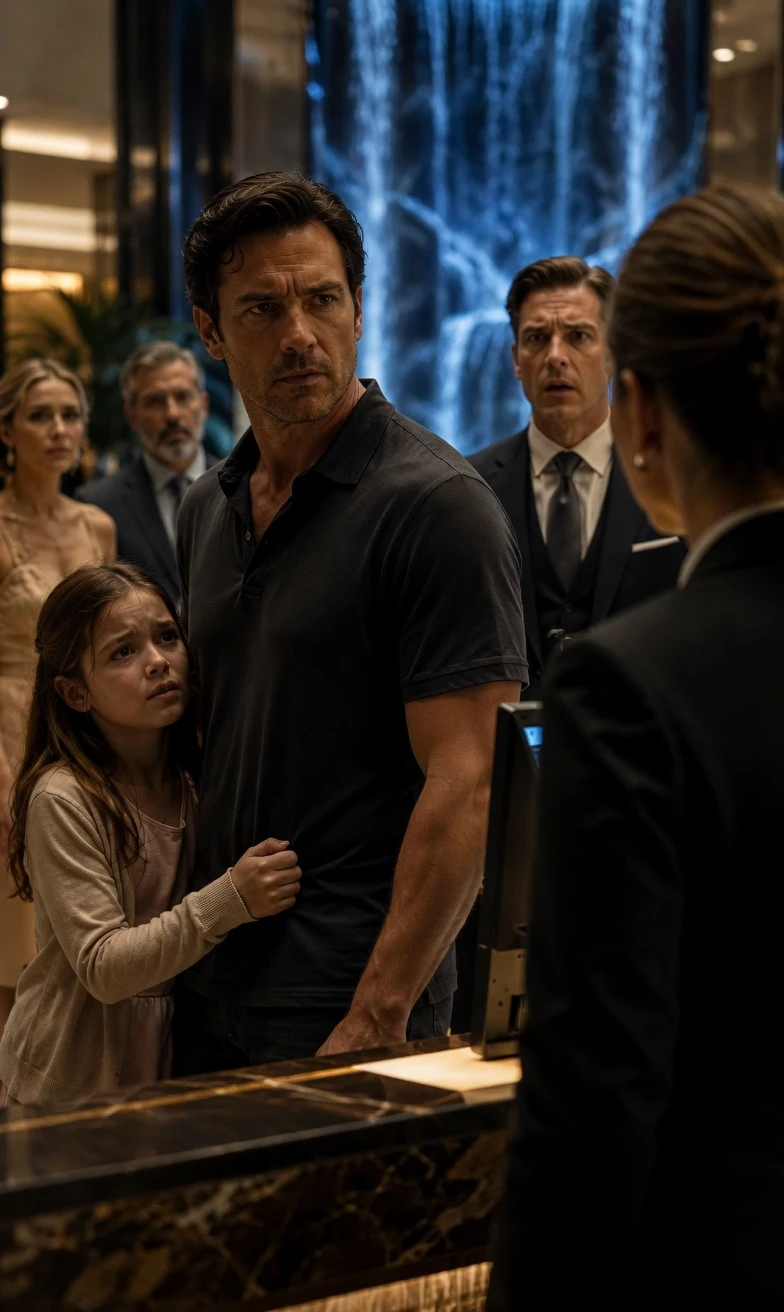
“She worked double shifts in Reno casinos while raising me alone.” A faint smile touched his mouth. “She used to come home smelling like bleach and expensive perfume from rooms she could never afford to stay in.”
Madison lowered her eyes.
Daniel continued.
“One night, a guest accused her of stealing a bracelet. Security searched her bag in front of everyone.”
The waterfall roared softly behind him.
“She hadn’t taken anything.” His jaw tightened slightly. “The bracelet was later found in the guest’s own suitcase.”
Nobody breathed.
“But nobody apologized to my mother. Nobody cared how humiliation lingers after the moment ends.”
Sophie watched him carefully now.
Daniel rarely talked about his childhood.
“I built these hotels because of her,” he said. “Not to create places for rich people to feel important. To create places where exhausted people feel human.”
Richard’s eyes glistened.
Madison was openly crying now.
Daniel looked directly at her.
“You saw my clothes. My truck. My tired daughter. And you made a decision about our worth before speaking to us for more than ten seconds.”
“I’m sorry,” she whispered brokenly.
“I know.”
And somehow that answer hurt more than anger would’ve.
The lobby stayed silent another moment.
Then Daniel clapped his hands softly once.
“Okay,” he said. “Enough public shame.”
Everyone blinked.
The shift in tone almost caused whiplash.
Daniel looked at Richard. “You’ll retrain your staff.”
“Yes, sir.”
“You’ll personally work front desk one weekend every month.”
Richard nodded immediately.
“And nobody gets fired tonight.”
Madison broke down entirely at that.
A quiet murmur spread through the staff.
Relief.
Shock.
Gratitude.
But Daniel raised one finger.
“However…”
The room stilled again.
“You will all spend tomorrow shadowing housekeeping.”
Several confused looks appeared.
Daniel smiled faintly.
“Nothing teaches humility faster.”
Even Richard almost laughed at that.
Almost.
Then Sophie suddenly raised her hand from the chair.
Every adult turned toward her.
“Can I ask something?”
Daniel smiled. “Always.”
She pointed toward Madison.
“Why was she mean?”
The poor woman looked like she’d been struck.
Daniel considered the question carefully before answering.
“Sometimes people get used to looking at surfaces instead of people.”
Sophie frowned thoughtfully.
“That seems lonely.”
Nobody in the room would forget those three words for the rest of their lives.
Daniel looked at his daughter then with an expression so full of aching love it physically changed him.
Because Sophie’s mother used to say things exactly like that.
Exactly.
The thought hit so hard he had to look away for a second.
Richard quickly stepped forward. “Sir, we’ve prepared the presidential suite for you and your daughter.”
“No.”
The answer surprised everyone.
Daniel glanced toward Sophie. “What room did we book?”
“The waterfall room!”
He smiled softly. “Then that’s the room we’ll take.”
Richard nodded quickly. “Of course.”
A bellhop hurried forward to take their bags.
Daniel stopped him gently. “I’ve got it.”
Then he looked once more at the gathered staff.
“This place only survives if kindness survives first.”
Nobody spoke.
Because there was nothing left to say.
—
Two hours later, the resort had settled back into quiet elegance.
The lobby incident had already spread through staff whispers like wildfire.
But upstairs, in room 814, none of that mattered.
Sophie stood barefoot against the glass balcony doors, staring down at the illuminated indoor waterfall below.
“It looks like magic,” she whispered.
Daniel watched her from the couch.
And for the first time all day, he smiled fully.
Real smiles had become rare after Claire died.
Rare enough that sometimes even Sophie noticed.
The thought tightened something inside him.
He stood slowly and walked onto the balcony beside her.
The desert night air was warm now instead of brutal.
Below them, soft piano music drifted upward from the restaurant lounge.
Sophie leaned against him sleepily.
“Daddy?”
“Hmm?”
“Mom would’ve loved this place.”
The words hit clean and deep.
Daniel stared out at the lights.
“Yeah,” he said quietly. “She would have.”
For a moment neither spoke.
Then Sophie asked the question he dreaded most every night.
“Do you still talk to her?”
Daniel’s throat tightened.
Every night.
Every single night.
In hospital parking lots.
In empty kitchens.
At red lights.
Into silence.
“Yes,” he admitted softly.
“What does she say?”
He almost broke right there.
Instead he smiled shakily.
“She mostly tells me when I’m messing things up.”
Sophie giggled.
Then her expression turned serious.
“Do you think she saw today?”
Daniel looked down at his daughter carefully.
“What do you mean?”
“The lobby thing.”
A pause.
Then:
“Mom always said people show you who they are when they think you can’t help them.”
Daniel froze.
Because those were Claire’s exact words.
Not close.
Exact.
He stared at Sophie.
At the familiar eyes.
The familiar kindness.
The familiar unbearable echoes.
And suddenly grief arrived all over again—not loud, but quiet and suffocating, the way real grief always returns.
Sophie slipped her small hand into his.
“I think Mom would be proud you weren’t mean back.”
Daniel looked away quickly before she could see his eyes shine.
The balcony fell quiet.
Below them, the waterfall continued its endless silver descent.
Then Sophie yawned.
Huge.
Dramatic.
Daniel laughed softly. “Bed.”
“But tomorrow’s my birthday adventure.”
“And adventures require sleep.”
She groaned theatrically but obeyed.
A few minutes later, Daniel tucked the blankets around her carefully.
She was almost asleep when she whispered, “Daddy?”
“Yeah?”
“If people are mean because they only see surfaces… then maybe your job isn’t owning hotels.”
Daniel smiled tiredly. “No?”
“No.” Her eyes drifted closed. “Maybe your job is reminding people to look deeper.”
The room went still.
Daniel sat there long after she fell asleep.
Watching her breathe.
Watching the city lights flicker beyond the balcony.
Watching the shape of his entire broken heart somehow continue existing outside his body in the form of one small sleeping girl.
Then finally, sometime after midnight, he stood and walked quietly toward the desk near the window.
There, beside a stack of renovation blueprints, sat a folded piece of paper.
A drawing.
Crayon-colored.
Stick figures beneath a giant waterfall.
One tall.
One small.
And above them, written carefully in uneven nine-year-old handwriting:
“Mom says we still look like a family.”
Daniel sat down slowly.
Very slowly.
Then lowered his head into his hands as the silent sob finally broke through him—while beyond the balcony glass, the waterfall he built kept falling endlessly into the dark.