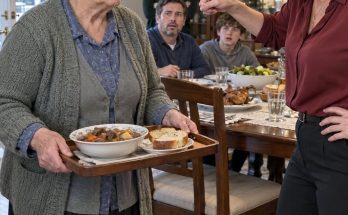
At my sister’s wedding, he made me wear a waiter’s uniform and serve food without tasting any of it. He laughed when I told him he’d regret it… until the groom saw me and shouted, “My CEO?”
At my sister’s wedding, he made me wear a waiter’s uniform and serve food without tasting any of it. He laughed when I told him he’d regret it… until the groom saw me and shouted, “My CEO?”
I never imagined that my younger sister Valeria Whitmore’s wedding would end with the groom as pale as a sheet and half the family pretending they didn’t know me.
The ceremony was held at a private estate outside Toledo, one of those restored haciendas with stone walls, perfectly manicured gardens, and waiters dressed in black and white moving like elegant shadows among glasses of cava. I had arrived from Madrid two hours earlier, wearing a discreet dark blue suit, a simple watch, and with the sincere intention of not stealing anyone’s thunder.
But Valeria had other plans.
She greeted me behind the main tent, away from the guests, with a smile I already knew all too well.
“Sebastian, you can’t come in like that,” she said, looking me up and down. “I don’t want anyone talking about you today.”
—It’s your wedding. Nobody’s going to talk about me.
She let out a dry laugh.
—They’re always talking about you. About your companies, your interviews, your awards. Today you’re going to do something useful for once.
Before I could answer, her organizer handed me a waiter’s uniform. Stiff white shirt, black vest, bow tie, cheap trousers. I thought it was a cruel joke, but Valeria just crossed her arms.
—Either you put it on, or I’ll tell Mom you came home drunk and made a scene. You know who they’ll believe.
I stood still. Our mother, Evelyn, had been emotionally dependent on Valeria for years. I, on the other hand, was “the cold son,” “the one who left,” “the one who thought he was superior.” Arguing there would have ruined the wedding before the reception.
So I put on my uniform.
During the reception, I served platters of Iberian ham, croquettes, and glasses of white wine without tasting any of it myself. Valeria walked past me in her French lace dress, giggling softly.
—Look at you, Sebastian. Finally in your place.
When I told her, in a low voice, that one day she would regret humiliating me like that, she placed a hand on my shoulder as if she were petting a dog.
—Regret? Nobody here knows who you really are.
Then it was time to serve at the head table. I approached with a platter of sliced sirloin. The groom, Daniel Harrington, looked up.
The glass slipped from his fingers.
The wine spilled onto the white tablecloth.
Daniel stood up abruptly, pushing the chair back.
—My CEO?
Silence fell over the farm like a slab of stone.
Valeria stopped smiling.
And I, still holding the tray, looked at my future brother-in-law and said:
—Good evening, Daniel. Nice wedding.
For three seconds, no one moved. Not the musicians in the quartet, not the hired waiters, not even my mother, who was sitting two places to Valeria’s left with a glass of champagne suspended halfway to her lips. Everyone seemed to be waiting for Daniel to explain that it had been a mistake, a joke, an absurd misunderstanding brought on by the stress of the day.
But Daniel Harrington was no fool. He was thirty-five years old, the finance director of a technology subsidiary in Madrid, and he could perfectly distinguish a waiter from Sebastian Whitmore, founder and CEO of Whitmore Meridian Group, the company that had just acquired sixty percent of his firm a mere three weeks earlier.
Valeria blinked, first in disbelief, then irritated.
—Daniel, darling, what are you saying?
He didn’t look at her. He continued to observe me with a mixture of horror and professional obedience.
“Mr. Whitmore… I didn’t know…” he stammered. “I swear I didn’t know you’d be here.”
“Technically, I’m invited,” I replied. “Although it seems the dress code changed without notifying me.”
A murmur rippled around the table. My cousin Martin put a hand to his mouth. Aunt Beatrice, who had been saying for ten years that my money was “surely exaggerated by the internet,” opened her eyes as if she had just seen an impossible bill.
Valeria got up slowly.
—This isn’t funny.
—No, she doesn’t have it —I said.
I placed the tray on a side stand. I didn’t raise my voice. There was no need. At a wedding, silence can be more humiliating than a shout.
Daniel took a step towards me.
—Sir, allow me to explain…
—Daniel, sit down —Valeria ordered.
For the first time since he had known her, he did not obey immediately.
That gave me more information than any financial report. Daniel wasn’t cruel by nature, but he was ambitious. He had cultivated an impeccable image for years: tailored suit, ideal son-in-law smile, calculated humility. His career depended on appearing trustworthy to investors, and now he had just discovered that his girlfriend had dressed up as a waiter the man who could decide his professional future with a single phone call.
My mother finally got up.
—Sebastian, son… this must be a misunderstanding.
I looked at her. Her expression wasn’t one of concern for me, but of fear of scandal. Evelyn Whitmore had spent her entire life protecting appearances. When my father died and left debts, it was I who sold the small London flat I’d inherited from my grandfather to pay for Valeria’s medical treatment, even though she was sixteen at the time and never knew. It was I who worked nights while studying business administration. It was I who, years later, secretly bought my mother’s house in Salamanca to prevent the bank from foreclosing on her.
But at family gatherings, Valeria would say that I “had been lucky.” And my mother would nod, because it was easier to believe that my success had fallen from the sky than to accept that the son they called selfish had saved them several times.
“It wasn’t a misunderstanding, Mom,” I said. “Valeria asked me to change. She threatened to make a scene if I didn’t. Then she put me to work serving food to the guests.”
Some guests glanced at each other. Others looked down at their plates, as if the tablecloth had suddenly become fascinating. The Spanish members of the in-laws’ family, especially Daniel’s uncles, seemed somewhere between embarrassed and attentive. In Spain, a public humiliation can be hidden behind smiles for years, but when the veneer cracks, everyone wants to know who bleeds first.
Valeria pursed her lips.
—Don’t exaggerate. I just didn’t want you to ruin my day.
—Are you serving yourself wine?
—You always have to be the center of attention.
—I haven’t even said my name today.
Daniel slowly turned towards her.
—Did you know who he was?
Valeria opened her mouth, but didn’t respond quickly. That second of delay condemned her.
—Daniel is my brother. Of course I know who he is.
—That’s not what I meant. Did you know that’s Sebastian Whitmore, the CEO of Whitmore Meridian?
Rage crossed Valeria’s face like a shadow.
—So what? Are you going to treat him like he’s God now because he signs your payrolls?
The blow was clean. Some guests swallowed hard. Daniel turned red, not from sentimental embarrassment, but from strategic panic. His mother, an elegant woman named Patricia Harrington, carefully placed the silverware down.
—Valeria —Patricia said—, perhaps you should apologize.
Valeria turned to her with a venomous smile.
—Apologize at my own wedding? Why? Because my rich brother can’t take a joke?
I sighed. I had expected something like this. Valeria never backed down when she had an audience. She’d rather set a room on fire than admit she’d lit a match.
“I’m not going to ruin your wedding,” I said. “You can continue with the banquet. But I’m not going to keep serving.”
I started to untie my bow tie.
Then Daniel did something unexpected. He took off his jacket, walked over to me, and spoke to me in a low voice, though everyone could hear him.
—Mr. Whitmore, I apologize on behalf of this family. This is unacceptable.
Valeria let out an incredulous laugh.
—On behalf of this family? Daniel, I am your wife.
“We haven’t signed anything yet,” he replied.
The sound that came out of my mother’s mouth was almost a moan.
The civil ceremony had taken place earlier, yes, but the documents still awaited the formal signature before the municipal official invited to the event. Valeria had wanted to postpone that part to take “more natural” photos at sunset. A whimsical detail. A detail that now made her feel uneasy.
“You wouldn’t dare,” she whispered.
Daniel looked at her. For the first time, I saw genuine doubt in his eyes. Not love, not hate. Calculation. He was wondering how much it cost to marry a woman capable of humiliating her own brother out of jealousy.
“I need to know who I’m marrying,” she said.
The music had completely died down. A young, nervous waiter held a bottle of wine, unsure whether to serve or hide. I took off my vest and left it on a chair.
“Daniel, your career doesn’t depend on this conversation,” I said calmly. “I’m not going to fire you for marrying my sister. But I’m also not going to pretend that what just happened is normal.”
Valeria turned towards me with shining eyes.
—Always the same. Always so perfect. Always waiting for the moment to make me small.
—I haven’t done anything, Valeria. That’s what bothers you.
The phrase left her breathless.
Because it was true.
I hadn’t screamed. I hadn’t insulted her. I hadn’t revealed any secrets. I had only obeyed her cruelty until someone else saw her.
And sometimes, to destroy a family lie, all it takes is for one witness to appear.
The wedding wasn’t immediately canceled. Luxury weddings have an absurd inertia: there are paid flowers, hired musicians, photographers searching for dramatic angles, and 120 people too uncomfortable to stand up at the same time. For a few minutes, everything continued like a theatrical performance after the lead actor forgot his lines.
Valeria disappeared toward the main house, the train of her dress trailing across the gravel. My mother followed her almost running. Daniel remained by the head table, staring at the wine-stained tablecloth as if he could read his future there. I retreated to the side courtyard, near an old fountain, to take off my white uniform shirt and put my jacket back on.
I wasn’t satisfied. That would have been too simple. I felt tired.
I had spent half my life trying to get my family to acknowledge me without having to show off. I sent money without a signature. I resolved legal issues without showing up. I paid for treatments, renovations, tuition, debts. And every time I returned to a family meal, Valeria found a way to make me the villain: too distant, too serious, too rich, too ungrateful for being “lucky.”
Ten minutes later, Daniel appeared in the yard.
—Can I speak with you?
-Of course.
He no longer looked like the impeccable groom from the photos. His tie knot was loose and his face had hardened.
“I’m not going to ask you to forget this,” he said. “That would be insulting. But I need to ask you something. Has Valeria always been like this?”
I looked toward the house. Through a lit window, I could see a silhouette moving abruptly. Probably her. Probably blaming anyone but herself.
“Valeria learned early on that she could get attention by starting fires,” I replied. “And she learned that my mother would always rush to put them out for her.”
Daniel nodded slowly.
—She told me that you abandoned her when you were young.
—I went away to study and work. I was twenty years old. She was fourteen. Our father had just died and there was no money. If I stayed, we would all go under.
—He also told me that you never helped.
I didn’t smile, but something in my face must have changed, because Daniel looked down.
“I’ve paid for more things than Valeria knows,” I said. “Not to buy affection. Just because they were my family.”
He took a deep breath.
—Today, before the ceremony, Valeria received a call from her mother. They argued about money. I didn’t quite understand. Something about an account you had closed.
Then I understood. Two months earlier, I had stopped covering Valeria’s personal expenses: credit cards, rent for an apartment in Madrid she claimed to use for “creative projects,” travel, and cosmetic treatments disguised as medical bills. I didn’t tell her in person. I sent a formal letter explaining that I would continue to help my mother with her basic expenses, but that Valeria, at thirty-two, should be able to support herself.
The wedding, then, was not just a celebration. It was revenge.
“I didn’t close an account,” I said. “I turned off a tap.”
Daniel let out a brief, joyless laugh.
—That explains a lot.
At that moment, Patricia Harrington came out into the yard. She approached her son, but spoke to me instead.
—Mr. Whitmore, I deeply regret what happened. My family does not participate in humiliations of this kind.
—Thank you.
—Daniel —she said, turning to him—, the official is asking if the signature is required.
Daniel closed his eyes for a moment.
From inside came Valeria’s voice, loud, broken, furious.
—Make him sign! Make him stop acting!
Patricia froze. Daniel opened his eyes.
“I’m not going to sign today,” he said.
The phrase wasn’t loud, but it pierced the night like broken glass.
Valeria came out seconds later, followed by my mother. Her makeup was still perfect, but her expression was no longer that of an offended bride. It was that of someone who was beginning to understand that she was losing control.
“What did you say?” he asked.
—That I’m not going to sign today.
—Not in front of everyone, Daniel.
—I’ve seen enough right in front of everyone.
She looked at me.
—This is your fault.
“No,” I said. “I only brought an invitation and ended up with a tray.”
My mother approached me with tears in her eyes.
—Sebastian, please. Do something. Talk to him. She’s your sister.
For years, those three words had worked like a master key: she’s your sister. With them, they asked me for money, silence, patience, forgiveness. That night, for the first time, they didn’t open anything.
“Yes,” I replied. “She’s my sister. And that’s why you should have taught her that people don’t exist to obey her whims.”
Valeria trembled with rage.
—You don’t know what it’s like to live in your shadow.
—I didn’t put you in my shadow, Valeria. You chose to measure your life against mine.
—Because everyone admires you.
—No. Some people are using me. It’s different.
The city official appeared discreetly in the doorway, looking uncomfortable. Daniel approached her and explained that the signing was postponed. There was no legal scandal, no dramatic outbursts. Just a chain of small, devastating gestures: guests getting up, whispers, taxi calls, photographers putting away their cameras, musicians packing away their violins.
The banquet ended without cake.
Valeria locked herself in a room at the estate until after midnight. My mother tried to blame Daniel, then Patricia, then me, and finally “wedding stress.” No one played along. For the first time, the official story couldn’t prevail.
The next day, Daniel requested a temporary leave of absence from the company. I didn’t deny it. A week later, he asked to meet with me, not as a frightened employee, but as a man in shame. He explained that he had decided to end the relationship. Not because of my position, he insisted, but because he had realized that Valeria didn’t regret what she had done; she only regretted being caught.
I believed him.
Valeria called me seventeen times in two days. I didn’t answer. Later, she sent me a very long message, accusing me of ruining “the most important day of her life.” I read it sitting in my Madrid office, overlooking the Paseo de la Castellana, and for the first time, I didn’t feel guilty.
I answered him with a single sentence:
“I didn’t ruin your wedding; I just stopped hiding who you were.”
My mother took three months to call me without asking for anything. When she did, her voice sounded older.
—Sebastian —she said—, I think I’ve been unfair to you.
It wasn’t a full apology. Not yet. But it was the first crack in a thirty-year-old wall.
Valeria moved to Valencia with a friend. For a while, she posted on social media about family betrayals and cowardly men. Then, little by little, she stopped. I learned from a cousin that she had started working at a small gallery, organizing exhibitions. Nothing glamorous. Nothing financed by me.
Perhaps that was the closest thing to a repair.
I never went back to that estate. I didn’t keep the uniform either. The real waiter who had lent it to me timidly asked for it back before I left, and I returned it to him clean, folded, and with enough of a tip to pay his rent for a month.
“Sir, I’m sorry for what happened,” he told me.
“Don’t worry about it,” I replied. “You were the only one doing your job.”
That night I learned something uncomfortable: there are families that don’t change when you explain your pain to them, but when others see it.
And I also learned that dignity doesn’t always consist of refusing to wear a uniform.
Sometimes it involves carrying it around long enough for everyone to see who forced you to bend over.