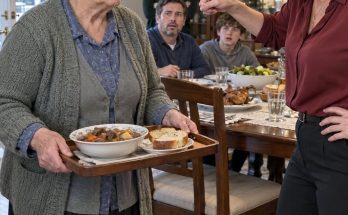
When my father saw me on the subway, pressing my children against me in the crowd, his face changed immediately and he asked me, with a coldness that made my blood run cold: “Why aren’t you using the car I gave you?”. Then I confessed to him, trembling, that my husband and his sisters had taken it from me and had threatened me. He only looked at me and said: “Don’t worry…”.
That Tuesday of fine rain, Clara was traveling on the Madrid subway with her two children, seven-year-old Leo and four-year-old Martina, pressed against her among school backpacks, wet umbrellas, and the metallic smell of brakes.
When the train stopped at Sol, the doors opened and a tall man, with impeccable white hair and a dark suit, entered looking distractedly at his phone until he looked up and stood motionless.
—Clara? —he said, with a mixture of surprise and something more dangerous: contained fury.
She took a second to react, but immediately recognized her father, Joaquín Valdés, a retired builder from Valencia, a proud, dry man famous in the family for never repeating a question twice.
Joaquín observed his daughter’s hands gripping the bar and asked in a low voice:
—Why aren’t you using the car I gave you?
Clara looked around before answering, as if even there, surrounded by strangers, someone could be watching her.
—Álvaro took the keys. His sisters too. They said that the car “belonged to the family” and that I didn’t need to drive because my place was at home. When I refused, they locked me up for one night with the children and told me that, if I spoke to you, I would regret it.
Joaquín did not change his expression.
He only raised his chin and asked:
—Did they lay a hand on you?
Clara nodded once.
The subway continued moving, oblivious to everything, but on her father’s face appeared a calm so absolute that it was more disturbing than any scream.
He took Leo by the hand, picked up Martina’s backpack from the floor, and said with an icy firmness:
—Don’t worry. We get off at the next one.
Clara wanted to ask him what he planned to do, but the tone of his voice left her speechless.
They exited at Atocha among the noise of suitcases and hurried steps.
Joaquín made a brief call, barely three sentences in Valencian that Clara did not fully catch, and five minutes later a black car pulled up to the curb.
They got in.
Upon arrival, she saw through the window her car, the grey Volvo that her father had given her when Martina was born, parked in front of the building entrance.
And next to it were Álvaro and his two sisters, Teresa and Berta, laughing under the awning of the corner café, as if the whole world belonged to them.
Then Joaquín opened the car door without taking his eyes off them, adjusted his silver cufflinks, and murmured:
—Now you are going to see why they should have never touched what was yours.
Clara stepped out behind her father with trembling legs, while Leo hid behind her coat and Martina squeezed her wrist against her chest.
Álvaro saw her first and smiled with that insolent security he always showed when he believed he was in control.
—Well, you finally showed up —he said—. I thought you would still be crying at some friend’s house.
Teresa let out a dry laugh, and Berta held up the Volvo keys, spinning the keychain on a finger.
—Your car is better off with people who know how to use it —she added.
Joaquín didn’t even look at Clara; he advanced until he was in front of his son-in-law and spoke with a courtesy so rigid it felt like a knife wrapped in velvet.
—You have exactly one minute to return those keys, apologize, and leave my daughter’s apartment.
Álvaro crossed his arms.
—That apartment is mine too.
Joaquín took an envelope from the inside pocket of his jacket and handed it to him without his pulse altering.
Álvaro opened it with contempt, but his expression changed upon reading the first page: it was a copy of the deed, which clearly stated that the home belonged solely to Clara by way of a gift prior to the marriage.
—That doesn’t mean anything —Teresa replied, although her voice no longer sounded so firm.
—It means much more than you think —Joaquín answered.
At his signal, the black car gave a short beep and two people stepped out: a lawyer from his old firm and a plainclothes national police inspector.
Clara froze.
Her father had listened to her on the subway, had connected the dots in seconds, and, before reaching the entrance, had already activated a plan.
The inspector identified herself and explained in a clear voice that a report was prepared for coercion, misappropriation of the vehicle, illegal detention, and threats against a mother with minors.
Berta turned pale.
Álvaro tried to laugh, but the lawyer intervened first.
—I also have here the recordings from the garage cameras and the statement from the doorman —he said—. And the car is still in the exclusive name of Mrs. Clara Valdés Serrano.
Clara felt the air returning to her lungs for the first time in weeks.
Then Álvaro dropped the friendly mask and took a step toward her.
—Are you really going to report me? —he whispered, his eyes burning—. Think of the children.
Leo clung to his mother’s waist.
Joaquín stepped between the two with a terrifying serenity.
—It is precisely because of them that you have made your final mistake —he said.
The inspector asked for the keys, Teresa tried to tuck them into her purse, and her nerves finally betrayed her: the remote fell to the ground along with the set of keys to Clara’s apartment.
There was a silence so hard that even the waiter on the corner stopped drying glasses to watch.
And it was then that Berta, trembling, suddenly blurted out a sentence that changed everything:
—It wasn’t just us. Álvaro’s mother also had a copy of the keys… and she is inside the apartment right now.
Clara felt her blood freeze at the thought of her children’s home being invaded.
Clara ran toward the entrance before anyone could stop her.
Joaquín followed her immediately, while the inspector ordered a newly arrived uniformed officer to guard Álvaro and his sisters on the street.
The elevator was taking too long, so they ran up the marble stairs of the building, five floors of broken breathing, fear, and footsteps that echoed like gunshots.
When Clara opened the door with her own key, it was already ajar.
Inside, it smelled of strong perfume and freshly made coffee, as if that domestic invasion wanted to seem normal.
In the kitchen, Carmen, Álvaro’s mother, was sitting at the table reviewing a ledger of expenses, with her glasses on the tip of her nose and an insulting tranquility.
Upon seeing them, she closed the notebook delicately.
—It’s about time you arrived —she said to Clara—. We need to talk about how you are going to manage your whims in front of the children.
Clara noticed that something inside her, something that had been bending for months to keep from breaking, finally straightened up.
—Get out of my house —she responded, without shouting.
Carmen smiled with contempt.
—Your house is supported by my son and his family.
Joaquín placed the envelope of documents on the counter, then the recovered set of keys, and finally, a much thicker blue folder.
—No, madam —he said in a low voice—. This house is supported by the truth, and today the bill has arrived.
He opened the folder.
There were the bank statements showing transfers made from Clara’s account to a company managed by Teresa; manipulated receipts; and printed messages where Carmen gave instructions to “get that car habit out of her” and “leave her without access to money for a few days”.
Carmen’s smile vanished.
—That doesn’t prove anything.
—It proves conspiracy, economic abuse, and ongoing coercion —the inspector said from the door, entering just behind them—. And it also proves that you did not enter here by mistake, but to control a victim.
For a second, Carmen seemed to look for an elegant way out, some phrase with which to preserve her pride.
She did not find it.
The inspector informed her of her rights, the officer collected the notebook and the mobile phones that were on the table, and Clara observed the scene with a strange mixture of trembling and relief.
In the street, Álvaro’s shouts rose from the sidewalk, but they already sounded distant, as if they belonged to another life.
The following months brought lawyers, statements, and cold courtrooms, but also something that Clara had forgotten: deciding for herself.
She drove the Volvo again, recovered her accounts, and learned not to lower her voice when someone tried to interrupt her.
Six months later, the court imposed restraining orders on Álvaro, Teresa, Berta, and Carmen, confirmed the housing and primary custody for Clara, and put in writing that the threats had been real.
One noon, upon leaving school with her children and seeing the Volvo under the autumn sun, she understood that she would not remember 그날 for the fear, but because that was where she recovered her home, her future, and her voice.