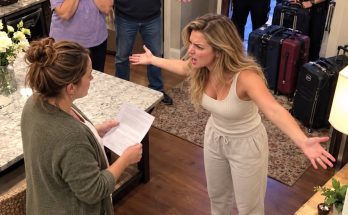
My daughter-in-law slapped me in front of 130 wedding guests because I refused to hand over the apartment keys. My son just stood there, motionless. I left and made a phone call. Thirty minutes later, a man walked in… and when they saw him, everyone was speechless, tears streaming down their faces.
The slap did not sound like skin on skin.
It sounded like fine china cracking in a quiet museum.
My glasses sailed from my face, skittered across the parquet floor of the Blue Ridge Manor ballroom, and shattered beneath a crystal chandelier that threw a thousand indifferent stars across one hundred thirty stunned guests.
My cheek burned.
But the pain in my chest spread like frost.
Sloan, my brand-new daughter-in-law, stood in silk that cost more than my car.
She lowered her hand with theatrical precision and smiled at me the way a wolf smiles at a fence.
“That’s what you get for being selfish,” she said, her voice bright enough to slice. “A woman your age doesn’t need that much space. Noah and I need your apartment. We need privacy to start our real life.”
People looked anywhere but at me.
A cousin stared hard at a centerpiece.
A groomsman coughed into a napkin.
My son, Noah, studied the gleam of his shoe as if it contained scripture.
The quartet stopped on a dissonant chord that vibrated in the rafters, then fell into a silence so complete I could hear the click of my own throat when I swallowed.
If you have made it this far into my story, do one thing for me.
Like, subscribe, and tell me in the comments where you are listening from.
I want to know how far truth can travel when it finally leaves the mouth that has been holding it back.
I crouched from old habit and gathered the warped frames and glass the way I had gathered my pride, my patience, and the slivers of respect people drop when they think you are too gentle to bend down and pick them up.
The chandelier blades sent spears of light into my eyes, and the room tilted for just a breath.
I stood slowly and smoothed the thrift-store dress Sloan had mocked earlier.
“Vintage,” she had said. “How brave.”
I searched for Noah’s face.
He did not raise his head.
“You’re not welcome in our home anymore,” Sloan continued, resettling her veil as if the air itself had misbehaved. “You create drama. You refuse to make sound decisions. Hand over the keys. We’ll make sure you’re taken care of.”
I thought of the keys.
The little iron leaf that had warmed my palm for decades.
And something inside me settled instead of breaking.
I nodded to no one, turned, and walked through rows of staring people who preferred spectacle to spine.
The doors opened on mountain air as cool as a blessing.
The night smelled like wet stone and boxwood.
Crickets insisted on their small music, unafraid of chandeliers or human cruelty.
The parking-lot lamps painted my old sedan the color of pewter.
I slid into the driver’s seat and did not start the engine.
My fingers found my phone in that worn leather purse Sloan called Grandma’s satchel and dialed a number I had always kept memorized.
The way you memorize the location of the fire extinguisher you pray you will never need.
“Raj,” I said when he answered on the second ring, “it’s Laya. I need you at Blue Ridge Manor. Bring the folder. The whole folder.”
His voice lost its warmth and snapped into the clean lines of his profession.
“Are you certain? Because once we do this, Laya, there’s no turning back.”
“Yes,” I finished. “Thirty minutes, please.”
I ended the call and leaned my forehead against the steering wheel.
Beyond the hedges, the party string lights wobbled like captured fireflies.
Laughter flared and died.
I watched clouds move across the moon with the patience that had been my oldest friend.
The left side of my face pulsed to the rhythm of the quartet’s aborted waltz.
People think I am small.
A florist with soil under her nails and a ten-year-old car.
A widow with a tidy pension and a knack for stretching a dollar like pie dough.
It is a shape I have worn like a cardigan.
Comfortable.
Colorless.
Forgettable.
My late husband, Thomas, and I chose it when we realized that money is a kind of megaphone and a kind of magnet, and we wanted to be neither loud nor hunted.
He used to say, “Visible wealth draws lightning. Invisible wealth builds a shelter.”
After he died, I learned to sit quietly beneath that roof and listen to storms pass.
Sloan never much liked quiet.
The first time she breezed into my apartment, she stood at the panoramic window and pretended to admire the view of downtown Asheville shoulder-to-shoulder with the blue humps of the mountains.
But her eyes flicked not to the skyline, not to the jacaranda I had coaxed to bloom and fail and bloom again, but to the crown molding, the floorboards, the elevator fob.
She inhaled the space the way a developer inhales a parcel.
Measurements instead of memories.
“How cozy,” she said.
The word lay on the floor between us, still damp with contempt.
Noah started using phrases I recognized only from brochures.
Appropriate for your age.
Safety.
Ease of living.
Sloan’s parents, Whit and Darlene, arrived one evening with smiley folders and statistics about falls, loneliness, and financial exploitation.
They tried to make cages smell like lavender.
They tried to turn my home into their second chance.
When people rehearse a script that makes them feel moral, they begin to speak louder.
They forget someone like me has ears and a long, slow memory.
I heard Whit on the phone in my kitchen murmuring about liquidating non-performing assets.
I watched Darlene trace my hallway with the tip of a manicured finger and say to Sloan, “Two big closets. This would be perfect for starting out.”
I found a business card left mistakenly in my recycling.
A guardianship attorney who advertised swift outcomes for concerned families.
I said very little.
Then I called a friend in real estate for a favor I hated to ask.
The numbers she gave me were a lit fuse.
Noah and Sloan’s rent was three months late.
The wedding was on credit.
Two cars they could not afford, washed weekly and posted to the internet like trophies.
Meanwhile, my son made inquiries about power of attorney and what courts look for when deciding capacity.
He did not choose a predatory mother-in-law over me.
He chose the easy story of a helpless old woman over the complicated truth of his own mother.
The oaks shifted, whispering.
I watched my hands, still steady, still mine, rest on the steering wheel and thought of the folder Raj would bring.
Inside were the stitches I had sewn to keep our complicated truth from unraveling.
Records of three years of transfers I had made quietly to keep Noah’s ship from sinking.
Lease guarantees signed without fanfare.
A cancellation letter drafted months ago, waiting for a date.
Medical evaluations stamped by my physician because I know what rumors do when they are fed.
An amended will that pointed away from blood and toward need.
The spare key to a version of myself I had not been in a long time.
The woman who can walk into a room and turn on a light, no matter who shouts for darkness.
A golf cart rumbled past, the estate manager ferrying a stray bridesmaid to the restrooms.
Her tulle fluttered like fog.
Somewhere, a guest laughed too loudly.
Somewhere, a phone camera stayed open.
I pictured Sloan back under those chandeliers, telling anyone who would listen that she had finally done what good wives do.
Protect their marriage from the dead weight of a needy mother.
I pictured Noah beside her, jaw flexing the way it did when he lied as a child and hated himself for it.
It is a strange thing to feel your heart break and harden in the same hour.
I pressed my fingers gently to the hot bloom on my cheek.
My eyes stung.
The first tears I let fall were for the boy I had raised.
The second were for the woman who had mistaken silence for love.
The last were not tears at all, but something clearer.
Headlights slipped through the hedge.
Sleek.
Familiar.
Raj parked three spaces down and got out with the leather portfolio cradled like a violin.
He looked at me through the windshield, measuring what I had not said.
Then he came to my door and opened it as if I were stepping into court.
Or a church.
Or a battlefield.
“Last chance to stay small,” he said quietly.
I took the portfolio.
It was heavier than I remembered.
The way truth is heavier when you carry it instead of hiding it under your coat.
“I’ve been small long enough.”
Together, we walked back toward the ballroom, past the manicured magnolia and the little sign that said, Please no sparklers near the hedge.
The violins had started again.
A valiant waltz trying to pretend nothing had happened.
When we reached the tall doors, Raj paused, and I saw my reflection in the brass.
Hair pinned in the simple twist Thomas loved.
Eyes neither young nor old.
Just awake.
If you are still with me, like, subscribe, and tell me where you are listening from.
I have a feeling the road this truth will travel is longer than the aisle I am about to walk.
I pressed the handle and stepped back into the light.
The chandeliers burned brighter when I stepped back inside, as though the room itself wanted to see me flayed.
Music fluttered to a halt for the second time that night.
The quartet bowed their heads, not out of respect, but out of instinct.
Animals ducking before a storm.
Conversations stuttered, cut short in midair.
The smell of champagne and peonies thickened in my throat.
Raj walked beside me, his leather portfolio under one arm, his expression carved from stone.
He had the bearing of a man who had spent decades guiding families through inheritances, disputes, and silent wars.
Tonight, he was my armor.
I let my eyes sweep across the room.
Noah finally looked up, his mouth parting as though he wanted to speak but found no words.
Sloan stood at his side, chin tilted, the smudge of victory still on her lips.
When she saw Raj, the victory faltered.
She knew his type.
Professional.
Unshakable.
A man who carried paper like weapons.
“Mother, what are you doing?” Noah asked, his voice higher than I remembered from childhood.
I ignored him.
Raj clicked open the portfolio with a sound that cut through the hush.
“Ladies and gentlemen,” he said evenly, “I apologize for interrupting, but Mrs. Laya Mercer has authorized me to present some urgent matters of record. It will take only a few moments.”
A ripple of unease slithered through the guests.
They leaned forward, drawn to the scent of scandal.
I caught sight of Whit and Darlene Archer at the head table.
They stiffened in unison like puppets sharing one string.
Raj’s hand moved with practiced precision.
“First,” he read, “effective immediately, the financial guarantee provided by Mrs. Mercer for her son’s lease has been revoked. Notice has been filed. The landlord will expect alternate arrangements within thirty days.”
Gasps punctured the air.
Noah blinked, confusion twisting his features.
“Financial guarantee?” he murmured.
Sloan’s fingers curled into his sleeve.
“She’s bluffing,” she said.
But her knuckles were white.
“Second,” Raj continued, his tone relentless. “All monthly transfers Mrs. Mercer has made into her son’s accounts, averaging four thousand five hundred dollars, are permanently suspended. This includes credit-card payments, vehicle insurance, and assorted living expenses.”
The murmurs thickened into whispers.
A few guests pulled out phones, already recording.
Darlene Archer’s mouth formed a hard line.
Whit’s face paled, then flushed red.
“That’s impossible,” Sloan cried, her voice shrill. “She works in a flower shop. Look at her car. She’s been penniless her whole life.”
I finally spoke.
My voice carried across the ballroom, steadier than I expected.
“Appearances deceive, Sloan. Thomas and I chose modesty. We learned long ago that wealth attracts vultures. So we lived simply and kept our fortune quiet. Tonight, you and Noah should be grateful for that silence. Because for three years, it is the only reason you could play at this life of yours.”
Noah’s face twisted.
Recognition flickered like lightning in his eyes.
He knew.
Deep down, he knew.
The late rent that mysteriously vanished.
The credit cards brought current.
The vacation he believed was financed by a tax refund.
He had suspected, but suspicion is easy to bury when it benefits you.
“Third,” Raj said, his final page crisp. “The guaranteed payment for this very celebration has been rescinded. The ballroom management will require immediate settlement or will suspend services.”
All at once, the music, the laughter, the shallow bravado collapsed into silence.
So sharp it rang.
Victor Ruiz, the ballroom manager, stepped forward from the shadows, his face stern.
“You heard him,” he said to the bride and groom. “Payment must be secured before midnight.”
Guests exchanged glances.
A few began edging toward the doors, unwilling to remain tethered to a sinking ship.
Sloan’s scream shattered the air.
“You bitter old woman. You’ve ruined everything. You’ve humiliated us on our wedding day.”
Her mascara streaked down her cheeks.
I met her eyes and spoke so everyone could hear.
“No, Sloan. I did not ruin your wedding. You did. The moment you slapped me in front of a hundred witnesses. The moment you mistook kindness for weakness.”
The words rolled through the ballroom like a bell tolling.
I could see shoulders stiffen.
Guests shifting.
Recording.
Whispering.
Noah stumbled forward, his voice breaking.
“Mom, please stop this. We can talk about it later. You’re making a scene.”
I turned to him.
My own son.
The boy I once rocked through fevers.
The man who now flinched from truth.
“Noah, the scene was made the moment you stood silent while your wife raised her hand against me. The moment you allowed her greed to eclipse your honor.”
He opened his mouth, but nothing came.
Raj closed the portfolio with a decisive snap.
“One last matter,” he said. “Mrs. Mercer has amended her will. All assets once designated for her son are now bequeathed to the Mountain Laurel Trust, a fund dedicated to protecting elders from abuse.”
The room erupted.
Gasps.
Murmurs.
Even laughter from some corners.
Whit Archer dropped his napkin.
Darlene’s hand trembled against her pearls.
Sloan’s legs buckled, and she sank into a chair, sobbing.
“You can’t do this. You can’t cut us out. We’re your family.”
I stepped closer, my voice cold as river stone.
“Family does not conspire to strip an old woman of her home. Family does not humiliate their own in public. Family does not measure love in square footage and bank accounts. If that is your definition of family, then I am grateful to be without it.”
The chandeliers blazed down, harsh and merciless, illuminating every crack in their perfect facade.
For the first time in years, I felt taller.
I turned to Raj.
“We’re done here.”
Together, we walked out, leaving behind a ballroom heavy with shame, shock, and the crumbling empire of two people who thought they could build their kingdom on my silence.
The night air outside was cooler than I expected, sharp with the scent of pine drifting down from the Blue Ridge.
My lungs expanded as though they had been shackled for years, and only now could they take their first full breath.
Behind me, chaos churned.
The scrape of chairs.
The rising hum of frantic voices.
Sloan’s sobs slicing through the ballroom’s gilded doors.
Raj placed a steady hand on my elbow.
“Mrs. Mercer,” he said quietly, “there is no undoing this. You’ve severed every lifeline they thought they had.”
“I know.”
My voice carried none of the trembling I felt inside.
“But they severed me first.”
From the corner of the lot, a familiar silhouette emerged.
Mrs. Eda Callaway, my neighbor of two decades.
She was bundled in her shawl, clutching a small purse, eyes wide with a mixture of shock and pride.
“Laya,” she whispered. “I saw everything. They tried to bury you alive in there, but you rose up like a flame.”
I embraced her, realizing my own hands were still shaking.
“Eda, you shouldn’t have come.”
“Nonsense,” she replied, her grip fierce despite her eighty years. “I’ve watched you be quiet for too long. Tonight you remembered who you are.”
Her words lit something inside me.
Something I had not dared to feel in years.
Defiance.
Yes.
But also a dangerous kind of freedom.
As we stood there, the ballroom doors slammed open.
Noah stumbled out, his tie askew, his eyes wild.
He looked like a man standing at the edge of a cliff, searching for a foothold.
“Mom,” he gasped. “Please don’t leave like this. We can talk. I didn’t know how far she was pushing you. I thought—”
His words broke, scattered like glass.
I studied him under the harsh glow of the parking lamps.
The boy I raised was still somewhere inside, but buried beneath years of weakness and greed.
“You thought wrong, Noah. You chose her silence over my dignity. And tonight, you both learned what that costs.”
His lips trembled.
He glanced back toward the ballroom where Victor Ruiz’s stern voice was booming about overdue payment.
Guests streamed out, faces tight with gossip and pity.
Noah reached for me, but Raj stepped forward, his presence a wall between us.
“This isn’t the place,” Raj said firmly.
Noah’s hand fell.
His shoulders slumped, and for a moment I thought he might crumple right there on the pavement.
Then Sloan’s shriek echoed from inside.
“Noah, get back here. They’re demanding the money.”
He looked at me one last time, despair etched across his face, before running back to the mess he had chosen.
Eda exhaled softly.
“You gave him a choice.”
“He walked back into the fire.”
I nodded, though my throat ached with grief.
“I can’t save a man who refuses to step out of the flames.”
Raj opened the car door for me.
“Mrs. Mercer,” he said gently, “there’s more we need to discuss. The will, the trust, the media. This will not stay contained in Asheville.”
“I don’t want it contained,” I murmured, sliding into the seat. “If my humiliation went public, then so should the truth. Let the whole world know what happens when a woman refuses to be erased.”
As the car pulled away, I looked once more at the ballroom.
The chandeliers still burned.
But now they looked less like stars and more like interrogation lights.
Merciless.
Exposing.
Stripping every false layer away.
For the first time in years, I did not feel invisible.
I felt seen.
The following morning, I awoke to a silence so heavy it felt deliberate, as though the world itself was waiting to see what I would do next.
My cheek still throbbed faintly from Sloan’s slap, the mark hidden beneath a faint bruise.
Yet the greater ache was deeper, a mixture of betrayal and something sharper, almost like rebirth.
I brewed a pot of chicory coffee, its bitter richness steadying me, and carried it to the balcony that overlooked the French Broad River.
From here, Asheville stretched out in pastel tones, mountains soft in the distance, rooftops touched by dawn.
This had been my sanctuary.
My fortress of modesty.
And now the world knew it was also a vault of secrets.
The newspaper arrived with a heavy thud.
On the front page, nestled between election coverage and a story about wildfire risks, was a photograph, grainy but unmistakable, of me standing in the ballroom with Raj at my side.
The caption read:
Heiress Exposes Family at Wedding Spectacle.
I traced the words with my fingertip.
So it had begun.
My phone vibrated endlessly.
Missed calls.
Messages.
Unknown numbers.
I ignored them until one name appeared that I could not.
Noah.
I let it ring twice before answering.
“Mom,” he said, his voice ragged. “They’re tearing us apart. Reporters, creditors, everyone’s calling. You didn’t have to do this.”
“I had no choice,” I replied evenly. “You forced my hand when you stood silent.”
“You think I wanted that? You think I liked watching her slap you?”
His voice cracked.
“But I couldn’t stop it. Not there. Not with everyone watching.”
“Not there or not ever?”
My tone was sharper than I intended.
“You’ve been choosing silence for months, Noah. That night was only the crescendo.”
On the other end, only breathing.
Heavy.
Ashamed.
Finally, he said, “She’s pregnant.”
The words knocked the air from me.
Pregnant.
A grandchild I had not even dreamed of.
Now tethered to a woman who despised me.
“That changes nothing,” I said, though my hands trembled on the railing. “If anything, it makes what I did more necessary. That child deserves parents who know the value of truth, not parasites who live off deception.”
He muttered something too low to catch, then hung up.
The dial tone hummed like a dirge.
I stood frozen for a long time until a knock startled me.
When I opened the door, Eda stood there again, a wicker basket of cornbread in her arms.
Beside her was a younger man in a crisp suit, his expression professional but kind.
“Laya,” Eda said, bustling in. “This here is my nephew, Jordan. He’s an attorney. He saw the news and insisted on coming.”
Jordan extended his hand.
“Mrs. Mercer, forgive the intrusion, but I believe you’ll need counsel beyond financial advisement. If your son and his wife are desperate, they may attempt to challenge your competency. I’ve seen it before.”
I blinked.
“Challenge my competency?”
The idea felt absurd.
And yet, had Sloan’s family not already tried to paint me as fragile, incapable, too old to manage my affairs?
Jordan placed a folder on my dining table.
“I’ve started compiling cases similar to yours. Seniors stripped of their homes, bank accounts drained, reputations smeared. You’d be surprised how many never fight back.”
I touched the folder as if it were an anchor.
“Then maybe it’s time they had someone to follow.”
Eda squeezed my shoulder.
“That’s what I told him. You’re not just fighting for yourself anymore, Laya. You’re fighting for all of us.”
The thought settled in my chest like an ember catching flame.
For the first time since the slap, I realized this story was no longer only mine.
By the week’s end, the fallout had spiraled into a spectacle no one could ignore.
The Asheville Gazette ran another feature.
Wedding of the Year Becomes Scandal of the Decade.
My face stared back at me from every newsstand, alternately painted as villain or hero, depending on the writer’s leanings.
Reporters camped outside my building, their lenses glinting like hungry eyes.
I pulled my curtains tighter and poured another cup of coffee, but the walls seemed thinner, their questions seeping through.
Did she betray her own son?
Was the bride justified?
Through it all, Raj remained calm.
“Laya,” he said one morning as we reviewed documents at my kitchen table, “the best defense is not silence. It’s ownership. If you let them write your story, they’ll twist it. You need to tell it yourself.”
The idea chilled me.
A public interview.
My life.
My secrets laid bare before strangers.
But then I thought of Sloan’s triumphant smirk as she declared me obsolete.
I thought of Noah’s silence, of that unborn child whose first legacy was greed and deceit.
I nodded.
“Then let’s find the right place to tell it.”
Meanwhile, Noah’s desperation deepened.
He appeared at my door one night, disheveled, eyes rimmed red.
“Mom, we’re being evicted,” he confessed, his voice small. “The lease. You pulled your guarantee. The landlord’s giving us thirty days.”
“You should have thought of that before conspiring against me,” I said quietly.
He sank into my armchair.
The same one he had curled in as a boy during thunderstorms.
“She says I should sue you for elder neglect. That we can prove you’re losing your mind.”
A blade between my ribs.
“And do you believe her?”
His gaze flickered.
Shameful.
Uncertain.
“I don’t know what I believe anymore.”
I walked to the mantel and picked up a framed photo of him at eight years old, grinning with two missing teeth.
I held it toward him.
“Do you see this boy? I raised him on honesty. I raised him to protect, not plunder. If you follow her path, Noah, you bury him forever.”
He stared at the photo, then set it down as though it burned him.
Without another word, he left, the echo of the door closing louder than any shout.
That night, I could not sleep.
The river outside churned dark and restless.
So did I.
Their plan was not just greed anymore.
It was war.
And wars are not won by defense alone.
The next morning, I called Jordan.
“File whatever you must. Conservatorship challenges, defamation suits. Prepare for everything. They’ve declared battle. I intend to finish it.”
Jordan’s voice was steady, resolute.
“Then, Mrs. Mercer, we’ll make sure the battlefield is on your terms.”
Two weeks later, the storm reached its breaking point.
The Asheville Civic Forum had invited me for what they called a community conversation on elder rights.
In truth, it was a televised panel designed to feed the frenzy my story had ignited.
I arrived at the auditorium in a navy dress, pearls at my throat, my hands steady for the first time in months.
Raj and Jordan flanked me, silent sentinels.
The seats were filled with neighbors, journalists, and strangers whose eyes gleamed with curiosity.
When the lights dimmed and the moderator introduced me, a hush fell.
Cameras swiveled.
I took a deep breath and leaned toward the microphone.
“My name is Laya Mercer,” I began. “I am seventy years old, and three weeks ago, I was slapped by my daughter-in-law on her wedding day for refusing to hand over the keys to my home.”
A murmur rippled through the crowd.
“That moment was not just about humiliation. It was about a truth far too many of us know. A truth where age is mistaken for weakness. Where family ties become shackles of exploitation.”
I recounted the subtle manipulations.
The staged interventions.
The financial vultures circling my apartment.
I told them about secret transfers that had kept Noah and Sloan afloat.
About the way greed dressed itself in the costume of concern.
“But let me be clear,” I said, my voice rising. “This is not only my story. It is the story of every elder whose dignity has been chipped away in silence. It is the story of every parent who is told they are a burden. It is the story of anyone whose kindness has been mistaken for weakness.”
The applause started tentative, then swelled until it shook the rafters.
Later, as I stepped off the stage, Lucy found me in the wings, her eyes glistening.
“Aunt Laya,” she whispered, “do you know what you just did? You didn’t just defend yourself. You gave a voice to hundreds of others who thought they were alone.”
For the first time in years, I felt a strange lightness, as if some invisible weight had shifted from my shoulders.
But I also knew the fight was not over.
The rumors spread by Sloan had not stopped.
Noah’s silence had deepened into estrangement.
And lurking ahead was a courtroom where truth and manipulation would clash head-on.
As I left the auditorium, flashbulbs exploded and reporters shouted my name.
But inside, I carried only one thought.
They wanted a war.
Now the world would witness how I intended to win it.
The courthouse in downtown Asheville loomed gray and unyielding the morning of the competency hearing.
Its stone columns seemed designed to intimidate, to make ordinary people feel small.
But I refused to bow my head.
Raj walked at my left, carrying a briefcase stuffed with documents.
Jordan on my right, her heels clicking a steady rhythm of defiance.
Inside, the air smelled faintly of varnish and fear.
Reporters swarmed the hallway, their cameras flashing.
They were not here for some minor probate matter.
They were here because the slapped mother-in-law had become a public fascination, a living cautionary tale.
In the courtroom, Sloan sat rigid beside Noah, her designer suit too crisp, her lips pressed into a hard line.
She did not look like a bride anymore.
She looked like a woman cornered, a fox baring her teeth.
Noah avoided my gaze, his shoulders hunched as though the weight of shame had finally begun to crush him.
The judge, a sharp-eyed woman in her sixties named Judge Ellery, called the case to order.
“Petition to assess the competency of Laya Mercer.”
Her tone was clipped.
Neutral.
“Counsel for the petitioners, you may proceed.”
Their lawyer, a slick man with slicker hair, began to weave a story of a senile widow lashing out irrationally.
He spoke of my emotional instability, citing the wedding incident as proof.
He held up affidavits from guests describing my outburst.
He painted a portrait of a fragile old woman unfit to manage her affairs.
I sat still, my hands folded in my lap.
But inside, I boiled.
When it was Raj’s turn, he rose slowly, every movement deliberate.
He placed one hand on the stack of folders we had compiled.
“Your Honor,” he said, “the narrative presented by the petitioners is not only false, it is malicious. Mrs. Mercer is of sound mind and has been the victim of a calculated scheme of elder abuse.”
He produced photographs of my bruised cheek taken after the slap.
He presented the viral videos, each one showing the ballroom scene from a different angle.
The courtroom screens replayed Sloan’s raised hand, her hissed insults, Noah’s motionless complicity.
Gasps filled the chamber.
Then Jordan took the floor, her voice steady as steel.
“We have documented financial records proving Mrs. Mercer has been the sole benefactor keeping these petitioners afloat for years. Without her quiet generosity, they would be bankrupt. And this—”
She held up a sheaf of emails.
“—is correspondence between Mrs. Dawson and attorneys specializing in elder guardianship months before the wedding, planning to seize Mrs. Mercer’s assets under the guise of concern.”
The judge’s gaze hardened as she read the damning words aloud.
In the gallery, murmurs rose like a tide.
Even reporters stopped scribbling, their pens frozen midair.
Finally, Judge Ellery turned toward me.
“Mrs. Mercer, do you wish to make a statement?”
I stood, my knees steady, my voice clear.
“Your Honor, I may be seventy, but I am not senile. I know when I am loved, and I know when I am used. What you have witnessed here is not the confusion of old age. It is the clarity of betrayal. My son and his wife tried to strip me of dignity, of property, of voice. But I am here, standing before you, to say I will not be erased.”
The silence that followed was thunderous.
Then Judge Ellery’s gavel cracked once.
“Petition denied. Mrs. Mercer is fully competent. Furthermore, I am referring this matter to the district attorney’s office for potential charges of elder abuse and fraud.”
Sloan’s face drained of color.
Noah buried his face in his hands.
And I, for the first time in years, felt the sweet, sharp taste of justice.
The news spread faster than wildfire.
By evening, every local station was replaying the footage from the courthouse.
Sloan’s pale face.
Noah’s collapse into silence.
My words echoing in the solemn chamber.
Headlines read:
Elder Abuse Scheme Exposed in Asheville Court.
And:
Widow Defends Herself Against Greedy Heirs.
I sat on my balcony that night with Joseph, my steadfast neighbor, sipping chamomile tea while the cicadas hummed in the distance.
“Laya,” he said softly, “you’ve not only defended yourself. You’ve defended countless others who never had the strength to fight back.”
But peace was still far off.
Two days later, Lucy arrived with a manila envelope, her eyes wide.
“Aunt Laya,” she whispered. “You need to see this.”
Inside were photocopies of new documents, evidence that Sloan had opened credit cards in Noah’s name, using my address as collateral.
The balance was already in the thousands.
Rage surged hot in my chest.
“Even after being exposed in court,” I murmured. “She’s still grasping at straws.”
Raj confirmed it the next morning.
“They’re desperate, Mrs. Mercer. The DA’s office is considering indictments, but in the meantime, they’ll claw for anything they can. It’s not over.”
That afternoon, I met with Amelia, my real-estate friend, who had uncovered even more.
Sloan had attempted to list my apartment for sale online, disguised through a proxy.
The audacity left Amelia shaking her head.
“She thinks she’s untouchable. But the digital trail is there. We can crush her with this.”
And yet, through the anger, my heart ached for Noah.
I caught sight of him one evening from my window, standing across the street under the lamplight, his shoulders slumped, a figure carved from regret.
He did not approach.
Did not knock.
Just lingered as if tethered by a guilt too heavy to carry.
Then he vanished into the night.
Inside my apartment, I sat at my desk and opened my old leather-bound journal.
For weeks, it had remained empty.
But now my pen raced across the page.
They thought age meant weakness.
They thought silence meant consent.
But tonight, I know the truth.
Strength grows sharper with time, and silence can become the loudest roar when broken.
The war was not over.
But the tide had turned.
The grand jury indictments came quicker than any of us expected.
Within two weeks, both Sloan and Noah were formally charged with fraud, conspiracy, and elder financial abuse.
The courtroom gasped when the charges were read aloud.
Sloan, once so smug in her designer heels, sat trembling, mascara streaking down her cheeks.
Noah simply looked hollow, a shadow of the son I had raised.
“Mrs. Mercer,” Raj whispered as we stepped out of the courthouse. “This is bigger than one family. Your case will set precedent here in North Carolina. Judges will cite it when protecting other seniors. You’re not just fighting for yourself anymore.”
His words sank deep.
I had felt the burden of my fight, but now I recognized it as a calling.
That evening, Lucy helped me set up a small gathering at the local library.
Flyers had gone up.
Know Your Rights: Protecting Seniors From Financial Exploitation.
I expected a handful of curious neighbors.
Instead, more than fifty people filled the room.
Gray-haired widows.
Retired veterans.
Even middle-aged children who whispered of siblings plotting against their parents.
Their eyes locked on me, searching for guidance.
I shared everything.
The manipulations.
The ambush at my apartment.
The slap at the wedding.
The humiliations whispered behind my back.
When I finished, the room erupted into applause.
Not because my story was unique.
Because it was theirs too.
From that moment, I knew the foundation had to be born.
With Joseph and Amelia as my first board members and Lucy volunteering her evenings, we drafted our mission.
To provide legal aid, counseling, and emergency support for seniors exploited by their families.
The local news covered our launch.
Suddenly, calls poured in from towns I had never even visited.
We were overwhelmed but determined.
For every case of betrayal, we offered a hand.
A plan.
A voice that said, You are not alone.
And yet at night, I still wrestled with dreams of Noah as a boy.
His laughter in the park.
The nights he cried over scraped knees.
The way he once clung to me after Robert’s funeral, whispering, “I’ll take care of you, Mom.”
I would wake drenched in tears, asking myself if the boy I loved so fiercely still lived somewhere inside the broken man across the courtroom.
Six months passed.
Then the trial began.
The courthouse was packed each day with reporters, curious onlookers, and families whose own stories mirrored mine.
It was not just about me anymore.
It was about exposing a pattern too many had suffered in silence.
On the witness stand, I faced my son.
His once-bright hazel eyes were dulled with shame, though pride still held his chin high.
“Did you or did you not attempt to pressure your mother into transferring ownership of her property?” the prosecutor asked.
Noah hesitated.
He glanced at Sloan.
Then muttered, “We thought it was what she needed. She couldn’t handle it on her own anymore.”
I wanted to scream.
But instead, I spoke calmly when it was my turn.
“What I needed,” I told the jury, my voice steady despite the tears that burned my eyes, “was respect. What I needed was a son who remembered that family isn’t about what you can take, but what you can protect. They saw my home as a prize to claim. They forgot it was the last place I shared with my late husband. They forgot it was sacred.”
Gasps rippled through the courtroom.
Even the judge’s eyes softened.
The jury deliberated for two days.
When they returned, the words rang out like thunder.
“Guilty on all counts.”
Sloan collapsed in her chair, wailing.
Noah simply lowered his head into his hands, shoulders trembling.
I left the courthouse into a swirl of camera flashes and microphones.
“Mrs. Mercer, what will you do now?” a reporter shouted.
I paused, the autumn wind tugging at my shawl.
“I will live. I will heal. And I will make sure no one else has to endure what I did. If my pain can protect another mother, then it was not in vain.”
That night, I sat on my porch with Joseph and Lucy, sipping chamomile tea.
The crickets hummed.
The air was cool.
For the first time in years, I felt the weight lift from my chest.
The scars remained, yes.
But beneath them, something stronger had taken root.
Purpose.
And though part of my heart still mourned the boy I had lost, I realized I had gained something even more powerful.
The certainty that dignity, once reclaimed, can never again be stolen.
Two years have passed since that night in the courthouse, when my world both shattered and remade itself.
Asheville has carried me gently through the storms of grief and into the sunlight of renewal.
My life is no longer defined by humiliation or betrayal, but by the quiet strength of rebuilding and the purpose I have chosen to live by.
The first major step I took was founding the Mercer Foundation for Dignity and Justice.
It began humbly, operating out of my own apartment, with Joseph keeping records in spiral notebooks and Lucy organizing phone calls from a folding chair at my kitchen table.
But word spread quickly.
Seniors who had been silenced, manipulated, or stripped of their independence came forward.
Their voices filled the same rooms where my own had once been broken, and slowly we began stitching together a tapestry of resistance.
Now, the foundation occupies a restored brick building downtown with sunlit offices, a community kitchen, and a legal-aid clinic staffed by volunteers.
Lucy, whose compassion shines brighter than ever, runs workshops for families, helping both parents and children recognize the difference between love and exploitation.
Joseph, whose humor can warm even the darkest room, delivers lectures titled Respect at Any Age.
His audience ranges from local college students to retirement-home residents, each leaving with a new understanding of dignity.
I myself have found a new rhythm.
Three mornings a week, I work with our foundation’s legal team, providing testimony in cases where seniors are being pressured into signing away homes or pensions.
Other days, I tend to the garden we planted in the foundation’s courtyard.
Roses.
Rosemary.
Lavender.
All flourishing under the Georgia sun.
Neighbors stop to talk, share their stories, or simply breathe in the scent of resilience growing from once-barren soil.
And yet, even as the seasons turn, the wound of Noah remains.
He reached out only once in these two years, sending a letter written in a shaky hand.
It was not an apology.
It was a plea for money.
Mother, I have a son now. Your grandson. Don’t let him suffer because of our mistakes.
I sat with that letter for days.
My heart torn in two.
The thought of a grandson, innocent and unknowing, pierced me deeply.
But I also knew that enabling Noah again would only repeat the cycle of betrayal.
In the end, I set up a trust fund in the boy’s name, one he will inherit at eighteen.
Until then, my door remains closed to his parents.
And perhaps that is the hardest lesson of all.
Love does not mean surrendering to abuse.
Sometimes the greatest act of love is the strength to say no.
I still ask myself in quiet moments on the porch, as the cicadas sing, whether I would do it all again.
The answer always rises.
Calm.
Unshaken.
Yes.
A thousand times yes.
Because the night my cheek burned from Sloan’s slap was the night I rediscovered my worth.
Did you like my story?
And which city are you listening from?
Let’s meet in the comments.
If you liked it, you can support me by sending a super thanks so I can keep bringing more stories like this.
Thank you so much for your sweet support.
I am looking forward to your comments on the story.
On the screen, you can see two new life stories that I highly recommend.
There is so much more ahead.
Do not forget to subscribe.
See you in the next life story, with love and respect.