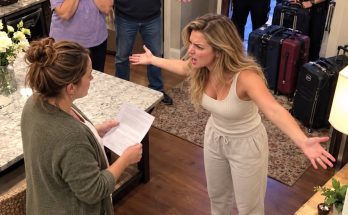
My brother left me 4.3 million dollars, but I did not tell anyone. Then one evening, while I was sitting in the living room watching television, my daughter walked over, snatched the remote, turned off the screen right in front of me, and said, “Mom, do you know how much money you have cost us?” The next morning, when they woke up, I was no longer there. I was standing in the house I had once dreamed of — a quiet, beautiful place, and finally one that belonged only to me.
My brother left me 4.3 million dollars, but I did not tell anyone.
Not my daughter.
Not my son-in-law.
Not my granddaughter.
Not the ladies from church who still called every few weeks to ask if I was settling in.
Not even the neighbor who had known me back when my husband Richard was alive and my front porch in Dayton still had two rocking chairs instead of one.
I kept the number folded inside me like a letter no one else had the right to open.
Then one evening, while I was sitting in the living room watching television, my daughter walked over, took the remote from the cushion beside me, turned off the screen right in front of me, and said, “Mom, do you know how much money you have cost us?”
For a moment, the room went so quiet I could hear the hum of the refrigerator in the kitchen.
The television screen had gone black.
In the reflection, I could see myself sitting in Greg’s oversized brown recliner, the one nobody used unless all the other seats were taken.
I could see Christine standing behind me, one hand still wrapped around the remote, her mouth pressed into that careful line she had inherited from me but sharpened into something I did not recognize.
I could see Greg in the dining room pretending to check something on his phone.
And I could see Becca, my eleven-year-old granddaughter, frozen at the bottom of the staircase with one sock on and one sock in her hand.
No one spoke.
Outside, a car passed slowly down their Columbus street, tires whispering over wet pavement. It had rained earlier, and the porch light threw a yellow shine across the front windows.
I looked at my daughter and said, “I’m sorry you feel that way.”
That was all.
Not because I had no answer.
Because I had too many.
I could have told her that I helped pay the down payment on that house twenty years earlier, back when she and Greg were newly married and pretending not to be scared.
I could have told her that I had watched Becca on sick days, school holidays, snow days, and half-days when Christine had meetings she claimed she could not miss.
I could have told her that for six months, I had cooked, folded, cleaned, walked the dog, watered the hydrangeas, picked up prescriptions, sat through parent-teacher conferences, and made myself smaller in every room so no one would have to admit I had become inconvenient.
I could have told her that the grocery bill had not gone up because of me.
It had gone up because Greg had started buying organic steak from the expensive market near his office, and because Christine ordered bottled cold brew by the case, and because Becca was eleven and hungry in the way children are hungry when they are growing into themselves.
I could have told her all of it.
But dignity, my husband used to say, was not something you threw onto the floor just because someone else wanted to watch you bend for it.
So I only said, “I’m sorry you feel that way.”
Christine laughed once under her breath.
Not a real laugh.
A tired, brittle little sound.
“You always do that,” she said.
“Do what?”
“Make yourself sound calm so everyone else sounds unreasonable.”
I looked toward the stairs.
Becca had not moved.
Her face had gone pale in that soft, frightened way children get when adults start speaking with knives hidden inside ordinary words.
“Christine,” I said quietly, “not in front of Becca.”
That was the wrong thing to say.
I knew it as soon as her eyes changed.
“Oh, now you’re worried about Becca?” she said. “You don’t think this affects her? You don’t think having you here affects this whole house?”
Greg stood then, pushing his chair back from the dining table.
“Chris,” he said, not gently enough to defend me, only firmly enough to manage the scene.
That was Greg’s way.
He did not like conflict.
He only liked silence after someone else had won it.
Christine looked at him, then at Becca, then back at me.
The room had filled with all the things none of us had said for months.
I picked up the paperback book I had left on the side table, slipped my reading glasses into the front cover, and stood.
“I think I’ll go upstairs,” I said.
No one stopped me.
As I passed the staircase, Becca whispered, “Grandma?”
I stopped.
Her eyes were wet, though she was trying very hard not to cry.
I smiled at her because children remember faces more than words.
“It’s all right, sweetheart,” I said. “Finish getting ready for bed.”
She looked past me at her mother.
Then she nodded.
I climbed the stairs slowly, not because my knees hurt, though they sometimes did, but because there are moments in life when every step becomes a decision.
At the top of the stairs, I turned once and looked back.
Christine was still holding the remote.
The black television screen behind her reflected the living room like an old photograph of a family pretending it was still whole.
The next morning, when they woke up, I was no longer there.
I was standing in the house I had once dreamed of.
A quiet, beautiful place on Clover Street, with a screened porch, a garden, a little creek moving behind the trees, and finally, finally, a front door that opened only because I wanted it to.
My name is Eleanor Whitaker.
I am sixty-nine years old.
I taught high school English for thirty-one years in Dayton, Ohio, and I know how to read a room.
That is not a figure of speech.
When you spend three decades standing in front of teenagers, you learn to hear what is not being said.
You learn the difference between boredom and pain.
Between sarcasm and fear.
Between a student who forgot to do the reading and a student who has not slept because home is not safe enough for sleep.
You learn how to pause before answering, how to let silence do its work, how to recognize the exact second a person decides whether you are worthy of the truth.
So yes, I knew how to read a room.
And by the time my daughter took that remote from me, I had been reading her house for months.
I knew when Christine wanted me in the kitchen because dinner needed to be made.
I knew when she wanted me upstairs because company was coming over.
I knew when Greg was irritated by the way I rinsed coffee mugs before putting them in the dishwasher, though he never said so directly.
I knew when Becca wanted to sit beside me but had begun checking her mother’s face first.
I knew when a chair at the table was technically available but not truly offered.
I knew the difference between a house that welcomes you and a house that makes room for you the way a closet makes room for something nobody knows where else to put.
For the first few months after I moved in, I tried not to see it.
That is another thing age teaches you.
Seeing clearly is not the same as admitting what you see.
I had moved into Christine and Greg’s house six months earlier, after I retired and sold the little brick ranch in Dayton where Richard and I had lived for thirty-seven years.
That house had become too quiet after Richard died.
The kind of quiet that sits at the breakfast table across from you.
The kind that waits in the hallway when you come home from the grocery store and still reach for a second set of keys that no longer exists.
At first, I thought I could stay there.
I told myself I was lucky.
I had a paid-off house, a pension, neighbors who waved, a church where people still saved me a seat, and memories in every room.
But memories can become heavy.
Richard’s coffee mug was still in the cabinet.
His old gardening gloves still hung on a nail in the garage.
His handwriting was still on the masking tape label of a Christmas box that said porch lights, though we had not used those lights in years because he always said they looked tacky and then put them up anyway because I liked them.
For two years after he passed, I kept everything almost exactly where he had left it.
Then one January morning, I caught myself saying good morning to his empty chair.
Out loud.
With my hand on the kettle.
That was when I knew loneliness had stopped being a season and had started becoming the architecture of my life.
A week later, Christine called.
“Mom,” she said, “why don’t you come stay with us for a while?”
I remember standing by the kitchen window, looking at the bare branches of the maple tree Richard had planted the year Christine turned ten.
“For a while?” I asked.
“Or longer,” she said. “We have the guest room. Becca would love having you here. Honestly, it might be good for everyone.”
Everyone.
That word had felt warm then.
Large enough to hold me.
I wanted to believe it.
Maybe I needed to believe it.
So I sold the house.
People think selling a house is a financial decision, but it is not.
Not when you are older.
It is a funeral with paperwork.
Every room asks you if you are sure.
The hallway where Christine learned to ride a scooter indoors because Richard said Ohio winters were too long for strict rules.
The kitchen wall where I used to mark her height in pencil until she got embarrassed in middle school and begged me to stop.
The bedroom where Richard and I argued, forgave each other, folded laundry, planned vacations, paid bills, and grew old in ordinary ways that now seemed almost holy.
I gave away most of the furniture.
I packed my books in copy-paper boxes from the school district because teachers always know where to find boxes.
I kept Richard’s watch, my grandmother’s quilt, my cast iron skillet, a framed photo of Christine at seven missing her two front teeth, and one blue ceramic bowl Richard bought me at a roadside pottery stand in Kentucky because he said it matched my eyes.
Then I drove four hours south to Columbus with my life reduced to what fit inside my Subaru.
Christine cried when I arrived.
I want to be fair about that.
She did.
She opened the front door before I even rang the bell, and Becca ran out barefoot even though it was cold.
Greg carried in my boxes.
The dog, a golden retriever named Murphy, kept pushing his head under my hand as if he had been waiting for me personally.
For a while, I thought I had done the right thing.
The guest room had lavender walls and one narrow window looking over the neighbor’s fence.
There was a white dresser, a soft gray blanket folded at the foot of the bed, and a candle on the nightstand that smelled like vanilla and rain.
Christine had cleared half the closet.
Becca had made a sign with markers that said Welcome, Grandma, with a crooked red heart under my name.
I taped it to the mirror.
That first week, I cooked chicken noodle soup because Greg had a cold.
I helped Becca with a book report on The Lion, the Witch and the Wardrobe.
I found the good grocery store, learned which cabinet held the mixing bowls, figured out how Christine liked her towels folded, and told myself this was what family did.
Family adjusted.
Family made space.
Family did not keep score.
At least, that was what I believed then.
The change came slowly enough that I could pretend it was not happening.
Greg stopped asking if I wanted anything when he drove to the store.
Christine began saying, “We’re just going to grab dinner with friends,” after she had already put on earrings and lipstick.
At first, I thought she had forgotten.
Then I realized she had remembered.
She had simply decided telling me earlier would create the obligation to include me.
So I began making sandwiches on those evenings.
Turkey and Swiss.
Peanut butter.
Sometimes just toast with butter and tea.
I would take my plate upstairs to the lavender room, sit on the edge of the bed, and read while laughter rose through the floorboards.
Not loud laughter.
Not cruel laughter.
Just the kind of laughter that reminds you you are near a life but not inside it.
Greg worked in commercial insurance and believed himself to be a reasonable man.
He liked spreadsheets, clean countertops, and controlling the thermostat.
He never insulted me outright.
That would have been too messy.
Instead, he made observations.
“The electric bill’s higher this month.”
“We’re going through coffee faster.”
“Somebody left the hall light on again.”
“Do we really need the heat at seventy-two?”
He said these things to the room, not to me.
That was the trick.
A direct accusation can be answered.
A comment released into the air becomes everyone’s responsibility and no one’s apology.
Christine would hear him.
I would hear him.
Becca would hear him.
And then we would all continue eating dinner as if the house had not shifted half an inch colder.
One Saturday morning, I came downstairs early and found Greg at the kitchen island with his laptop open, a bank statement on one side and his phone on the other.
Christine was at the toaster.
I poured myself coffee.
Greg did not look up.
“The grocery bill’s up again,” he said.
Christine pressed the toaster lever down.
I added a little milk to my coffee.
Greg clicked something on the laptop.
“I’m just trying to figure out where it’s all going.”
There it was.
Not my name.
Not my face.
Just my existence translated into a line item.
I waited for Christine to say something.
She could have said, Mom cooks dinner half the week.
She could have said, Becca eats like a linebacker lately.
She could have said, Greg, not now.
She said nothing.
The toast popped up.
She buttered it carefully, right to the corners, the way Richard used to say only civilized people did.
I stood there with my coffee and understood something so completely that it did not hurt at first.
It only cleared.
I was not a mother in that house anymore.
I was not a guest either.
I was an expense with a bedroom.
Six weeks before the evening with the remote, my brother Harold died.
Harold was seventy-four.
He lived alone in a small adobe-style house in Scottsdale, Arizona, with gravel landscaping, two citrus trees, and a mailbox that leaned slightly to the left no matter how often he tried to fix it.
He had never married.
He used to say he had considered it twice, both times during tax season, and decided against it once he got enough sleep.
That was Harold.
Dry.
Quiet.
Funny only if you were paying close attention.
He worked as a civil engineer for forty years, mostly on water systems and municipal projects that nobody ever noticed unless something went wrong.
He drove the same truck for eighteen years.
He wore white undershirts until they became nearly transparent and then claimed they were finally comfortable.
He bought good tools, cheap shoes, and exactly one expensive chair, which he placed on his back porch facing west.
We talked every Sunday afternoon.
Not long conversations.
Twenty minutes.
Sometimes thirty.
He called me Ellie, though no one else had called me that since I was sixteen.
He asked about my garden.
I asked about the heat.
He complained about both political parties, the price of oranges, and his neighbor’s wind chimes.
I told him about Becca’s school projects, Christine’s work, Greg’s promotions, the church rummage sale, and later, after I moved in with Christine, small things about the household that I thought were harmless.
I never said, I feel unwanted.
I never said, I am afraid I made a mistake.
I never said, I sold my house and now I do not know where I belong.
But Harold heard more than I said.
He always had.
The call came on a Thursday morning in September.
I was folding towels in Christine’s laundry room when an Arizona number appeared on my phone.
A woman named Mrs. Alvarez, Harold’s neighbor, told me he had been found on his back porch.
He had gone quickly, she said.
No distress.
No long suffering.
Just a sudden stop in the place he loved best, with the desert morning around him and his coffee cup on the little metal table.
I sat down on the laundry room floor because the chair was across the room and my legs had forgotten what they were for.
Christine was at work.
Greg was at work.
Becca was at school.
The dryer hummed beside me, warm and ordinary, as if the world had not just removed the one person who still called me by a name that belonged to my younger self.
I flew to Scottsdale two days later.
Christine hugged me at the airport curb before I left.
Greg said, “Let us know if you need anything,” in the sincere tone people use when they are reasonably sure you will not ask.
Becca slipped a folded note into my purse.
I read it on the plane.
It said, I am sorry about Uncle Harold even though I only met him once. I remember he gave me a silver dollar and said not to spend it unless I saw a dragon. I still have it.
That was the first time I cried.
Not when Mrs. Alvarez called.
Not when I packed.
Not when the plane lifted over Ohio and the clouds closed beneath us like a white door.
But when I read that note and remembered Harold solemnly handing my granddaughter a silver dollar at Richard’s funeral, telling her dragon money should never be wasted on ordinary candy.
Harold’s funeral was small.
Smaller than he deserved, maybe, but exactly the size he would have wanted.
A few neighbors.
Two retired engineers.
A woman from the county office who said Harold had once spent three hours helping her find a mistake in a permit map and refused to accept anything but black coffee as thanks.
Mrs. Alvarez brought a casserole.
Someone else brought lemon bars.
The minister said Harold had lived simply, worked honestly, and loved quietly.
I thought, yes.
That was the whole man in seven words.
After the service, I stayed in his house.
I could have gone to a hotel, but that felt wrong.
His house was tidy in the particular way of a man who never expected company but wanted to be ready for it anyway.
There was one plate in the drying rack.
One pair of shoes by the door.
One jacket on a hook.
One crossword puzzle half-finished on the kitchen table.
The clue for 17 Across was “lasting shelter.”
Harold had written haven in small, precise letters.
I stood there for a long time looking at that word.
Three weeks after I buried my brother, I sat in a lawyer’s office in downtown Scottsdale and learned he had left me everything.
The lawyer’s name was Mr. Okafor.
He was a kind man with silver at his temples and reading glasses he kept pushing up his nose.
His office overlooked a parking lot, a row of palm trees, and a strip of sky so blue it looked almost artificial.
He began with the usual formalities.
I knew enough from teaching Shakespeare to distrust any conversation that began too formally.
“Mrs. Whitaker,” he said, “your brother was very organized.”
“That sounds like Harold,” I said.
“He updated his estate plan regularly. He was clear about his intentions.”
I nodded.
I expected the house.
Maybe the truck.
Maybe a savings account large enough to make the next few years easier.
Then Mr. Okafor slid a folder across the desk.
I opened it.
Numbers do not always look real at first.
Words, I trust.
Words have texture.
They reveal themselves if you sit with them long enough.
Numbers simply sit there, indifferent to your disbelief.
I read the total once.
Then again.
Then a third time, because surely I had misplaced a comma.
Four point three million dollars.
Not cash sitting in one account, of course.
Harold would never have done anything so simple.
It was spread across retirement accounts, investment funds, municipal bonds, the value of his house, the truck, and several accounts he had apparently managed with the quiet discipline of a man who saw no reason to announce what he was building.
Thirty-one years of careful living.
Forty years of steady work.
A lifetime of not needing to impress anyone.
All of it left to me.
I looked at Mr. Okafor.
“I don’t understand,” I said.
He folded his hands.
“Your brother wanted you to be secure.”
“I have a pension.”
“He knew that.”
“I’m not destitute.”
“He knew that too.”
“Then why?”
Mr. Okafor was quiet for a moment.
Then he opened another page.
“There is a note,” he said. “Not a legal document. Just something he asked me to keep with the file.”
My hands began to tremble before I even touched it.
The note was typed, because Harold’s handwriting had become worse after he hurt his wrist repairing a fence years earlier.
Ellie, it said, you spent your life making rooms better for other people. Make sure you keep one for yourself.
That was all.
One sentence.
No grand confession.
No emotional speech.
No explanation.
Just Harold.
I pressed the paper flat with my palm.
I did not cry in the office.
Teachers are very good at waiting until the bell rings.
I thanked Mr. Okafor.
I signed what needed signing.
I drove back to Harold’s house, parked in the carport, walked inside, and stood in his kitchen with my purse still on my shoulder.
The silence there felt different from the silence in Dayton after Richard died.
It did not feel hungry.
It felt patient.
I made tea in Harold’s chipped blue mug, sat at his kitchen table, and looked out at the orange tree in the yard.
Then I took out my phone.
Christine’s name was at the top of my recent calls.
I looked at it for a long time.
And I did not call her.
Not then.
Not that night.
Not the next day.
There are things you tell family because you want to share joy.
There are things you do not tell family because you want to see who they are when they still think you have nothing to give.
I flew back to Columbus carrying Harold’s note inside a book of poems in my purse.
Christine picked me up from the airport.
That was kind of of her.
I remember noticing that kindness because, by then, kindness in that house had begun arriving in pieces, like mail delivered to the wrong address.
She pulled up at passenger pickup in her navy SUV, wearing sunglasses though the day was cloudy.
She hugged me quickly over the console when I got in.
“How did everything go?” she asked.
“Slowly,” I said.
“Estates always take forever,” she said. “Greg’s aunt had one that dragged on for almost a year.”
I nodded.
She merged into airport traffic.
For a few minutes, we talked about Harold’s house, the weather in Arizona, and whether I had eaten lunch.
Then Christine shifted to Becca’s school play.
The Wizard of Oz.
Becca had hoped to be Dorothy but had been cast as a munchkin, which at eleven apparently felt like a public statement on her dignity.
Christine told me the costume committee needed help.
She told me Greg’s mother had opinions about Thanksgiving.
She told me a woman in her book club was getting divorced and pretending to be delighted about it.
She did not ask how it felt to sit in Harold’s empty house.
She did not ask if I was sleeping.
She did not ask whether I had lost the last person who knew me before I became a wife, a mother, a widow, and a guest in my daughter’s spare room.
When we pulled into the driveway, she turned off the engine and said, “I made pasta. It’s in the fridge if you’re hungry.”
“Thank you,” I said.
“We already ate because Becca had rehearsal.”
“Of course.”
I heated the pasta and ate alone at the kitchen island under the bright pendant lights Greg had installed himself and mentioned every time someone complimented them.
The sauce had dried a little around the edges.
I added water and stirred.
From upstairs came the faint sound of Becca practicing a song.
From the living room came Greg’s television.
From my purse came the weight of Harold’s note.
After dinner, I washed my bowl and went upstairs to the lavender room.
The Welcome, Grandma sign was still taped to the mirror, but one corner had curled away.
I pressed it back down with my thumb.
Then I opened my laptop.
I do not know why I searched homes for sale that night.
Maybe because Harold’s sentence had already begun rearranging me from the inside.
Maybe because Christine’s pasta in the fridge had told me more than she meant it to.
Maybe because for the first time in six months, I had the means to ask myself a question without first asking whether it would inconvenience anyone else.
I searched within an hour of Columbus.
Small towns.
Quiet streets.
Single-story or mostly single-story.
A porch if possible.
A garden if possible.
Not too much land.
Not one of those new builds with gray floors and no trees.
That was when I found the Craftsman bungalow in Asheford Hills.
Clover Street.
Three bedrooms.
White trim.
Deep front porch.
Screened porch in back.
A garden running toward a creek.
The listing photos were ordinary real estate photos, too wide and too bright, but I could still see the soul of the place.
The afternoon light fell across the wood floors in long golden rectangles.
The kitchen had white cabinets, a farmhouse sink, and a window over the counter.
There was a built-in bookcase in the living room.
A blue window seat in the primary bedroom.
A little upstairs room that could become a reading room or a place for Becca to sleep when she visited.
I stared at the pictures until the house stopped feeling like a property and started feeling like a door.
The next morning, Christine came into the kitchen while I was having toast.
She had her work blouse tucked into dark pants, one earring in and one still in her hand.
She leaned against the counter.
“Mom,” she said, “I’ve been meaning to talk to you about something.”
Her voice was careful.
Rehearsed.
I put down my knife.
“All right.”
“Greg and I have been talking.”
That phrase should be banned from family kitchens.
It never brings anything warm.
“We want to make sure we’re all on the same page about the future,” she said. “About the plan.”
“What plan?”
She looked toward the living room, then back at me.
“Your plan.”
“My plan?”
“For where you’re going to be long term.”
There it was.
Clean.
Polite.
Wrapped in concern like a dish nobody wanted to bring to the table.
I looked at my daughter.
Christine was forty-one.
She had my eyes, Richard’s stubborn chin, and the same little crease between her eyebrows that appeared when she was trying not to feel guilty.
She was not a cruel person.
I want that understood.
Cruel people enjoy pain.
Christine did not enjoy pain.
She simply had a talent for moving discomfort out of her own way and calling it practicality.
“You’re asking when I’m leaving,” I said.
She looked down.
“I’m asking what the long-term plan is.”
“Because of space.”
“Because of space,” she said quickly. “And routines. And Becca getting older. And Greg works from home more now. It’s not that we don’t love having you here.”
There are sentences that collapse under their own weight.
That was one of them.
I folded my napkin.
“Christine,” I said, “it’s all right.”
She looked up.
“I understand.”
Relief moved across her face so quickly she could not hide it.
That relief hurt more than the question.
Because it told me she had been carrying this conversation around for a while.
It told me Greg had known.
It told me maybe even Becca had felt the house holding its breath.
“I don’t want you to think we’re pushing you out,” Christine said.
I smiled faintly.
“No one ever wants to think that.”
She flinched.
I did not apologize.
After she left for work, I went upstairs, sat on the edge of the bed, and looked at the lavender walls.
My life had become too small for those walls.
Not because the room was small.
Because I had accepted the size they had assigned me.
I opened my laptop and found the listing again.
The real estate agent’s name was Patricia Webb.
Her photo showed a woman in her fifties with silver-blond hair, a red blazer, and the confident smile of someone who knew where every county office kept its forms.
I wrote her an email.
Dear Ms. Webb, I am interested in the Craftsman bungalow on Clover Street and would like to know if it is still available. I am able to make a cash offer.
I hovered over the send button.
Then I thought of Harold’s note.
You spent your life making rooms better for other people. Make sure you keep one for yourself.
I clicked send.
Within the hour, Patricia called.
Her voice was bright but not pushy.
“The Clover Street house is still available,” she said. “There has been interest, but no accepted offer yet. Would you like to see it?”
“Yes,” I said.
“When are you available?”
I looked around the lavender room.
“Today.”
There was a brief pause.
“Today works.”
I told Christine I had errands to run.
That was true.
Buying your life back is an errand of the highest order.
I drove to Asheford Hills under a sky the color of pewter, past strip malls, cornfields, gas stations, churches with changeable-letter signs, and subdivisions with names like Fox Run and Heritage Pointe.
Asheford Hills was smaller than I expected.
A real small city, not a staged one.
Brick storefronts downtown.
A library with columns.
A diner with an American flag in the window and a handwritten sign advertising chicken pot pie on Thursdays.
Old maples lining the streets.
Houses that looked as if people had been born in them, raised children in them, argued in them, repainted them, and kept going.
Clover Street curved gently past a row of bungalows and old two-stories with porches deep enough for rocking chairs.
The house was cream-colored with dark green trim.
There was a small American flag tucked into a planter by the front steps, faded from sun but still standing.
I parked across the street and sat in my car for a moment.
Patricia’s silver sedan pulled up behind me.
She stepped out, waved, and crossed the sidewalk with a folder under her arm.
“Eleanor?”
“Yes.”
“I’m Patricia. I’m glad you came.”
She did not ask why I was alone.
I appreciated that.
Some people meet an older woman and immediately look for the adult in charge.
Patricia handed me the listing sheet and walked me to the front door.
The key turned with a soft click.
The house opened.
That is the only way I can describe it.
Some houses receive you politely.
Some houses resist you.
This one opened.
The entry smelled faintly of old wood, lemon oil, and something floral left behind by the previous owners.
The living room had built-in shelves on both sides of the fireplace.
The floors creaked once under my feet, not in complaint but in greeting.
A wide front window looked out toward the street, where the maple trees were just beginning to turn.
I walked slowly.
Not like a buyer inspecting square footage.
Like a woman listening for her own name.
The kitchen was brighter than in the photos.
White cabinets.
Butcher-block counters.
A farmhouse sink deep enough for soup pots.
A small brass light fixture over the breakfast nook.
And above the sink, a window looking out to the back garden.
I stood there and imagined washing a cup with no one waiting behind me to reach around for something.
No one sighing.
No one calculating electricity, water, groceries, space.
Just my hands in warm water.
My cup.
My window.
My morning.
The screened porch ran the length of the back of the house.
When Patricia opened the door, the smell of damp leaves drifted in.
Beyond the porch, the garden sloped gently toward a narrow creek moving between sycamores and brush.
Not a dramatic creek.
Not the sort people photograph for calendars.
Just a steady, quiet line of water going where it needed to go.
I loved it immediately.
I walked through the bedrooms.
The first could be mine.
The second could be for Becca, though I did not say that out loud.
The third could be a room for books, letters, and the sewing machine I had not used since Richard died because mending things in an empty house had felt too symbolic.
The primary bedroom had a window seat with a faded blue cushion.
I sat down.
Patricia stood in the doorway, wisely silent.
Outside, a squirrel ran along the fence like it owned the place.
Light fell across the floor.
I placed my hand on the window frame.
And for the first time since I sold the Dayton house, I felt a future instead of an arrangement.
“What do you think?” Patricia asked gently.
I stood.
“I’d like to make an offer today.”
Her eyebrows lifted.
“Today?”
“Today.”
By four o’clock, after three calls, two counteroffers, one proof-of-funds letter, and Patricia saying, “Cash does tend to simplify things,” the seller accepted.
I sat in my car outside the house with both hands on the steering wheel.
Then I laughed.
Not loudly.
Not wildly.
Just one small laugh that surprised me by sounding young.
On the drive back to Columbus, I rolled the window down even though the air was cool.
I wanted to feel weather on my face.
I wanted proof that I was still in the world, not just moving through rooms other people controlled.
When I returned, Christine was in the kitchen scrolling on her phone.
“Everything okay?” she asked.
“Yes,” I said. “Everything’s fine.”
And for once, that was not a lie.
Two weeks passed between the accepted offer and the closing.
Those two weeks changed the way I moved through Christine’s house.
Not outwardly.
I still made dinner.
I still walked Murphy.
I still helped Becca memorize lines for The Wizard of Oz.
I still folded towels because I have never been able to watch clean laundry sit in a basket without feeling judged by it.
But inside, I had stepped back.
That is hard to explain unless you have done it.
I still lived there, but I no longer belonged to the tension.
When Greg muttered about the thermostat, I did not defend myself.
When Christine forgot to tell me her book club was coming until the women were already at the door, I smiled, made tea, and took my novel upstairs.
When Becca came to my room later and whispered, “Grandma, Mom didn’t mean to make you hide,” I patted the bed beside me.
“I’m not hiding,” I said.
She climbed up next to me.
“You’re in your room.”
“That’s different.”
She leaned her head against my shoulder.
“Are you sad?”
I looked at her little hand resting on the quilt.
“Sometimes.”
“Because of Uncle Harold?”
“Yes,” I said. “And other things.”
She nodded with the solemn understanding of a child who does not know the details but knows the weather.
“Mom’s stressed,” she said.
“I know.”
“Dad too.”
“I know that too.”
She was quiet.
Then she said, “But sometimes they act like you’re extra.”
The word broke my heart.
Extra.
Not unwanted.
Not loved.
Just extra.
A thing beyond the planned amount.
I kissed the top of her head.
“You are not responsible for grown-up feelings,” I said.
“I know.”
But she did not know.
Children always think they are somehow in charge of the air in a house.
The closing happened on a Friday morning in a conference room with a long table, a bowl of peppermint candies, and a stack of documents thick enough to qualify as literature.
Patricia sat beside me.
The title agent explained each page.
I signed my name again and again.
Eleanor May Whitaker.
A name I had written on attendance forms, mortgage papers, permission slips, Christmas cards, sympathy cards, lesson plans, checks, and once, long ago, on a marriage license with Richard standing beside me grinning like the luckiest fool in Ohio.
When the title agent handed me the keys, she smiled.
“Congratulations, Mrs. Whitaker. The house is yours.”
The house is yours.
I held the keys in my palm.
They were ordinary keys.
Silver.
A little sharp at the edges.
Nothing about them revealed what they had returned to me.
I did not tell Christine that day.
Not because I wanted to punish her.
Punishment requires a desire to make someone feel small.
I knew too well what that felt like.
I simply wanted one thing in my life to belong to me before anyone else had an opinion about it.
On Saturday, Christine and Greg were taking Becca to a soccer tournament two hours away.
The tournament had been on the calendar for months.
I had not arranged my move around their absence at first, but when the timing worked out, I did not correct it.
There is a difference between making a scene and leaving cleanly.
Harold understood that difference.
So did Richard.
I packed on Friday night.
It did not take long.
Six months in a lavender guest room does not accumulate the weight of a life.
My clothes went into two suitcases.
My books into six boxes.
Richard’s watch into my purse.
My grandmother’s quilt into a plastic storage bag, though I apologized to it as I did so because quilts deserve better.
I took the Welcome, Grandma sign from the mirror and laid it flat between two books.
I did not know if Becca would notice it was gone.
I hoped she would.
I hoped she would understand later that I kept it because it had been real.
At seven-thirty Saturday morning, Christine knocked lightly on my door.
“We’re leaving,” she said. “Becca wants to say goodbye.”
I opened the door.
Becca stood in the hallway wearing her soccer jacket, hair pulled into a ponytail, cleats in one hand.
She hugged me hard.
“Wish me luck,” she said.
“Kick only the ball,” I said.
She rolled her eyes.
“Grandma.”
“What? It’s excellent advice.”
She smiled, but her eyes searched my face.
Children notice suitcases.
Even when you hide them behind the bed.
“Are you going somewhere?” she asked.
Christine looked from her to me.
I kept my voice steady.
“I have some things to take care of today.”
“What things?”
“Grown-up things.”
She frowned.
“I hate when people say that.”
“I know.”
I touched her cheek.
“We’ll talk tonight, sweetheart.”
That did not satisfy her, but Greg called from downstairs that they were late, and the moment moved on without resolving itself.
By eight, their SUV pulled out of the driveway.
By eight-fifteen, the movers arrived.
Two men in navy sweatshirts, cheerful and efficient.
One of them had a daughter at Ohio State.
The other complimented my cast iron skillet and said his grandmother had one just like it.
They carried boxes down the stairs while Murphy followed them anxiously, toenails clicking against the hardwood.
I scratched his head.
“I’ll miss you too,” I told him.
He leaned his full golden weight against my leg.
Dogs understand departures better than people pretend they do.
By ten-thirty, the guest room was empty.
I vacuumed it.
I do not know why.
Habit, maybe.
Or gratitude.
Or the need to leave no one an excuse to reduce my leaving to a mess.
The lavender walls looked bare without my books and Becca’s sign.
The room seemed to have exhaled.
I walked through the house slowly.
The kitchen where I had cooked a hundred meals.
The dining table where I had sat through small humiliations and also real laughter.
The living room where Christine had taken the remote from my hand.
The hallway where Becca’s backpack always landed in a heap.
The laundry room where I had sat on the floor after Harold died.
The backyard where Murphy liked to lie in a patch of sun beside the hydrangeas.
I did not hate that house.
That would have made leaving simpler.
But life rarely gives us clean categories.
That house had hurt me.
It had also held my granddaughter’s laughter.
It had made me smaller.
It had also given me six more months of watching Becca grow.
It had shown me where I did not belong.
And sometimes that is a gift, though it arrives dressed like rejection.
I left a note on the kitchen counter.
Christine, I found my own place. I’ll call you tonight. The guest room is all yours. Thank you for the six months. Mom.
I considered writing more.
I considered explaining the grocery bill, the remote, the careful conversations, the way the house had taught me to listen for my own inconvenience.
But Harold’s voice came back to me.
Not everything needs a speech, Ellie.
So I left the note as it was.
Then I locked the front door behind me and put the key through the mail slot.
It landed inside with a small metal sound.
Final.
But not cruel.
Just final.
When I arrived at Clover Street, the moving truck was already there.
The little American flag in the front planter lifted slightly in the breeze, as if greeting me.
I stood on the sidewalk for a moment before going in.
My house.
Not Harold’s.
Not Richard’s.
Not Christine’s.
Mine.
The word felt strange.
Almost selfish.
Then it felt like air.
The movers carried in my boxes.
I told them where to put the bed, the bookshelves, the old blue bowl, the kitchen table I had kept from Dayton because Richard had refinished it one summer and then talked about that accomplishment for the next fifteen years.
By two o’clock, the house was full of my things.
Not arranged perfectly.
Not yet.
But present.
My books filled the built-ins around the fireplace.
My grandmother’s quilt lay across the bed.
Richard’s photo sat on the dresser.
The cast iron skillet hung from a hook beside the stove.
The blue bowl rested on the kitchen counter, catching afternoon light.
I made tea in my own kettle.
I carried it to the screened porch and sat in the wide wicker chair I had ordered before the closing, green cushions still stiff from being new.
The creek moved beyond the garden.
A few leaves floated on its surface.
Somewhere nearby, a lawn mower started.
A church bell rang in the distance.
The house settled around me with little creaks and sighs.
And for a long time, I did nothing.
No laundry.
No dinner prep.
No listening for footsteps.
No calculating whether my presence had become too much.
I sat on my porch, in my chair, with my tea, and watched my creek move through the last gold of afternoon.
Christine called at six.
I let it ring twice before answering.
Not to punish her.
Just to remind myself I was allowed not to jump.
“Mom?” she said.
“I’m here.”
“I got your note.”
“I thought you would.”
Her breathing sounded uneven.
Behind her, I could hear car noise. They were probably driving back from the tournament.
“Where are you?”
“At my house.”
A pause.
“Your house?”
“Yes.”
“What does that mean?”
“It means I bought a house.”
The silence that followed was full of arithmetic.
I could almost hear her adding and subtracting possibilities.
“Mom,” she said carefully, “how?”
“Harold’s estate.”
Another pause.
This one longer.
“Harold left you money?”
“Yes.”
“How much?”
There it was.
The question arrived exactly when I expected it.
Not because Christine was greedy in some dramatic, villainous way.
Real life is rarely that theatrical.
She was startled.
She was practical.
She was already measuring what the number might mean.
For me.
For her.
For Greg.
For Becca.
For the future she had assumed would involve managing me rather than being surprised by me.
I looked out at the creek.
The late sun had turned the water copper.
In the Phoenix airport bookstore weeks earlier, while waiting for my flight back to Ohio, I had spoken with a woman about my age. We had both reached for the same mystery novel and laughed.
Somehow, as strangers do in airports, we told each other truths we might not have told people we knew.
I mentioned an inheritance.
She looked at me over her glasses and said, “Don’t tell them the number.”
I had smiled politely.
She touched my arm.
“I mean it,” she said. “The number changes everything. Tell them enough. That’s all anyone needs unless they’re your accountant.”
Now, standing on my screened porch, I understood the wisdom of that stranger.
“Enough,” I told Christine.
“Enough?”
“Enough to buy this house and live comfortably. That’s all you need to know.”
She was quiet.
Then she said, “Mom, I didn’t know.”
“No,” I said. “You didn’t.”
I could have made that sentence heavier.
I did not.
“Why didn’t you tell me?”
I watched a leaf fall from one of the sycamores.
“Because I needed to know what I wanted before anyone else told me what I should do.”
“That’s not fair.”
“Maybe not.”
“We would have helped you.”
“Christine,” I said gently, “you were asking me for my long-term plan.”
She inhaled sharply.
“That’s not the same thing as kicking you out.”
“I know.”
“Do you?”
“Yes,” I said. “And I also know how it felt.”
There was a sound on the other end, maybe her shifting the phone, maybe wiping her face, maybe turning away from Greg and Becca.
“Mom, I was stressed. Greg was stressed. The house felt crowded, and I didn’t know how to talk about it.”
“I believe you.”
“I didn’t mean to make you feel unwanted.”
“I believe that too.”
“But you did feel that way.”
“Yes.”
The truth sat between us.
Not shouted.
Not decorated.
Just placed there.
For once, neither of us picked it up too quickly.
Finally, Christine said, “What’s the house like?”
I looked around.
The porch screens.
The garden.
The creek.
The last light.
“It’s beautiful,” I said. “It has a porch and a garden. There’s a creek out back. The kitchen has a window over the sink.”
“Oh,” she said softly.
“Becca will like it.”
At the mention of her daughter, Christine’s voice changed.
“Can she visit?”
“Of course. Anytime she wants. You and Greg can too.”
Another silence.
“But this is my house,” I said. “And this is my life. I’m going to live it the way your father always told me I should.”
Christine was quiet so long I thought the call had dropped.
Then she said, “Dad would have loved that.”
It was not really a question.
She knew Richard.
She knew how he would have stood on that porch, hands on his hips, pretending to inspect the railing while already planning where to put bird feeders.
“He would have sat out here every evening,” I said. “Until I made him come inside for dinner.”
Christine laughed.
A small laugh.
Real.
Not polished.
Not defensive.
The laugh she had as a little girl when Richard used to pretend to lose at checkers.
“I’m sorry, Mom,” she said.
I closed my eyes.
“I know.”
“I’m really sorry.”
“I know that too.”
“I don’t know how to fix it.”
That was the first honest thing she had said in months.
“You don’t fix everything with one apology,” I said. “You just stop doing the thing you’re apologizing for.”
She was quiet.
“Okay,” she said.
We talked for another twenty minutes.
About Becca’s soccer game.
About the Munchkin costume.
About Greg’s mother and Thanksgiving.
About nothing important at all, which is sometimes the only bridge people can cross at first.
When we hung up, the porch had darkened.
I sat there until the creek was more sound than sight.
Then I went inside, locked my door, and made dinner in my own kitchen.
Scrambled eggs.
Toast.
Tea.
A meal no one would call too much.
Three weeks later, Becca came to visit.
Christine drove her down on a Saturday afternoon.
I watched from the front window as the navy SUV pulled up to the curb.
Becca got out before the car had fully settled, backpack bouncing against her shoulder.
She stopped on the sidewalk and stared at the house.
Then she looked at the little American flag in the planter, the porch swing Patricia had helped me find at an estate sale, the mums I had placed by the steps, and the front door painted a soft green.
Christine got out more slowly.
She looked nervous.
That made me sadder than I expected.
Not because I wanted her nervous.
Because daughters should not have to stand outside their mothers’ houses wondering how much forgiveness lives inside.
I opened the door.
Becca ran up the steps.
“Grandma!”
I hugged her so tightly she squeaked.
“You got taller,” I said.
“You saw me three weeks ago.”
“Still taller.”
She stepped inside and immediately began looking around with the serious attention of an inspector.
Christine followed, carrying a tote bag.
Her eyes moved over the living room.
The bookshelves.
The quilt folded over the back of the couch.
Richard’s photo on the mantel.
The blue bowl on the table.
“This is lovely,” she said.
“Thank you.”
Her voice was careful again, but differently this time.
Not rehearsed.
Respectful.
I showed them the kitchen, the porch, the garden.
Becca loved the creek immediately.
Of course she did.
Children and water understand each other.
She wanted to go down right away, but I told her we had apple cake to make first.
“My grandmother’s recipe,” I said.
“Your grandmother or my grandmother?”
“My grandmother. Your great-great-grandmother.”
Becca widened her eyes.
“That’s a lot of grandmothers.”
“It is. Which means we have to take the cinnamon seriously.”
Christine stayed for coffee.
At first, she perched on the edge of the kitchen chair as if she were visiting a museum display titled Mother, Newly Independent.
Then slowly, she relaxed.
She told me Becca had talked about the visit all week.
She told me Greg had asked if he should come and then decided maybe Becca and I needed time alone.
I appreciated that more than I expected.
Before Christine left, she stood by the front door.
“I can pick her up around six,” she said.
“Seven is fine,” I said. “We may need time for the creek.”
Becca, already tying an apron around herself, shouted from the kitchen, “Seven!”
Christine smiled.
Then she looked at me.
“Thank you.”
“For what?”
“For letting her come.”
“She’s my granddaughter.”
“I know. I just…”
She stopped.
I let her.
Not every unfinished sentence needs rescuing.
After Christine left, Becca and I made apple cake.
She peeled apples badly but enthusiastically.
Flour got on the counter, the floor, and somehow one of Murphy’s old hairs that had followed me on a sweater months earlier appeared on my sleeve like a ghost from the other house.
Becca stirred the batter with both hands on the spoon.
“This is hard,” she said.
“Most worthwhile things involve some stirring.”
“That sounds like teacher talk.”
“It is teacher talk.”
She grinned.
While the cake baked, we walked down to the creek.
The afternoon was bright and cool.
Leaves had begun turning amber and gold.
Becca found a flat stone and skipped it four times.
Four.
Her personal record.
She screamed in victory so loudly a bird shot out of a bush.
On the way back, she slipped her hand into mine.
“Grandma?”
“Yes?”
“Are you mad at Mom?”
I had expected the question eventually.
Children are braver than adults when it comes to asking what a room is made of.
“No,” I said.
“Were you?”
“Yes.”
She nodded.
“Are you mad at Dad?”
“A little.”
She considered that.
“He said you should’ve told them about the money.”
“Did he?”
“He said families shouldn’t keep secrets.”
I smiled faintly.
“What did your mother say?”
“She told him to stop talking where I could hear.”
“That sounds like your mother.”
Becca kicked a leaf.
“Should you have told them?”
I stopped walking.
So did she.
The creek moved beside us, steady and unconcerned.
“I think,” I said slowly, “that sometimes privacy looks like a secret from the outside. But they are not always the same thing.”
She frowned.
“That’s confusing.”
“Yes.”
“Can you say it like I’m eleven?”
I laughed.
“All right. Your mother had a right to know I was safe. She did not have a right to know every dollar I had.”
Becca thought about that.
“Because it was yours?”
“Because it was mine.”
“And Uncle Harold wanted it for you?”
“Yes.”
She nodded again.
“I think this is your real house.”
My throat tightened.
“You do?”
“Yeah. The other one felt like you were visiting.”
Eleven years old.
Sharp as a tack.
I looked toward the bungalow, the porch, the flag moving slightly in the breeze, the warm light in the kitchen window.
“I think you’re right,” I said.
That evening, after Christine picked Becca up and the apple cake was wrapped in foil on the passenger seat, I locked the door and returned to the porch.
I poured myself a glass of wine.
Not much.
I have never been much of a drinker.
But Harold had kept one very good bottle in his kitchen cabinet, and I had brought it from Scottsdale, saving it for the right moment.
The right moment, I decided, was not some grand celebration.
It was a quiet evening after my granddaughter had laughed in my kitchen and called my house real.
I sat in the green wicker chair and watched the creek.
I thought about Harold.
About all those Sunday phone calls.
About how he had never said, Ellie, are you lonely?
Never said, Ellie, do they appreciate you?
Never said, Ellie, you sound like you are disappearing.
He had simply listened.
Then, in the only way Harold knew how, he had built an answer.
Not with speeches.
Not with drama.
With accounts and signatures and careful planning.
With a note tucked into a legal file.
With a sentence that opened a door.
You spent your life making rooms better for other people. Make sure you keep one for yourself.
I thought about Richard too.
Richard, who would have loved the porch.
Richard, who would have pretended to complain about the creek because it would attract mosquitoes, then spent an entire weekend building a better path to it.
Richard, who once told me, after Christine left for college and I cried in the laundry room, that motherhood was the only job where success meant being needed less and loving anyway.
I had not understood then how many times a woman could be asked to disappear in the name of love.
Not all at once.
Not dramatically.
Just inch by inch.
Give up the bigger slice.
Take the smaller room.
Move your chair.
Keep the peace.
Do not make it awkward.
Be grateful.
Be useful.
Be easy.
Then one day, someone turns off the television in front of you and asks if you know how much you have cost them.
And if you are lucky, if someone loved you quietly enough, you remember the answer.
I cost more than you expected because I am a whole person.
I raised my glass toward the darkening yard.
“Thank you, Harold,” I said.
The creek kept moving.
The trees were turning amber and gold in the last of the evening light.
Somewhere down the street, a dog barked twice and then stopped.
A car passed slowly.
The porch screens held the cool air around me.
Inside, my kitchen waited.
My books waited.
My bed waited.
My life waited.
Not loudly.
Not urgently.
Just openly.
I finished my wine and went inside.
I washed the glass by hand, dried it, and placed it in the cabinet.
Then I stood for a moment at the sink, looking out the dark window toward the garden I could no longer see but knew was there.
That was enough.
After so many years of making sure everyone else had what they needed, I had finally learned the shape of enough.
It was not 4.3 million dollars.
It was not a house bought in cash.
It was not the look on anyone’s face when they realized I had options.
It was a key in my hand.
A porch light I could leave on or turn off.
A kettle on my stove.
A granddaughter’s laughter in the walls.
A brother’s quiet love still reaching me after he was gone.
It was dinner made in my kitchen, in my house, on my terms, in my life.
And that was more than enough.