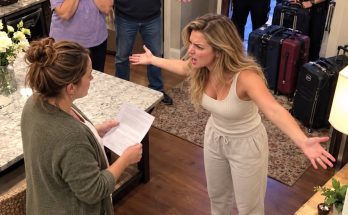
I gave birth to my daughter completely alone while my husband was stationed a thousand miles away, fourteen hours of labor with nothing but fluorescent lights and rotating nurses, and the very first text I opened from my own mother said “Penny’s kids want new phones, send me $2,000 tonight before the sale ends”
— not a single word about me or my baby. I named her Hazel and I lay there in that hospital bed, stitches and all, staring at her tiny fingers opening and closing against the blanket, and something inside me went completely still and cold because I knew that if I didn’t break this cycle right now it would one day become her problem too. I had been sending money for years — rent, car repairs, bills, gifts, endless emergencies for my sister Penny and her three kids — and everyone in my family had quietly decided that my military income existed to absorb whatever crisis came next. So for the first time in my adult life I turned my phone face down and said absolutely nothing. The guilt texts came immediately, then the guilt calls, then the classic lines I had heard my whole life about how family shows up and how I was punishing innocent children, and I ignored every single one of them. One week after giving birth I was standing in my living room running on no sleep when my front door flew open because my mother Martha still had a spare key, she walked in without knocking, never asked about Hazel, never asked how I was healing, just pointed at me and said “what is wrong with you” — and that was the moment something in me finally snapped. I didn’t scream. I picked my daughter up, held her against my chest, and told my mother to lower her voice or get out of my house. She looked at me like I had crossed a line she never believed existed, then told me the military had changed me, that I was cold, that I was abandoning real family, and then she stepped closer, dropped her voice, and said “you really think your husband is going to protect you from us?” — and I want every mother reading this to know that the moment someone says that to you while you are still bleeding from childbirth, holding your one-week-old baby, that is not family, that is control, and you are allowed to be done.
I want you to understand what it feels like to stand in your own living room, one week postpartum, still bleeding, holding your newborn against your chest, and look your mother dead in the eyes and realize she is not afraid of losing you — she is only afraid of losing access to you, and those are two completely different things, and the day you finally understand the difference is the day everything changes forever. I didn’t respond to her threat. I didn’t cry, I didn’t beg, I didn’t try to explain myself one more time like I had spent my entire adult life doing, instead I walked to my front door, opened it, held it open with one hand while holding Hazel with the other, and I said “leave my house now” in the same calm voice I use when I mean something completely and I will not be repeating it. Martha stood there for a long moment like she was waiting for me to collapse back into the version of me she had always known, the one who apologized first, the one who eventually sent the money just to make the noise stop, the one who convinced herself that keeping the peace was the same thing as being loved — but that woman was gone, and I think part of her could finally see it. She left without another word and the door clicked shut behind her and the house went so quiet I could hear Hazel breathing. I texted Caleb that night and told him everything and he called me within four minutes, his voice tight and controlled the way it gets when he is trying not to say something he cannot take back, and he told me we were changing the locks first thing in the morning and that no one — not his family, not mine — would ever walk through our door uninvited again, and I cried for the first time since the delivery, not because I was sad but because I finally felt like someone was standing beside me. We changed the locks. I blocked my mother on every platform and told Penny directly that I would not be sending money for phones, for birthdays, for emergencies, or for anything else going forward, and that if she wanted a relationship with me and with her new niece she was welcome to build one slowly and respectfully, but the ATM was permanently closed. Penny called me selfish. She said her kids would remember this. She said I was going to regret choosing a man and his rules over my own blood, and I almost laughed because Caleb had never once asked me for a single thing that cost me my peace — he had only ever asked me to let him love me, which is more than my own family had managed in thirty years. The weeks that followed were the strangest kind of quiet I had ever experienced, not empty, but clean, like a room after you have finally thrown out everything broken that you had been stepping around for years. I healed. Hazel grew. Caleb came home and held his daughter for the first time in the middle of our living room and sobbed in a way I had never seen from him before, and I stood there watching the two of them and thought this — this right here — is what I was protecting when I finally said enough, and I would do it again without hesitation, and if you are reading this from a hospital bed or a living room floor wondering whether you are allowed to choose yourself and your child over a family that has never once chosen you, I am here to tell you that you are, you absolutely are, and it is not selfish, it is survival, and your baby deserves a mother who knows the difference.
Part 2
What nobody tells you about finally setting a boundary with your family is that the hardest part is not the confrontation itself — it is the silence that comes after, because your entire nervous system has been trained since childhood to interpret their anger as something you are responsible for fixing, so when the calls stop and the texts stop and the guilt trips stop, instead of feeling free you spend the first few weeks waiting for the other shoe to drop, checking your phone out of old habit, replaying every argument wondering if you said too much or not enough, and grieving a version of your mother that probably never existed in the first place but that you spent your whole life hoping would one day show up. I grieved her. I am not ashamed to say that. I sat in Hazel’s nursery one night at two in the morning during a feeding and I cried for the mother I deserved and never had, the one who should have been in that delivery room, the one who should have shown up with food and soft words and asked me how my body was healing instead of storming through my door demanding money for birthday phones, and I let myself feel every bit of that loss because I had earned the right to feel it and because pretending it didn’t hurt would have been just another lie I told myself to survive. But here is what else happened in that silence — I started to hear myself again. For the first time in years I could make a decision without immediately calculating how my mother would react to it or whether Penny would find out and weaponize it or whether someone in my family would decide it was their business to have an opinion about my life. I bought Hazel a mobile for her crib because I wanted to, not because I had budget left over after everyone else took their share. I made doctors appointments without rescheduling them around someone else’s emergency. I slept — actually slept — without my phone lighting up at midnight with another crisis dressed up as urgency. And slowly, carefully, like something fragile finally being handled with the gentleness it always deserved, I started to feel like a person instead of a resource. Caleb noticed first. He told me one evening while we were washing dishes side by side that I seemed lighter, and I didn’t have a word for it at the time but I understood exactly what he meant because I had been carrying weight so long I had forgotten what my own posture felt like without it. Then about six weeks after I changed the locks, my aunt Beverly — my mother’s younger sister who had always been the quieter one, the one who watched everything from the edges of family gatherings without saying much — sent me a private message that I almost didn’t open because I assumed it was another attempt to negotiate my way back into compliance, but something made me read it, and what she said stopped me completely cold. She told me she had watched my mother treat me this way since I was a teenager. She told me she had seen money disappear from my accounts for years while everyone pretended it was generosity instead of extraction. She told me that when I was in labor, my mother knew, and she chose to send that text anyway, and that the family’s reaction to my silence was not grief — it was panic, because I was the one who had been holding the entire financial structure of that household together and now that structure was gone and everyone was scrambling. She said she was proud of me. She said Hazel was lucky. And then she said something I have thought about every single day since — she said “Martha is not angry because you stopped loving her, she is angry because you stopped being useful, and the fact that she cannot tell the difference is the saddest thing about all of this.” I read that message four times. Then I screenshot it, sent it to Caleb, and sat down on the kitchen floor with my back against the cabinet and just breathed, because someone who had watched my whole life unfold from the inside had just confirmed in plain language what I had only recently allowed myself to believe — that I was not the problem, I had never been the problem, I was simply the solution everyone had gotten too comfortable relying on, and the moment I stopped solving problems that were never mine to solve, I finally got to start living a life that actually belonged to me, and if you have a Beverly in your life, someone quiet on the edges who sees everything clearly, hold onto that person, because sometimes the truth you need most comes not from the loudest room but from the one person who was paying attention the whole time and was simply waiting for you to be ready to hear it.
Part 3
Hazel was three months old the first time she smiled at me — a real smile, not the reflex kind that new parents convince themselves means something just because they need it to — and I was sitting cross-legged on the bedroom floor in an old army shirt with my hair unwashed and my coffee gone cold beside me, and she looked up at my face and just lit up like I was the greatest thing she had ever seen in her entire short life, and I want you to know that in that single moment every hard decision I had made in the past three months collapsed into something so simple and so certain that I almost couldn’t breathe, because that little girl had no idea about the money or the locked doors or the unanswered texts or the grandmother who had never once asked to meet her — all she knew was my face, and my face meant safe, and I decided right then that I would spend the rest of my life being worthy of exactly that look. Caleb came home permanently four weeks after that and we fell into the kind of ordinary routine that people who have never been through deployment probably take completely for granted — groceries and bedtime routines and arguments about whose turn it is to do the dishes and slow Sunday mornings with Hazel between us on the bed — and I soaked up every single second of it like someone who had been thirsty for a very long time and had finally found water that actually belonged to them. My mother made one more attempt. About four months after I changed the locks she showed up at the end of my driveway — not at the door this time, just at the end of the driveway, which I only know because my neighbor Ms. Patrice texted me a photo and asked if everything was alright — and she stood there for about ten minutes and then left, and I don’t know what she was hoping for, whether she wanted me to see her from a window and come running out or whether she simply needed to stand in the proximity of what she had lost and feel the weight of it, but I did not go outside, I did not send a message, I simply held Hazel a little tighter and let her go, not with hatred, not with satisfaction, but with the quiet and permanent grief of someone who has accepted that some people will never become who you needed them to be no matter how long you wait or how much of yourself you offer them. Penny sent one final message about eight weeks later, not asking for money this time, which surprised me, but telling me that her oldest had asked about me, had asked why Aunt Lena didn’t come around anymore, and that she didn’t know what to tell him, and I sat with that message for two full days before I responded, and when I did I kept it short and I kept it honest — I told her that I loved her kids and I always would, but that I could not be in spaces where my worth was measured in what I could send, and that if she ever wanted to build something different, something real, I was open to that conversation, but I would not be rushed into it and I would not be guilted into it and I would not be the one doing all the reaching. She never responded. And I made peace with that too. Because here is what three months of silence and healing and watching my daughter discover her own hands taught me — you cannot pour from a vessel that has been drained by people who never once stopped to ask if you were okay, and the bravest thing I have ever done was not fourteen hours of labor alone in a military hospital, it was not holding my ground while my mother stood in my living room and tried to make me feel small, it was not changing the locks or blocking the numbers or standing in the grief of a family that chose money over me — the bravest thing I ever did was decide that Hazel would grow up in a home where love was not a transaction, where showing up for someone did not come with a price tag, where the word family meant safety and softness and consistency and not obligation and extraction and guilt, and every single day I get to watch her grow into a little person who has never once had to wonder whether she is loved, not because life is perfect, not because Caleb and I don’t have hard days, not because the ache of what my mother never gave me has completely disappeared — but because we chose, deliberately and stubbornly and with everything we had, to stop the cycle exactly where it stood and build something entirely new from the ground up, and if you are somewhere in the middle of your own version of this story, if you are still in the hospital bed or still at the locked door or still staring at a text message that makes your chest hurt, I need you to hear me when I tell you that choosing yourself is not abandonment, protecting your child is not cruelty, and the family you build with intention and love and honesty will always, always mean more than the one you were born into that never learned how to treat you like you mattered — and you do matter, you always did, and it was never your job to keep proving it to people who had already decided you were more valuable as a resource than as a human being — let them go, change the locks, hold your baby, and build your life, because you deserve every quiet, peaceful, beautiful second of it.
SHORT SUMMARY:
This is the story of Lena, a military wife who gave birth to her daughter Hazel completely alone while her husband Caleb was stationed a thousand miles away — and within hours of delivering, her mother Martha sent her a text demanding $2,000 for her sister Penny’s kids’ birthday phones. Not a congratulations. Not a single question about the baby. Just another demand. What followed was a mother finally reaching her breaking point — blocking numbers, changing locks, cutting off a family that had spent years treating her military income like a personal fund — and choosing instead to build a home rooted in real love, safety, and peace for her daughter. It is a story about the moment a woman stops being a resource and starts being a person, and how everything changes when you finally decide that your child will never grow up watching you be treated as less than you are worth.
THE LESSON WE CAN ALL LEARN:
The people who guilt you the loudest for setting boundaries are almost always the ones who benefited the most from you having none. Real family does not show up at your door demanding money while you are still bleeding from childbirth. Real love does not come with a price tag or a deadline or a threat. You are allowed to grieve the mother you deserved and never had while still walking away from the one who kept proving she would never be her. Protecting your peace is not selfishness — it is parenting. Because the greatest gift you will ever give your child is not money, not things, not sacrifice — it is showing them every single day what it looks like to be loved without conditions, and sometimes that means being brave enough to stop the cycle exactly where you stand, even when it costs you everything you once called family. Choose the child in front of you over the approval behind you — every single time.