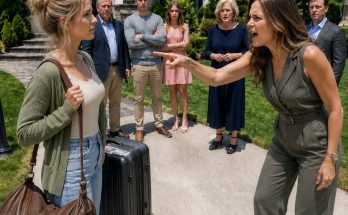
The morning my father demanded that I surrender the estate I’d spent five years restoring, he arrived carrying an expensive bottle of champagne for my brother.
“You have seventy-two hours, Claire,” he announced, gesturing toward the beautiful property behind me. “After that, Daniel is taking control.”
I stared at him, struggling to believe what I was hearing.
Five years earlier, when my mother passed away, Dad had gathered the family to distribute what he described as our inheritance.
My younger brother, Daniel, received a luxurious Manhattan apartment overlooking Central Park, complete with designer furnishings and a private parking space.
I received something entirely different.
A deteriorating country mansion outside Hudson, New York, surrounded by forty acres of neglected land.
The roof was falling apart, the gardens were overgrown, and the house hadn’t been properly maintained in decades.
“Daniel has always had a talent for business,” Dad declared in front of everyone. “Claire, on the other hand, enjoys fixing things. This should keep her busy.”
Daniel laughed while swinging the keys to his new apartment.
“Maybe you can turn it into a vegetable farm.”
I was thirty-one years old and already working as a restoration architect. Neither my father nor my brother had ever shown the slightest interest in my career.
Instead of arguing, I quietly thanked Dad, signed the ownership documents, and walked away.
They thought they’d given me the family’s most worthless asset.
But I saw something they couldn’t.
Potential.
That first year was brutal.
Rain leaked through the ceilings, the heating system barely functioned, and I spent freezing winter nights sleeping beside a portable heater.
For months, I washed dishes in an old bathtub because the kitchen plumbing didn’t work.
During the day, I took architecture consulting jobs. At night, I repaired walls, removed moldy wallpaper, and studied renovation plans until my eyes burned.
Eventually, I sold my car, secured a construction loan, and convinced three local investors to support my vision.
Everyone thought I was making a terrible mistake.
But I kept going.
Five years later, the neglected mansion had become Willowmere House, a prestigious countryside retreat.
It featured eighteen elegant guest suites, a stunning glass conservatory, and a restaurant serving ingredients from nearby farms.
Our wedding calendar was fully booked eighteen months in advance.
The renovated barns hosted workshops for local artists, and forty-six employees depended on the business for their livelihoods.
Every permit, financial agreement, renovation contract, and operational decision had passed through my hands.
My family had visited only once during construction.
Dad had walked through the unfinished entrance hall, shaken his head, and called it a hopeless financial disaster.
Then a prestigious travel magazine named Willowmere one of the country’s most remarkable countryside destinations.
Suddenly, everything changed.
Two weeks after the article appeared, Dad and Daniel arrived without warning.
Daniel wandered through the property taking photographs, questioning employees, and demanding financial information from my manager.
He behaved as though he already owned the place.
Later, while guests enjoyed afternoon tea on the terrace, Dad made his announcement.
“I’ve decided Daniel should take over Willowmere,” he said confidently. “He has the business connections necessary to turn this into a national brand.”
I put down my coffee.
“That isn’t your decision.”
Dad narrowed his eyes.
“Excuse me?”
“This is my business.”
“I gave you this property, Claire.”
“Yes, you did.”
“Then you can return it.”
Daniel smirked.
“Don’t worry, Claire. You can take whatever personal belongings you want. I’ll handle the serious business decisions from here.”
Dad folded his arms.
“You have three days to move out.”
For a moment, neither man spoke.
They were waiting for me to cry, argue, or beg.
Instead, I glanced at the polished brass plaque mounted beside the terrace entrance.
Engraved across it was the name of the company that legally owned the estate.
I smiled.
“Three days?” I repeated.
Dad nodded.
“That’s right.”
“Perfect. I’ll make sure everything is ready.”
Neither of them understood what I’d just agreed to.
By the following morning, Daniel had already begun advertising Willowmere as his newest business venture.
He posted photographs online beneath the headline:
COMING SOON: HAWTHORNE RESORTS — OUR PREMIER DESTINATION.
He even altered the magazine feature, replacing my photograph with his own.
Within hours, confusion spread throughout the property.
Employees feared losing their jobs. Wedding clients called to ask whether their reservations were still valid. One supplier wanted to know whether Daniel was authorized to change our payment arrangements.
I gathered my management team.
“Nothing is changing,” I assured them. “Daniel has no authority here. Continue operating as usual.”
Then I called my attorney, Evelyn Price.
After listening to the entire situation, she gave me a reassuring answer.
“Claire, your father transferred this property through an unconditional deed five years ago. The ownership transfer was properly recorded. Legally, he cannot simply demand it back.”
I exhaled.
But Evelyn wasn’t finished.
“Unfortunately, there’s something else you need to see.”
She emailed me a document titled Property Control and Operating Authorization.
I opened it.
The agreement claimed that I had granted Hawthorne Resorts exclusive management rights over Willowmere for fifteen years, including control over its revenue.
At the bottom was a signature.
My signature.
Except I had never signed it.
“Evelyn, this is a forgery.”
“I suspected as much,” she replied. “And there’s more.”
Daniel had used that agreement to attract investors for his proposed luxury hotel company.
One investor, Robert Keene, had already transferred $800,000.
I sat motionless.
My brother hadn’t merely planned to take my business.
He had already convinced strangers to invest money in property he didn’t own.
“How did you discover this?” I asked.
“Keene’s attorney contacted your bank to verify the property’s ownership and financing arrangements. Your lender immediately notified us.”
That afternoon, my father called.
“Claire, you’re making our family look ridiculous,” he snapped. “Daniel says you’re refusing to give him access to the reservation accounts.”
“Dad, did you tell investors you still owned Willowmere?”
He hesitated.
“This property belongs to our family.”
“No. It belongs to my company. Did you sign anything involving Daniel’s investors?”
“I provided a financial guarantee. Daniel needed someone credible supporting his venture.”
My stomach sank.
My father had personally backed a business deal built around a property he no longer owned.
“Did Daniel tell you I had approved the transfer?”
“Of course he did. Stop being difficult and hand over the keys.”
I ended the call.
Evelyn immediately began preparing our response.
We secured copies of Daniel’s advertisements, documented the false ownership claims, and obtained certified property records.
My bank confirmed in writing that no transfer of management rights had been approved.
A forensic document examiner was engaged to investigate the suspicious signature.
Meanwhile, Keene’s attorney received the authentic ownership documents.
By Friday evening, Daniel was becoming increasingly aggressive.
He left me a voice message.
“Saturday morning, nine o’clock. We’re bringing a moving truck and new locks. Have your belongings packed, or we’ll remove them ourselves.”
I forwarded the recording to Evelyn.
She arranged for law enforcement to be present as a civil standby and requested emergency court protection against unauthorized entry.
We also warned the moving company that Daniel had no legal right to remove anything.
Late Friday, a judge issued a temporary restraining order preventing Dad and Daniel from entering the property to disrupt the business while the dispute was reviewed.
Just before midnight, another message appeared on my phone.
YOUR SEVENTY-TWO HOURS ARE OVER.
It was from Daniel.
I didn’t respond.
Instead, I stood beneath the glass ceiling of the conservatory, watching my employees prepare decorations for the following day’s wedding.
For five years, my father and brother had ignored every sacrifice I’d made.
They hadn’t cared when I worked through freezing winters.
They hadn’t offered help when money was tight.
They had laughed at my ambitions.
But the moment Willowmere became successful, they decided it belonged to them.
Tomorrow, they were finally going to discover how wrong they were.
At exactly 8:57 Saturday morning, a pickup truck pulled into Willowmere’s driveway.
Daniel was driving.
Dad sat beside him wearing an expensive blue blazer, with a box of replacement door locks at his feet.
A moving van followed close behind.
Daniel honked impatiently.
I walked toward the front gate wearing my old denim jacket and work boots—the same clothes I’d worn during the earliest renovations.
But I wasn’t alone.
Evelyn stood beside me, accompanied by a sheriff’s deputy and two attorneys Daniel didn’t recognize.
“Where are your moving boxes?” Daniel shouted through the window.
I smiled.
“Inside the house, exactly where they belong.”
Dad climbed out of the truck.
“Claire, I’ve had enough of these childish games. Open the gate.”
Evelyn stepped forward and handed him a document.
“This is a temporary restraining order,” she explained. “Willowmere is owned by Willowmere Holdings, my client’s company. You are prohibited from entering the property to interfere with its operations.”
Dad stared at the paperwork.
“This land was mine! I gave it to my daughter!”
“And you legally transferred ownership to her five years ago,” Evelyn replied. “A completed gift doesn’t become reversible simply because its value increases.”
Daniel scoffed.
“I have a signed agreement giving me complete operating control.”
A voice behind Evelyn interrupted him.
“Are you referring to this agreement?”
Robert Keene stepped forward, holding a copy of the document.
His attorney stood beside him.
Daniel’s expression changed instantly.
“Robert? What are you doing here?”
“Trying to understand why you accepted eight hundred thousand dollars from me using an authorization the actual property owner never signed.”
Daniel swallowed.
“You’re misunderstanding the situation.”
“Really?” Keene replied. “Because your company represented that it had the legal right to operate this property. We’ve now confirmed that it doesn’t.”
He raised the document.
“My attorney has demanded repayment and referred the suspected forgery to investigators.”
Dad turned sharply toward Daniel.
“You told me Claire had agreed to this!”
Daniel looked away.
For once, he had nothing clever to say.
Then Keene’s attorney produced another document.
“Mr. Hawthorne, perhaps you should review this as well.”
It was the personal financial guarantee Dad had signed.
He read the first page.
Then the second.
His hands began trembling.
“What’s this supposed to mean?”
“It means you personally guaranteed certain obligations connected to this investment,” the attorney explained. “If those obligations aren’t met, we intend to pursue the remedies available under that agreement.”
Dad turned toward Daniel.
“You told me this was just a formality!”
Daniel’s face flushed.
“Dad, I can explain—”
“Explain what? You told me everything was legitimate!”
Daniel suddenly pushed toward the gate.
“This is ridiculous! I have investors! I have contracts! I’m changing those locks whether she likes it or not!”
The sheriff’s deputy stepped directly in front of him.
“Sir, remain outside the gate. You have been served with a court order.”
Daniel stopped.
Behind him, the movers exchanged uncomfortable looks before returning to their vehicle.
Dad stood silently for several moments.
Then he turned to me.
“Claire, please. We’re your family.”
I looked at the man who had repeatedly dismissed my career, favored my brother, and tried to take away everything I’d built.
I remembered those winter nights when I could barely afford heating.
I remembered working until sunrise, worrying about payroll, and wondering whether my dream would survive another month.
And I thought about the forty-six employees inside Willowmere who trusted me to protect their jobs.
“Dad, you gave me a house nobody wanted,” I said quietly.
“You called it worthless. Daniel laughed at me for accepting it.”
Neither man answered.
“I spent five years rebuilding it. I took the financial risks. I found the investors. I created this business.”
My father lowered his eyes.
“And now that it’s successful, you think you can simply take it away?”
“Claire—”
“No. Family doesn’t turn a gift into a weapon. And family doesn’t forge signatures to steal someone else’s work.”
I stepped back.
“You both need to leave.”
Eight months later, the consequences had become impossible for either man to ignore.
Daniel sold his luxurious Manhattan apartment to cover legal expenses and contribute to a civil settlement.
His ambitious hospitality company collapsed before opening a single resort.
Dad paid a substantial amount under his personal guarantee and eventually resigned from his property business after his partners discovered what had happened.
The investigation into the forged authorization continued.
As for Willowmere, we kept growing.
We expanded our apprenticeship program, opened a second restaurant, and welcomed more guests than ever before.
One peaceful Sunday afternoon, I sat alone in the conservatory, watching golden sunlight fall across the orchard.
For the first time in years, I thought about my mother’s funeral without feeling the familiar sting of humiliation.
Dad had believed Daniel deserved the valuable inheritance.
He’d given me the crumbling mansion because he thought it would never amount to anything.
But he’d misunderstood something important.
The real value had never been in the house itself.
It was in what I had the courage, patience, and determination to build.
And when my father and brother finally drove away that Saturday morning, I didn’t feel the need to chase after them.
I simply watched their pickup truck disappear down the driveway.
They had once given me what they considered a worthless consolation prize.
I had turned it into my future.
And this time, they couldn’t take it away.