For my daughter’s 18th birthday, my mother handed her a $15 bracelet and announced, “She gets the leftovers—the real granddaughter gets a Jeep
-
October 06.112026 – by oldstorylife
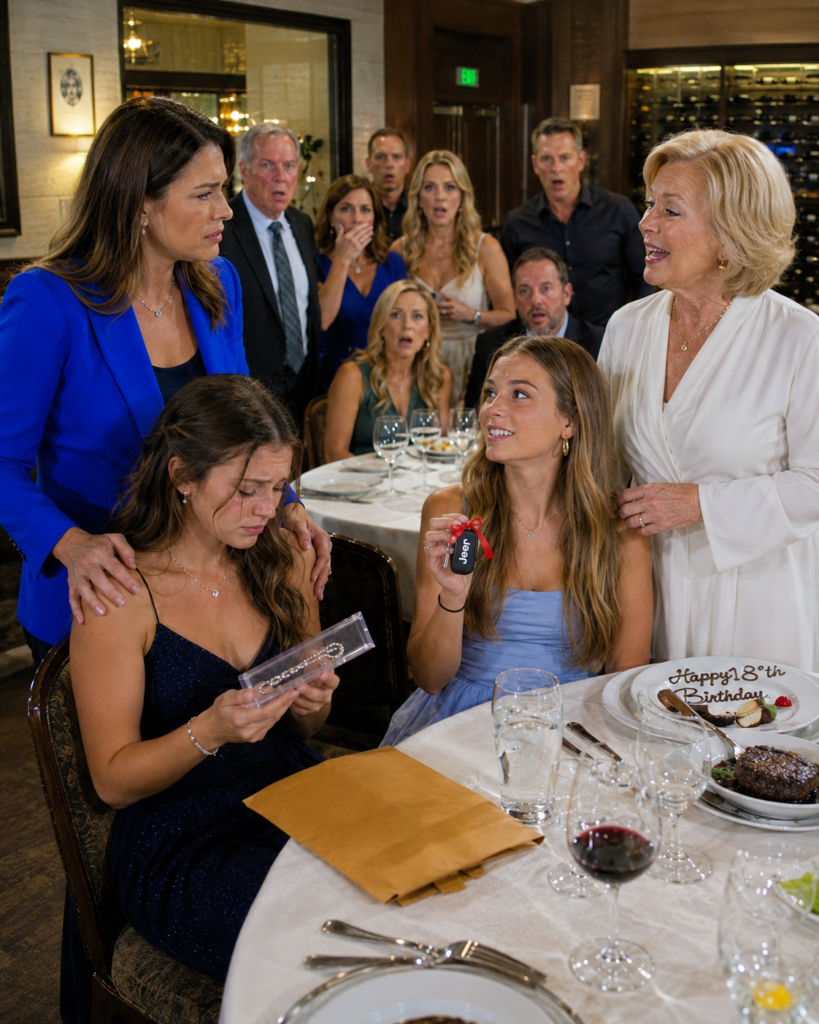
The bracelet was still inside its clear plastic case when my daughter’s smile finally gave way.
There was no velvet box, no ribbon, no handwritten card. It was the kind of lightweight costume jewelry sold beside travel-size shampoo and discount reading glasses, with a bright yellow clearance label still attached to the lower corner.
$1.15.
I could read the price from three seats away.
So could the other twenty-two people gathered in the private dining room.
My daughter, Sage, accepted it with both hands and thanked her grandmother.
Her voice did not shake. Her posture remained straight. She even managed a small smile, the careful kind she had been practicing at family gatherings since she was eleven years old.
It was not a happy smile.
It was a shield.
Across the long white tablecloth, my mother, Claudia Pennington, watched Sage with the satisfied expression of a woman who believed she had just delivered an important life lesson.
The lesson was simple.
Some people received the best.
Others learned to be grateful for whatever remained.
The restaurant was called Marquetti’s, a polished Italian steakhouse on Main Street with dark wood walls, brass lamps and black-and-white photographs of families who had crossed an ocean with nothing but suitcases and determination. Claudia had reserved the private room because Sage and my niece, Brin, were turning eighteen during the same week.
She had called it practical.
One dinner. Two cakes. One gathering for the whole family.
But I had grown up under Claudia’s roof. I knew she rarely arranged two things side by side unless she intended for someone to compare them.
Brin’s gift had been opened first.
Claudia rose slowly from her chair, smoothing the front of her ivory blouse before lifting a set of car keys with a red ribbon tied around the ring. She turned them beneath the overhead lights so the polished metal flashed.
Then she announced that an Arctic White Jeep Wrangler was waiting in the parking lot.
The vehicle had cost $46,800.
Most of it, she said, had already been paid.
The room erupted in applause.
Brin covered her mouth and looked at her mother, my younger sister, Tabitha. Tabitha was already smiling for the phones. Her husband, Willis, lifted his wineglass and offered a toast about the next generation taking the wheel.
Two of Brin’s soccer teammates began recording.
Claudia walked around the table instead of handing Brin the keys from where she stood. She took the long route, passing every guest so they could admire the gift before Brin touched it.
She spoke about Brin’s athletic scholarship, her discipline and the state soccer finals she would play in after Christmas. She said my father, Forest, would have been proud.
Then she closed Brin’s fingers around the key ring.
Only after the cheering faded did Claudia turn toward Sage.
She reached into a shopping bag near her chair and removed the plastic bracelet case.
No speech about Sage’s part-time job at the bookstore.
No mention of the transfer program she had earned admission to at the community college.
No acknowledgment of the nights she had stayed awake helping her father inventory the auto parts store after a software failure wiped out three weeks of records.
Claudia placed the bracelet in front of her and said, “I thought this suited you.”
Sage thanked her.
That should have been the end of it.
It would have been unkind but survivable. Sage had survived smaller versions of that moment for years.
Claudia, however, had not brought twenty-three people together merely to hand out presents. She had brought them together to establish a ranking.
She rested one hand on the back of her chair and addressed the room.
“Brin has worked very hard for her future,” she said. “She has earned opportunities. I don’t believe in pretending every child has made the same choices simply because it feels more comfortable.”
The servers had just begun wheeling in a dessert cart. When they heard the tone in Claudia’s voice, they stopped near the doorway.
My husband, Sterling, looked at me.
I could feel him preparing to stand.
I placed my hand on his forearm.
“Wait,” I whispered.
Claudia continued.
“Sage is a sweet girl, but she is attending the local community college because her parents did not prepare for anything else. Sterling manages an auto parts store. Rowan works at a credit union. They live responsibly, but responsibly is not the same as successfully.”
A few people lowered their eyes.
Nobody interrupted her.
That silence gave Claudia confidence.
She looked directly at my daughter.
“Sometimes one side of a family provides opportunities,” she said. “The other side provides leftovers. That is simply life.”
Sage’s polite smile remained in place for another second.
Then the corners of her mouth lowered.
Her chin dipped.
She placed the bracelet on the table as carefully as if it were made of glass rather than thin plastic and plated metal.
I had known my mother could be dismissive.
I had known she could be theatrical.
I had known she preferred Tabitha and treated Brin as if the sun had been assigned to follow her.
But until that moment, some small part of me had still believed Claudia possessed a boundary she would not cross.
Watching Sage sit beneath twenty-three pairs of eyes while her own grandmother calculated her value at $1.15 removed the last of that belief.
Sterling pushed his chair back an inch.
I tightened my hand around his sleeve.
“Please,” he murmured.
“Not yet.”
Inside my purse, a white envelope pressed against my hip.
Sage’s full name was written across the front in my father’s careful handwriting.
The envelope had been sealed for six years.
Beside it was a copy of a custodial account agreement, an official transaction summary and a letter from the credit union’s legal department.
Three weeks earlier, I had believed the birthday dinner would merely be uncomfortable.
Now I knew it would become the night my family’s private mathematics finally stopped working.
I stood.
Every voice in the room disappeared.
“Sage,” I said, “please give the bracelet back.”
My daughter looked at me.
Her eyes were bright, but her hands were steady.
She slid the plastic case across the table until it stopped near Claudia’s place setting.
Claudia’s expression hardened.
“What are you doing?”
I reached into the pocket of my blazer and placed another set of keys in front of Sage.
The fob was black leather and brushed metal. A chrome running horse caught the light.
For the first time that evening, Sage forgot to protect her expression.
Her mouth opened slightly.
Sterling leaned back and watched her with quiet pride.
“There is a certified pre-owned 2024 Ford Mustang GT in the parking lot,” I said. “Magnetic gray. Twenty-three thousand miles. Clean title. Fully paid.”
Sage looked from the keys to me.
I had rehearsed that sentence several times.
I had not rehearsed what happened to her face.
The pain did not disappear. It was still there, but something else moved in beside it—disbelief first, then warmth, then a fragile kind of relief.
“The title transfer is ready,” I continued. “The insurance is covered for the first year. You will complete the defensive-driving course we discussed, and your father has already installed the monitoring system you promised not to complain about.”
A small laugh escaped her.
It was the first honest sound she had made all night.
Sterling nodded toward the keys.
“It has new tires,” he said. “I checked.”
That brought another laugh from Sage, this one stronger.
She picked up the fob and turned it over in her palm.
Claudia stared at me.
The color slowly left her face.
“You bought her a Mustang?”
“I did.”
“That is absurd.”
“No,” I said. “It was planned.”
“You cannot afford that car.”
“I paid $39,500.”
Her eyes narrowed.
“With what loan?”
“No loan.”
“What credit card?”
“No credit card.”
“You expect us to believe you had almost forty thousand dollars sitting around?”
“It was not sitting around. Sterling and I saved it.”
For three years, we had transferred money into an account Claudia did not know existed. Seven hundred dollars every month came automatically from our paychecks. Tax refunds went in. Sterling’s quarterly performance bonuses went in. I accepted additional compliance reviews during two merger projects and deposited every extra dollar.
We had postponed replacing our kitchen cabinets.
Sterling had kept his old truck running past two hundred thousand miles.
I had worn the same winter coat for four seasons.
We did not feel deprived.
We had simply decided that when Sage turned eighteen, she would receive at least one gift that had not been measured against Brin.
Claudia looked around the room as if expecting someone to question me.
Nobody did.
I took one slow breath.
“The important question is not how I paid for Sage’s car,” I said. “The important question is how you paid for Brin’s.”
The room changed.
It did not become louder.
It became still.
Tabitha’s smile vanished.
Willis lowered his glass.
Brin looked down at the Jeep key in her hand.
Claudia pulled her chair closer to the table.
“I don’t know what you are suggesting.”
“I am not suggesting anything.”
I removed the first document from my purse.
It was a photocopy of the custodial account agreement my father had kept in a labeled file inside his workbench.
The paper was eight years old. The fold lines had softened, but the names remained clear.
Forest Pennington had established the account under our state’s custodial transfer law when Sage was ten. The funds legally belonged to Sage, though a custodian managed them until she reached adulthood.
My father had served as the original custodian.
Claudia was listed as successor custodian.
Not owner.
Not beneficiary.
Custodian.
My father had believed the distinction would protect Sage.
He had believed the title carried a duty.
That was the single measurement Forest Pennington had gotten wrong.
I placed the agreement on the table.
“Dad opened a custodial account for Sage in 2018,” I said. “He deposited twenty-five thousand dollars. After he passed, I contributed two hundred dollars every month. With interest, the balance had grown to a little over forty-two thousand.”
Claudia’s fingers closed around the edge of her napkin.
Tabitha looked at her.
I continued.
“On September third, thirty-eight thousand dollars was removed from that account by the successor custodian.”
Nobody moved.
“The funds were converted into a cashier’s check,” I said. “Two days later, the check was presented to Lehman Motors as the down payment on Brin’s Jeep.”
Willis turned toward Claudia so quickly that his chair creaked.
“What?”
Claudia raised one hand.
“It was Forest’s money.”
“It was Sage’s money,” I said.
“He saved it while we were married.”
“And then he legally transferred it to Sage.”
“He would have wanted both girls cared for.”
“Then he would have opened an account for both girls.”
Claudia’s mouth tightened.
“Your father did not understand how much Brin’s future would cost.”
“Dad understood exactly what he signed.”
Tabitha looked between us.
“Mom told me the down payment came from her retirement savings.”
Claudia did not answer.
“Mom,” Tabitha repeated. “You said it was your money.”
“It was family money.”
Willis placed his glass on the table.
“Did it come from your retirement account or not?”
Claudia turned toward him.
“You are missing the point.”
“No,” he said quietly. “I think I am finally seeing it.”
Brin still held the Jeep key, but the excitement had left her face. She looked younger than eighteen. Her shoulders had folded inward, and her thumb moved anxiously over the red ribbon.
“I didn’t know,” she said.
Her voice was almost too quiet to hear.
I looked at her.
“I believe you.”
That mattered.
Brin had benefited from Claudia’s favoritism, but she had not created it. She had grown inside the same family system as Sage, only from the protected side. Claudia praised her before she had time to understand what the praise cost someone else.
Brin looked at Sage.
“I really didn’t know.”
Sage closed her hand around the Mustang keys.
“I know.”
Claudia turned sharply toward her.
“You do not need to apologize for receiving something good.”
Brin flinched.
“This doesn’t feel good.”
“It is your birthday gift.”
“It came from Sage’s account.”
“It came from your grandfather.”
“He wasn’t my grandfather,” Brin said. “He was Sage’s grandfather too.”
The sentence struck Claudia harder than anything I had said.
She stared at Brin as if the girl had violated an agreement neither of them remembered signing.
I took the legal department’s letter from my purse but did not open it.
The document was addressed to Claudia.
I placed it beside the bracelet.
“Three weeks ago, the Jeep financing file entered my department at First Heartland Credit Union,” I said. “I saw the family names and immediately reported the conflict to my manager. I did not investigate the account myself. I was removed from the case.”
That detail mattered, both professionally and personally.
I had spent nine years learning that good evidence could be weakened by bad procedure. The moment I recognized Claudia’s name on the loan application, I locked the screen and went directly to my supervisor, Opel Ramsey.
Opel had taken one look at my face and closed her office door.
I told her the application involved my mother, my sister and my niece. I told her the listed down payment appeared connected to an account my father had created for Sage.
Opel did not allow me to reopen the file.
She called internal review.
She documented my recusal.
She asked the compliance director to assign the matter to an investigator in another branch.
Then she made me sit down.
“You are not touching this case again,” she said.
“I understand.”
“You are not calling the dealership.”
“I understand.”
“You are not confronting your mother with information obtained through your job.”
“I understand.”
Opel studied me over the rims of her glasses.
“Do you?”
“Yes.”
“What are you allowed to use?”
“Documents already owned by my family. Public records. Information voluntarily disclosed by the parties. Anything Sage receives once she reaches the legal transfer age.”
“And what are you not allowed to use?”
“Confidential bank information that has not been released through proper procedure.”
She nodded.
“Good. Be her mother. Let us be the bank.”
The distinction saved me from making the kind of angry mistake Claudia could have used to shift attention away from herself.
Over the next two weeks, the credit union’s investigators reviewed the transaction independently. They confirmed that the account was custodial, that Sage was the legal owner of the funds and that Claudia’s authority was limited to expenditures made for Sage’s benefit.
A Jeep for another grandchild did not qualify.
The remaining balance was frozen for Sage’s protection.
The legal department prepared a demand for restoration of the funds.
I learned only what Sage’s rights allowed me to know and what our family’s own documents already established.
That evening at Marquetti’s, the sealed letter on the table was the first official notice Claudia had received.
She stared at it.
“What is that?”
“A letter addressed to you.”
“From whom?”
“First Heartland’s legal department.”
Her hand remained near the envelope, but she did not touch it.
I looked toward the door.
At exactly 7:45, the restaurant manager entered with a man in a navy blazer.
Royce Ashworth was the senior finance director at Lehman Motors. He had not come to reveal confidential banking information or perform for my family. He had come because the dealership had received a lender notice stating that the Jeep’s down payment was under formal review.
His responsibility was to deliver a sealed packet to Claudia and Tabitha, the parties whose signatures appeared on the purchase documents.
Royce stepped toward the table.
“Mrs. Pennington? Mrs. Whitfield?”
Neither woman answered immediately.
Royce placed two envelopes on the table.
“I am required to provide notice that the funding source used for the Jeep purchase has been challenged,” he said. “The vehicle is not being taken tonight. However, it must not be sold, transferred or refinanced until the review is resolved. The dealership will cooperate with the lender and the account owner.”
He looked at Brin, who still held the key.
“This is not directed at you.”
Brin nodded without speaking.
Royce turned back toward Claudia.
“The documentation explains your options, including repayment, replacement financing or voluntary return of the vehicle.”
Claudia pushed the envelope away.
“This is a private family disagreement.”
Royce’s expression remained professional.
“The dealership has no position on your family disagreement. We do have obligations regarding disputed funds.”
He gave me a brief nod and left.
The heavy door closed behind him.
For several seconds, the only sound in the room came from the ventilation system.
Claudia looked at the envelopes, the account agreement and the cheap bracelet lined up together on the white cloth.
Then she reached for the role she had used whenever facts stopped favoring her.
She became wounded.
“I cannot believe you planned this,” she said to me.
“I did not plan your decision.”
“You invited a dealership employee to embarrass me.”
“He delivered a required notice.”
“At a birthday dinner.”
“You chose the birthday dinner as the stage.”
Her lips trembled.
“I was trying to celebrate my grandchildren.”
“You were celebrating one and evaluating the other.”
“That is your interpretation.”
“No,” Sterling said.
It was the first time he had spoken directly to her all night.
He did not raise his voice.
He did not need to.
“You called our daughter leftovers.”
Claudia looked at him.
“I said your side of the family provides leftovers.”
Sterling nodded slowly.
“Thank you for clarifying.”
Something about his calmness unsettled her more than anger would have.
For years, she had dismissed him as the alternator man, as though steady work and mechanical knowledge were evidence of limitation. Sterling had never defended himself because he did not need Claudia’s approval.
But Sage was different.
“You have referred to me as a man who sells alternators for nineteen years,” he said. “That is true. I manage an auto parts store. I also supervise four employees, negotiate vendor contracts, balance inventory worth more than this restaurant and make sure people can get to work when their vehicles fail.”
Claudia looked away.
“I did not come here to discuss your job.”
“No. You came here to use my job as a reason my daughter deserved less.”
He leaned forward slightly.
“I have never borrowed money from your husband’s savings. I have never used your daughter’s account to impress people. I have never asked a child to smile while I explained why somebody else mattered more.”
The room remained silent.
Sterling rested his hands on the table.
“So, yes, Claudia. I sell alternators. I am proud of the way I earn my living.”
Sage looked at him, and I saw the pride move across her face before she could hide it.
Claudia’s breathing grew shallow.
She pressed a hand near her collarbone.
“I do not feel well.”
Tabitha instinctively moved as if to stand, then stopped.
That hesitation was new.
For most of our lives, Claudia’s discomfort had ended every difficult conversation. A headache excused her departure from my wedding reception. A dizzy spell changed the subject when she forgot Sage’s recital. A sudden need to rest appeared whenever someone questioned her treatment of Tabitha and me.
I stepped closer.
“Do you need medical assistance?”
Claudia looked at me.
The question was sincere and deliberately practical.
If she needed help, I would call for it.
If she did not, the conversation would continue.
She lowered her hand.
“I need my family to stop attacking me.”
“No one is attacking you,” I said. “We are asking you to account for a financial decision.”
“You are speaking to me like I am a stranger.”
“I am speaking to you like the custodian of my daughter’s money.”
“I am your mother.”
“And Sage is your granddaughter.”
Claudia looked around the table.
Her church friend, Dolores Medina, had not touched her wine in several minutes. Another guest studied the pattern of the tablecloth.
Nobody stepped forward to rescue her.
For the first time in Claudia’s life, the room did not reorganize itself around her discomfort.
She looked at Tabitha.
“Tell them.”
Tabitha stared at the Jeep key.
“Tell them what?”
“That I have always supported this family.”
“You supported parts of it.”
Claudia blinked.
Tabitha’s voice shook, but she continued.
“You paid for my wedding. You helped with our first house. You attended every one of Brin’s games.”
“I did those things because I love you.”
“I know.”
“Then explain that to them.”
Tabitha shook her head.
“I cannot explain taking Sage’s money.”
“I was going to replace it.”
“With what?”
“I have investments.”
“You told me you were worried about property taxes last month.”
Claudia’s face tightened.
“That was unrelated.”
“Was it?”
Willis turned toward his wife.
“How much did you know?”
Tabitha’s eyes filled with panic.
“I knew Mom was paying the down payment. She told me it came from an old account Dad had left behind.”
“Did you ask whose account?”
“She said it was family money.”
“Did you ask for proof?”
“No.”
“Why not?”
Tabitha’s gaze dropped.
The answer sat between them.
She had not asked because the gift was large, flattering and convenient.
Questions might have made it smaller.
“I trusted her,” Tabitha whispered.
Willis glanced at Claudia.
“So did Forest.”
That sentence ended the argument more effectively than anything else had.
I reached into my purse and removed the white envelope with Sage’s name written across the front.
Her expression changed immediately.
She recognized the handwriting.
“Is that Grandpa’s?”
“Yes.”
I held it for a moment, feeling the softened paper beneath my fingers.
Forest had given it to me in a hospital room six years earlier. He had been weak, but his instructions had been precise.
For Sage.
On her eighteenth birthday.
Not one day sooner.
Do not open it.
I had kept my promise.
Now, standing in a private dining room filled with unfinished cake and silent relatives, I handed the envelope to my daughter.
“Your grandfather wrote this for you.”
Sage took it carefully.
“When?”
“During his final weeks.”
Her fingers rested on the flap.
“Did you read it?”
“No.”
“Not once?”
“Not once.”
She looked at Sterling.
He shook his head.
“Your mom guarded that envelope like it contained national secrets.”
A small smile appeared.
Then Sage opened it.
Inside was a single sheet of lined notebook paper, written on both sides in Forest’s compact handwriting. He had used the same paper for woodshop grading sheets, project plans and grocery lists.
Sage read silently.
The room watched her.
At first, her expression softened. Then she covered her mouth.
She reached the middle of the page and stopped.
Her eyes moved back to the top of the paragraph.
“What does it say?” Sterling asked gently.
Sage swallowed.
For a moment, I thought she would keep the words private.
Then she raised the page.
“My sunrise,” she read. “By the time you open this, you will be old enough to choose what kind of life you want to build. People will offer you instructions. Some will be useful. Some will only be their fears wearing a confident voice.”
Nobody moved.
Sage continued.
“I opened a custodial account for you when you were ten. The account number ends in 1308. The money is yours. Use it for school, training, tools, a home or any careful beginning that helps you become more independent. Do not use it to impress people who disappear when the impressive thing is gone.”
Her voice weakened for a second.
She steadied it.
“Your grandmother is named as successor custodian because I trust her to protect it until you are old enough to manage it yourself.”
Claudia closed her eyes.
Sage read the next lines more slowly.
“If anyone ever makes you feel small, remember the first bookshelf we made. One board looked useless by itself. Once we measured it correctly and gave it the right support, it held more weight than anyone expected. People are not clearance items, Sage. Nobody else gets to attach your price.”
The bracelet sat inches from Claudia’s hand.
Its yellow sticker faced upward.
Sage lowered the letter.
Her face was wet now, but the tears were quiet. She was not the girl who had nearly disappeared behind a polite smile twenty minutes earlier.
She looked directly at her grandmother.
“You knew.”
Claudia opened her eyes.
“Sage—”
“You signed the account paperwork.”
“I believed your grandfather wanted the family cared for.”
“You knew it was mine.”
“I was planning to make it right.”
“When?”
Claudia looked toward the legal letter.
“I need time.”
“You had eight years.”
“Sage, you are too young to understand the pressure adults face.”
“I am old enough to understand my name.”
The sentence landed with a clean finality.
Brin placed the Jeep key on the table.
The red ribbon slid across the cloth.
“I don’t want it,” she said.
Claudia stared at her.
“Do not be dramatic.”
“I don’t want a car paid for with Sage’s money.”
“The dealership said the situation can be resolved.”
“Then resolve it without me driving it.”
“Brin, the vehicle is already registered.”
“Then return it.”
“You have wanted a Jeep since you were fourteen.”
“I wanted a Jeep,” Brin said. “I did not want this.”
She stood and moved around the table.
For a second, Sage appeared uncertain.
Then Brin stopped beside her.
“I’m sorry.”
“You didn’t know.”
“I should have asked more questions.”
“You were given a birthday present.”
“And I liked being the one who got more.”
The honesty surprised everyone.
Brin wiped beneath one eye.
“I knew Grandma treated us differently. I told myself it was because of soccer, or because I visited more, or because our families were different. I let those explanations make me comfortable.”
Sage looked down at the Mustang key.
“I used to think you enjoyed it.”
“Sometimes I did.”
Brin’s answer was barely audible.
“That is what I am sorry for.”
Sage studied her cousin for a long moment.
Then she reached out.
They did not embrace dramatically. They simply held hands between the chairs, two eighteen-year-old girls standing inside a family structure that had been built before either of them could speak.
That was the moment Claudia truly lost control of the room.
Her power had never depended only on money.
It depended on separation.
Tabitha from me.
Brin from Sage.
Success from dignity.
Approval from love.
The moment the girls stopped accepting the comparison, Claudia’s ranking system became useless.
She stood abruptly.
“I will not sit here while everyone turns me into a villain.”
“You may leave,” I said.
Her eyes widened.
“You are throwing me out of a dinner I arranged?”
“I am giving you a choice. Open the legal letter and begin fixing the account, or leave and have your attorney contact the credit union.”
“You cannot speak to me this way.”
“I just did.”
“You think buying a flashy car makes you a better mother?”
“No.”
“Then what exactly are you proving?”
I looked at Sage.
“That she never needed your permission to matter.”
Claudia picked up her purse.
She did not take the bracelet.
She did not take the legal letter either.
I moved the envelope closer to her.
“You need this.”
Her hand hovered above it.
For one second, I saw something beneath the anger.
Fear.
Not fear of prison or public scandal.
Fear of a world in which the people she had ranked no longer waited for their assigned positions.
She grabbed the envelope and walked out.
Nobody followed her.
The restaurant manager quietly returned several minutes later and asked whether we still wanted the candles lit.
Sage looked at Brin.
Brin looked back.
“Yes,” Sage said. “For both cakes.”
The servers rolled the cart into the center of the room.
The candles were placed side by side.
Nobody sang loudly at first. The song began unevenly, then strengthened as Sterling carried the lower notes and Willis joined from the other end of the table.
Sage and Brin blew out the candles together.
Claudia’s empty chair remained at the head of the table.
For the first time, it did not feel like the most important chair in the room.
After dinner, we walked into the cool October night.
The Mustang waited beneath the parking lot lights, metallic gray and polished clean. Sterling had parked it near the entrance but angled it away from the Jeep.
Sage stopped beside it.
She ran her fingertips over the roof and looked at me.
“You really paid for this?”
“We did.”
“Why didn’t you tell me?”
“Because surprises should occasionally be kind.”
She smiled.
Then her expression became serious.
“Can we afford the insurance?”
Sterling laughed.
“That question is how I know we raised you right.”
He explained the policy, the defensive-driving discount and the conditions we had placed on the car. No driving after midnight during the first six months. No more than one teenage passenger unless an adult approved. No showing off. No turning the highway into a racetrack.
Sage listened without complaint.
“I would have accepted a used Civic,” she said.
“I suggested a Civic,” I told her.
Sterling looked offended.
“She has been helping me identify engine sounds since she was twelve.”
“You wanted the Mustang.”
“I believed the Mustang offered strong educational value.”
Sage laughed.
The sound carried across the lot.
Near the white Jeep, Brin stood with Tabitha and Willis. They were not arguing, but the distance between them looked unfamiliar.
Brin walked toward us.
“Can I see it?”
Sage unlocked the Mustang.
Brin leaned into the passenger side and admired the dashboard.
“This is beautiful.”
“You can ride with me after I finish the safety course.”
Brin smiled.
“Deal.”
Tabitha remained near the Jeep.
When I looked at her, she turned away.
Willis approached Sterling.
“I owe you an apology.”
Sterling shook his head.
“You did not buy the Jeep with that account.”
“I did not ask enough questions either.”
“Then ask them now.”
Willis looked back at his wife.
“I intend to.”
The first official meeting took place nine days later at First Heartland Credit Union.
Because I had been recused from the case, I attended only as Sage’s mother and only after Sage signed written authorization allowing me to be present.
The conference room was small and deliberately plain. There was no dramatic wooden table or wall of legal books. Just gray chairs, a speakerphone and a framed poster explaining deposit insurance.
Sage sat between Sterling and me.
Across from us were Opel Ramsey, a legal officer named Marcus Hale and an investigator from another branch.
Claudia arrived with an attorney.
She wore a navy suit and carried Forest’s old leather document case, the one he had used during school board meetings. Seeing it in her hands made something tighten in my chest.
Marcus explained the account structure carefully.
The original twenty-five thousand dollars had been transferred to Sage under the custodial statute. Once deposited, it became Sage’s property. Claudia, as successor custodian, could spend funds only for Sage’s benefit and was required to maintain records.
“Do you have receipts showing that the thirty-eight-thousand-dollar withdrawal benefited Sage?” Marcus asked.
Claudia’s attorney answered.
“No.”
“Do you dispute that the funds were used as a down payment on a vehicle titled for another household?”
“No.”
“Do you dispute that Mrs. Pennington signed the cashier’s check request?”
Claudia’s attorney paused.
“No.”
Marcus folded his hands.
“Then the institution’s position is that the account must be restored.”
Claudia looked at Sage.
“I can make payments.”
“How much?” Marcus asked.
“Five hundred dollars a month.”
The investigator calculated silently.
“That would require more than six years before interest and administrative costs.”
“I am retired.”
Marcus nodded.
“That is why we provided additional options. You may liquidate eligible investments, obtain a secured loan, sell property or authorize the dealership to unwind the Jeep transaction and apply the recovered value toward the account.”
Claudia looked at her attorney.
The attorney cleared his throat.
“The vehicle has depreciated since purchase.”
“Yes,” Marcus said. “The account owner did not create that loss.”
Claudia’s hands tightened around the leather case.
“You are speaking as if I spent the money on myself.”
“You spent it outside the permitted purpose.”
“I spent it on my granddaughter.”
Marcus looked toward Sage.
“You spent it on a different granddaughter.”
Claudia turned toward me.
“This is what you wanted.”
I kept my voice calm.
“I wanted Sage’s money protected.”
“You wanted to punish me.”
“I wanted you to stop.”
“For one mistake?”
Sage shifted in her chair.
“It wasn’t one mistake.”
Everyone looked at her.
She had prepared a statement but had not told us whether she planned to read it. She removed a folded page from her bag.
“When I was thirteen,” she said, “you promised to attend my ballet recital. You chose Brin’s soccer game instead. When I turned sixteen, you gave Brin a laptop and gave me a used planner from your desk. When I was accepted into the community college transfer program, you asked whether I had considered doing something easier.”
Claudia’s face hardened.
“I encouraged you to be realistic.”
“You encouraged me to expect less.”
“I was trying to prepare you for disappointment.”
“You were the disappointment.”
The room became still.
Sage looked down at her paper.
“I don’t want you removed from my life because of one bank transaction. I want distance because the transaction proved what your words had already shown me. You believed my future could be reassigned.”
Claudia’s expression changed.
For the first time since the dinner, she did not immediately answer.
Sage continued.
“I want the account restored. I want the Jeep handled without blaming Brin. I do not want phone calls asking me to forgive you before you have done anything differently. And I do not want gifts.”
Claudia swallowed.
“What do you want from me?”
“Honesty.”
“I have always been honest.”
“No. You have always been direct. That is not the same thing.”
Opel lowered her eyes, hiding the smallest hint of approval.
Sage folded the statement.
“I also want Grandpa’s document case returned.”
Claudia looked down at the leather case in her lap.
“It belongs to me.”
“It contains his account records.”
“I brought those because my attorney requested them.”
“Then copies can be made.”
Claudia looked at her attorney.
He nodded.
She placed the case on the table.
Sage rested her hand on it but did not pull it away immediately.
“Grandpa labeled everything,” she said. “He wanted people to understand where things belonged.”
Claudia released the handle.
That afternoon, she agreed to three steps.
The Jeep would be returned to the dealership for resale. The net amount recovered would be credited toward Sage’s account. Claudia would use a home-equity line to repay the difference. She would also reimburse the legal and administrative expenses created by the transaction.
No one celebrated.
The resolution did not feel joyful. It felt necessary.
When we left the conference room, Claudia remained behind with her attorney.
Sage carried Forest’s leather case against her chest.
Outside, she stopped beneath the bank’s blue awning.
“Do you feel better?” I asked.
She considered the question.
“I feel like the floor stopped moving.”
Sterling placed one arm around her shoulders.
“That is a start.”
The Jeep was returned three days later.
Brin drove it to Lehman Motors with Willis in the passenger seat. Claudia did not go with them.
Royce inspected the vehicle and explained that the dealership could repurchase it, but the family would lose taxes, fees and a portion of the vehicle’s initial value.
Brin handed him the key.
“Do what you need to do.”
Royce looked at her.
“You understand this was not your fault?”
“I understand I am responsible for what I do after finding out.”
Royce nodded.
“That is a useful distinction.”
Tabitha waited in the dealership lobby.
She had not spoken to me since the birthday dinner. She had sent one message saying the situation should have been handled privately.
I had read it and left it unanswered.
At the dealership, however, she approached Sage.
“I am sorry.”
Sage stood beside the coffee machine.
“For what part?”
The question unsettled Tabitha.
“For the dinner.”
“You need to be more specific.”
Tabitha glanced toward Brin.
“I am sorry I sat there while Mom compared you. I am sorry I knew about the Jeep and did not question where the money came from. I believed her because believing her was easier.”
Sage nodded.
“Okay.”
Tabitha waited.
“That’s all?”
“I heard you.”
“Do you forgive me?”
Sage looked at her aunt with a calmness that reminded me so strongly of Forest that I had to turn away.
“I don’t know yet.”
Tabitha’s face fell.
Sage continued.
“I used to forgive things immediately because I was afraid people would leave if I made them uncomfortable. I’m not doing that anymore.”
Brin returned from Royce’s office in time to hear the last sentence.
She stood beside Sage.
Tabitha looked at both girls and seemed to realize how many years had passed while she and Claudia treated their silence as consent.
“I understand,” she said.
It was the first honest beginning she had offered.
Willis and Tabitha did not separate.
They came close.
For several weeks, Willis slept in the guest room, not because he believed Tabitha had knowingly misused Sage’s account, but because he no longer trusted the way decisions were made in their home.
They began counseling.
Tabitha had to confront an uncomfortable truth: Claudia’s favoritism had not only benefited her. It had trained her to avoid questions whenever the answers might threaten that benefit.
She had spent her life being chosen and mistook being chosen for being right.
Brin attended some sessions with them.
She stopped playing the role of the grateful golden child.
At Thanksgiving, she refused to attend Claudia’s house unless Sage was invited and treated respectfully. Sage declined the invitation anyway.
We celebrated at home.
Sterling cooked the turkey on the grill because our oven failed at six in the morning. Sage made mashed potatoes. Brin arrived carrying two pies and no dramatic announcement.
Tabitha and Willis came later.
Nobody ranked the food.
Nobody compared the girls.
Nobody mentioned the Jeep.
The conversation was occasionally awkward, but awkwardness was healthier than performance.
After dinner, Sage took Brin to the garage and showed her the wooden toolbox she had built with Forest when she was ten. The corners were uneven, and one hinge sat slightly higher than the other.
“He let me keep it like that,” Sage said.
“Why?”
“He said the first thing you build should remind you that you survived being a beginner.”
Brin ran a finger over the crooked hinge.
“I like that.”
Sage opened Forest’s leather document case.
Inside were account statements, woodworking plans, receipts and a stack of handwritten notes. Forest had documented every deposit he made into Sage’s account.
There were also several pages of sketches for a scholarship fund he had never lived long enough to establish.
The words SUNRISE TOOL GRANT were written across the top.
The idea was simple.
Each year, Forest wanted to provide a small amount of money to a student entering carpentry, automotive technology, electrical work, welding or another skilled trade.
“He never told me about this,” I said.
“He probably thought he had more time,” Sterling replied.
Sage studied the pages for several minutes.
Then she looked at us.
“I know what I want to do with part of the restored money.”
The credit union completed the account restoration in January.
The Jeep resale covered most of the amount. Claudia’s home-equity loan covered the remaining shortage, along with the related expenses. Sage received a full accounting statement and control of the funds as required by state law.
She did not use the money to attend an expensive university simply to prove Claudia wrong.
She stayed with the transfer program she had already selected.
The community college offered smaller classes, lower tuition and an engineering pathway connected to a state university. Sage could complete two years locally, continue working part-time and transfer without taking on unnecessary debt.
Her choice had never represented failure.
It represented planning.
She used a portion of the restored account to pay tuition and purchase a reliable laptop. She set most of the balance aside in a conservative investment account.
Then she contributed one thousand dollars to launch the first Sunrise Tool Grant.
Sterling’s auto parts store matched five hundred.
First Heartland Credit Union matched another five hundred after Opel presented the proposal to the community outreach committee.
The first recipient was a nineteen-year-old woman named Elena Torres, who had completed the college’s automotive technology program while working nights at a grocery warehouse.
At the small award ceremony, Sage presented her with a professional tool set and a check for certification fees.
There were no balloons.
No luxury vehicle waiting outside.
No phones held up to record a reaction.
Elena opened the tool case and ran her fingers over the polished sockets.
“My father used to have a set like this,” she said.
Sage smiled.
“So did my grandfather.”
Claudia did not attend the ceremony.
She had not been invited.
For the first few months after the birthday dinner, she tried to regain control through messages.
Some were angry.
Some were sentimental.
Some referred to Forest.
Some warned me that family separations could become permanent.
I answered only once.
I wrote that future contact would require accountability, no comparisons between Sage and Brin, no surprise visits and no attempts to use my father’s memory as leverage.
Claudia did not respond for six weeks.
Then, on a cold February afternoon, she arrived at our house.
She did not knock immediately.
Through the front window, I watched her stand on the porch holding a narrow wooden object wrapped in an old dish towel.
Sterling came beside me.
“Do you want me to answer?”
“No.”
I opened the door but did not invite her inside.
Claudia looked older than she had in October. Her hair was neatly arranged and her coat was buttoned to the throat, but the usual certainty was missing from her posture.
“I brought something for Sage.”
“She asked for no gifts.”
“It is not a gift.”
She unwrapped the object.
It was Forest’s twenty-four-inch wooden level.
His initials were burned into one side.
I recognized the small dark mark near the center where Sage had accidentally touched it with a hot glue gun years earlier.
“Where did you find it?”
“In the hall closet.”
“Why was it there?”
Claudia looked down.
“After Forest passed, I packed away most of the garage.”
“You told us his tools had been donated.”
“Some were.”
“And the rest?”
“I kept a few things.”
“Why?”
Her fingers moved over the wood.
“I don’t know.”
That may have been the most honest answer she had given me in years.
Sage came down the hallway.
She stopped when she saw Claudia.
The space between them filled with everything that had not been repaired.
Claudia held out the level.
“This belongs to you.”
Sage did not take it immediately.
“Why now?”
“Because your grandfather would have wanted you to have it.”
Sage’s expression tightened.
Claudia noticed.
“I am sorry,” she said. “That is what I always say, isn’t it? What your grandfather would have wanted.”
Neither Sage nor I answered.
Claudia lowered the level.
“I used his name because people respected him. I thought if I attached his name to my decisions, no one would question them.”
Sage looked at her.
“Did you think he wanted you to take the account?”
“No.”
The answer came quietly.
“Then why did you?”
Claudia stared toward the yard.
Across the grass, the old treehouse Sterling had built stood bare among the winter branches.
“Because I wanted to give Brin something people would remember,” she said. “I wanted everyone to see that I could still provide something important.”
“You could have helped her without using my money.”
“I did not have enough.”
“So you used mine.”
“Yes.”
Sage absorbed the admission.
Claudia continued before courage left her.
“I told myself I would replace it. Then the dinner got closer. The Jeep was already ordered. Tabitha was excited. Brin was excited. I kept moving forward because stopping would have required me to admit what I had done.”
She looked at Sage.
“The bracelet was not supposed to be cruel.”
“It had the clearance sticker on it.”
“I know.”
“You left it there.”
“I know.”
“You gave it to me after giving Brin a Jeep.”
“I know.”
“And then you called me leftovers.”
Claudia closed her eyes.
“Yes.”
“Why?”
The question was simple.
The answer took a long time.
“Because your mother challenged me.”
I felt my shoulders stiffen.
Claudia looked at me.
“Rowan never needed my approval the way Tabitha did. Even as a child, she would quietly decide what she believed and continue whether I agreed or not. I called it stubbornness.”
“It was independence,” Sage said.
“Yes.”
Claudia nodded.
“When Rowan married your father, they built a life that did not include asking me for permission. Sterling did not care whether I respected his job. You did not compete for my attention. Every time the three of you seemed content without me, I felt unnecessary.”
“That is not Sage’s fault,” I said.
“No.”
“Or Sterling’s.”
“No.”
“Or mine.”
Claudia looked at me.
“No.”
The word seemed difficult for her.
Sage stepped closer to the doorway.
“So you tried to make us feel smaller.”
Claudia’s eyes filled.
“Yes.”
There was no explanation that could make the admission harmless.
But truth, even late, changed the shape of the conversation.
Sage finally reached for the wooden level.
Claudia let it go.
“This does not mean everything is fixed,” Sage said.
“I understand.”
“It does not mean you can come to the house without calling.”
“I understand.”
“And I am not ready to spend holidays together.”
Claudia nodded.
“I understand.”
Sage studied her.
“Do you?”
“I am trying to.”
For once, she did not ask for forgiveness.
She did not reach for Sage.
She did not turn her apology into a speech about her own loneliness.
She simply stepped back from the porch.
Before leaving, she looked at me.
“I found three more boxes in the attic. Forest’s things. I will bring them to Sterling’s store if that is acceptable.”
“Call first.”
“I will.”
She walked to her car.
Sage remained in the doorway holding the level.
When Claudia drove away, Sterling joined us.
He took one look at the tool and exhaled.
“I thought that was gone.”
“So did I,” Sage said.
He placed the level against the porch railing.
The bubble settled perfectly between the two lines.
“Still true,” he said.
Sage smiled.
By spring, the Mustang had become an ordinary part of our driveway.
That was healthy.
It was no longer a symbol placed beneath restaurant lights. It carried Sage to class, to the bookstore and to her Saturday defensive-driving course. She kept a small photograph of Forest in the glove compartment and his letter inside a waterproof sleeve.
She also respected the rules.
Mostly.
Sterling received one alert showing the car traveling six miles above the speed limit. He printed the notification and taped it to the refrigerator.
Sage wrote beneath it, “Downhill.”
Sterling added, “Nice try.”
The note remained there for two months.
Brin occasionally rode with her.
Their relationship did not transform overnight into effortless closeness. They had to learn how to speak without Claudia’s comparisons occupying the space between them.
Sometimes Brin over-apologized.
Sometimes Sage became suspicious of ordinary compliments.
Sometimes they argued.
But the arguments belonged to them.
That alone made them healthier than the forced politeness of their childhood.
Tabitha began visiting without Claudia.
She once spent an entire afternoon helping Sage prepare scholarship applications without mentioning Brin’s grades, soccer record or college plans. The effort was visible, but so was the change.
Willis became a quiet supporter of the Sunrise Tool Grant. His company donated safety glasses and work gloves for the next recipient.
No one announced the donation at dinner.
Claudia attended individual counseling.
I learned that from Tabitha, not from Claudia.
She also sold several pieces of jewelry and used the money to pay down the home-equity line faster. One of the pieces was the pearl necklace she had worn at the birthday dinner.
When Tabitha told me, I felt no triumph.
Consequences were not trophies.
They were simply the cost of returning what never belonged to her.
In June, eight months after the dinner, Claudia mailed Sage a letter.
Not a birthday card.
Not a check.
A letter.
Sage read it alone and placed it inside Forest’s leather case. She did not show it to us, and we did not ask.
Several weeks later, she agreed to meet Claudia at a coffee shop for thirty minutes.
She drove herself.
She kept the Mustang keys on the table.
When she returned home, I was in the kitchen pretending not to watch the driveway.
“How did it go?” I asked.
“Awkward.”
“Good awkward or bad awkward?”
“Honest awkward.”
She opened the refrigerator.
“Is there any pasta left?”
“That sounds promising.”
“She apologized without mentioning Grandpa.”
“That is progress.”
“She also said she used to believe love was something people noticed only when it was unequal.”
I leaned against the counter.
“What did you say?”
“I said love that needs a loser is not love.”
Sage removed the pasta container and closed the refrigerator.
“Then she cried.”
“What did you do?”
“I handed her a napkin.”
I laughed before I could stop myself.
Sage smiled.
“I am not ready to call her every week.”
“You do not have to.”
“I might meet her again.”
“That is your decision.”
She nodded.
That was the point Forest had tried to leave her in his letter.
Nobody else decided her worth.
Nobody else decided her boundaries either.
The following October, on Sage’s nineteenth birthday, we returned to Marquetti’s.
Not to recreate the dinner.
Not to prove that we had won.
The restaurant was simply Sage’s favorite place for mushroom ravioli, and she refused to surrender it to one terrible evening.
There were only eight of us.
Sterling, Sage and me.
Brin, Tabitha and Willis.
Opel Ramsey and her husband.
No private dining room.
No staged gifts.
No speech.
We sat near the front windows where the lights from Main Street reflected against the glass.
After dessert, the restaurant manager approached our table carrying a small padded envelope.
Sage looked alarmed.
“I told everyone no surprise cars.”
The manager laughed.
“This is not a car.”
He handed her the envelope.
Inside was a photograph from the Sunrise Tool Grant ceremony. Elena stood beside Sage, holding the tool case. Forest’s wooden level was visible on the table between them.
On the back, Elena had written a message.
Thank you for helping me begin with something solid.
Sage read the sentence twice.
Then she passed the photograph around the table.
When it reached Tabitha, she touched the edge carefully.
“Your grandfather would have liked this.”
Sage looked at her aunt.
“Yes,” she said. “I think he would.”
The words did not feel borrowed or manipulative.
They felt true.
Outside, the Mustang waited at the curb.
Its paint was no longer flawless. There was a tiny mark near the rear wheel from a grocery cart, and the passenger-side floor contained three empty coffee cups Sage had promised to remove.
It was becoming a real car.
A used thing.
A useful thing.
A thing with a life beyond the moment it had been presented.
Before leaving, Sage paused near the restaurant’s service hallway.
Months earlier, an employee had thrown the plastic bracelet into a trash container after nobody claimed it. The bracelet was long gone now.
No symbol remained.
No yellow sticker.
No cheap plastic case.
Only the memory of what it had represented.
Sage looked toward the private dining room, where another family was celebrating an anniversary.
Then she walked outside.
She did not need to see the bracelet again.
She did not need to preserve it as evidence.
The account had been restored.
The money had been protected.
The boundaries had been spoken.
Brin was no longer holding a gift she had never wanted at that price.
Tabitha was learning to question comfort.
Claudia was learning that apology did not guarantee access.
And Sage had stopped accepting pain simply because it arrived wrapped as family tradition.
She unlocked the Mustang and placed Forest’s photograph on the dashboard for the drive home.
Sterling leaned through the open window.
“Speed limit?”
“Forty-five.”
“Actual speed?”
“Forty-five.”
He raised an eyebrow.
“Forty-six downhill.”
He tapped the roof.
“I heard that.”
Sage started the engine.
The low rumble filled the street, steady and controlled rather than loud enough to demand attention.
Brin climbed into the passenger seat.
I watched them pull away beneath the warm lights of Main Street.
For years, Claudia had taught us that families were built like ladders. Someone had to stand above. Someone had to remain below. Every gift, compliment and invitation became another rung proving who mattered more.
Forest had understood something different.
He built bookshelves.
A good shelf did not become stronger by weakening the shelf beside it. Each board carried its own share. Each joint mattered. Every piece required honest measurement and dependable support.
That was the family we were building now.
Not flawless.
Not finished.
But level.
And strong enough to hold.