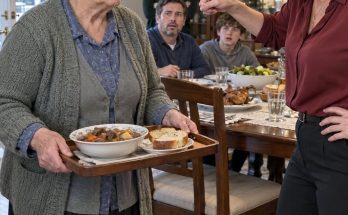
My children gave my husband’s mistress a Mother’s Day card because he told them I had abandoned the family.
My daughter would not look at me.
My son’s hands shook.
The mistress cried and hugged them like she had won a war, pressing her glossy cheek against my daughter’s hair while half the table murmured, “How sweet.”
My mother-in-law lifted her champagne glass and said, “Children always know who truly shows up.”
I did not cry.
I did not scream.
I did not ask my husband how he could sit at the head of my own dining table and let another woman accept my children’s love like stolen jewelry.
I only looked at my eleven-year-old daughter, Sophie, and asked one quiet question.
“Did you write that card yourself, sweetheart?”
Her chin trembled.
Across the table, my husband’s smile froze.
And then Sophie whispered the sentence that turned the entire room cold.
“Dad wrote it.”
CHAPTER 1 — THE CARD AT THE END OF THE TABLE
Mother’s Day in Westport, Connecticut, always smelled like lilacs and money.
At least, that was how it smelled at the Whitaker house.
White hydrangeas lined the front walk. The lawn looked as though each blade of grass had signed a nondisclosure agreement. The driveway curved past imported stone planters, a fountain, and a row of black cars polished so perfectly they reflected the sky.
The house itself sat on six acres overlooking the water, with tall windows and a wraparound terrace where my mother-in-law, Marjorie Whitaker, loved to host brunches that felt less like family gatherings and more like courtroom proceedings with better flowers.
I had not been welcome there for six months.
That was the first lie.
The second lie was that I had left.
The third was that I had stopped being a mother.
I arrived at 12:08 p.m., eight minutes after the time printed on the invitation Marjorie’s assistant had sent me. It was not a warm invitation. It was a dare wrapped in cream-colored cardstock.
Mother’s Day Brunch
At The Whitaker Residence
Family Only
Under that, in Marjorie’s slanted handwriting, someone had added:
We hope you can be civil.
I stood in the doorway wearing a pale blue dress, low heels, and the pearl earrings my mother had given me before she died. My hair was pinned at the nape of my neck. My hands were empty except for a small leather purse and a white envelope I had not yet opened in front of them.
I could hear laughter before I entered the dining room.
Jenna Palmer’s laughter.
It was light, practiced, and breathy, the kind of laugh that made men feel witty and women check whether they had lipstick on their teeth.
She sat to my husband Grant’s right.
My chair.
She wore a soft pink dress and a diamond tennis bracelet I recognized because I had bought it for myself five years earlier, then found the box missing from my jewelry drawer two weeks before Christmas.
Grant saw me first.
For half a second, his face did something honest.
Fear crossed it.
Then he recovered.
“Nora,” he said, leaning back in his chair as though I were a late delivery. “You came.”
The table went quiet in that rich-people way, where nobody gasps but everyone inhales at the same time.
Marjorie sat at the far end beneath the chandelier, silver hair swept into a perfect knot, one hand resting on the stem of her mimosa.
“Of course she came,” Marjorie said. “It’s Mother’s Day.”
The words were sweet. The smile was not.
My children sat on the left side of the table.
Sophie, eleven, with her dark braid and serious eyes, stared at her untouched quiche. Miles, eight, had both hands under the table, twisting the hem of his navy blazer. He had lost another tooth. I knew because there was a new gap in his smile when he glanced at me and looked away too fast.
The last time I had held him, he had cried into my coat outside the family court building and said, “Mommy, Dad says I’m not supposed to make you sad.”
That sentence had kept me awake for weeks.
I wanted to run to them.
I wanted to kneel between their chairs, gather them against me, and tell them the truth. I wanted to say I had never stopped calling, never stopped writing, never stopped driving to school pickups where I was told Grant had already collected them. I wanted to say every birthday gift I sent had been returned unopened. I wanted to say I had not abandoned them.
But children in the middle of adult cruelty do not need more noise.
So I smiled gently.
“Hi, my loves.”
Sophie’s mouth moved. No sound came out.
Miles blinked too quickly.
Jenna placed a hand over her heart.
“Oh, Nora,” she said softly, as though we were old friends and not women connected by betrayal. “I’m glad you came. Truly.”
I looked at her hand.
Her nails were pale pink. On her ring finger sat a diamond I had never seen before.
Grant had not even waited for the divorce.
I took the empty chair beside my son.
Not my old seat. Not the seat Grant had given Jenna.
A smaller chair, near the corner, where the sunlight hit my face and everyone could watch me pretending not to break.
The brunch continued.
Marjorie asked Grant about a charity golf event. Grant discussed numbers he had not earned. Jenna complimented the lemon tart. My sister-in-law Whitney avoided my eyes and drank too much rosé.
Every few minutes, Jenna touched one of my children.
A hand on Sophie’s shoulder.
A thumb brushing crumbs from Miles’s sleeve.
A little laugh when Miles forgot which fork to use.
Each touch landed in my chest like a nail.
Then Marjorie tapped her glass with a spoon.
“I believe the children have something special,” she announced.
Grant’s mouth curved.
Jenna pressed both hands to her lips, already emotional before she knew what performance was being staged.
Sophie reached under her chair and pulled out a large card sealed in a lavender envelope. Her fingers were stiff. Miles helped her hold it, but he would not lift his head.
The envelope said:
To Jenna
In glitter letters.
Not Mom.
Not Nora.
Not even Stepmom.
Jenna.
Still, the whole table understood the message.
Grant sat back, eyes on me.
Jenna opened the envelope slowly, carefully, like a beauty queen reading her winning name.
The card was handmade, or made to look that way. Construction paper. Pressed flowers. Two crooked hearts.
Inside, in handwriting far too neat for either of my children, were the words:
Thank you for being the mother who stayed.
Thank you for making our house happy again.
Thank you for loving us when Mom chose herself.
Happy Mother’s Day.
For a moment, there was no air in the room.
Jenna began to cry.
“Oh,” she whispered. “Oh, you two.”
She stood and pulled Sophie and Miles into her arms. Sophie’s body went rigid. Miles’s face crumpled, but he held it in.
Grant looked at me over the rim of his glass.
He expected me to shatter.
That was his favorite version of me.
The one who cried in the laundry room when he came home smelling like another woman’s perfume.
The one who apologized after he yelled because somehow I had learned to make peace faster than he made cruelty.
The one who begged him not to bring his affair into our children’s lives.
But six months of silence can change a woman.
It can burn the pleading out of her.
It can leave behind something colder.
Marjorie lifted her glass.
“Children always know who truly shows up,” she said.
Nobody corrected her.
Nobody said my name.
Nobody asked why Sophie’s hands were trembling.
I turned to my daughter.
Her eyes were full of tears she was trying not to spill.
I kept my voice calm.
“Did you write that card yourself, sweetheart?”
Sophie shook her head once.
Grant leaned forward.
“Sophie,” he warned.
I did not look at him.
“Sweetheart,” I said again, “you can tell the truth.”
My daughter’s lips parted.
The room held its breath.
“Dad wrote it,” she whispered.
CHAPTER 2 — SIX MONTHS OF LOCKED DOORS
Grant Whitaker had always been good at choosing rooms.
He chose restaurants with the best corner tables. He chose hotel suites with views. He chose boardrooms with lighting that made his jaw look sharper. He chose the chapel where we married because, he told me, “Old money photographs better in stone.”
He also chose the room where he ended our marriage.
It was our kitchen on a rainy Tuesday in November, the night after I found the hotel receipt in his coat pocket.
The hotel was in Manhattan.
The suite had been booked for two.
The champagne had cost more than Sophie’s winter coat.
Grant stood by the marble island, sleeves rolled, wedding ring still on his hand. He did not deny it. Denial was for men who felt shame.
Instead, he sighed.
“Nora, don’t be dramatic.”
That was how my marriage ended.
Not with a confession.
Not with an apology.
With my husband standing in the kitchen where I packed school lunches and telling me that heartbreak was a tone problem.
Jenna Palmer was twenty-nine, blond, ambitious, and employed by the Whitaker Foundation, where Grant served as executive director despite never once being able to explain what the foundation actually did. She coordinated donor events. She wore silk blouses. She laughed at Grant’s stories before he reached the punchline.
When I asked how long, he said, “Long enough for me to know what happiness feels like.”
I remember gripping the edge of the counter.
Not because I wanted to hit him.
Because I wanted to remain standing.
I asked for one thing that night.
“Do not bring her near the children until we know what this is.”
Grant looked offended, as though I had asked him to store garbage in the foyer.
“You don’t get to make rules anymore.”
The next week, my mother had a stroke in Ohio.
I flew to Columbus with one suitcase, after kissing Sophie and Miles goodbye at the school drop-off line. I told them Grandma Helen was sick and I would be back soon.
I called every night.
At first, Grant put them on speaker.
Then he said they were busy.
Then tired.
Then confused.
Then he stopped answering.
My mother died thirteen days before Christmas.
I came home from her funeral to find the locks changed.
My clothes had been boxed and sent to my sister’s house in Norwalk.
The children were not home.
Grant stood on the porch beneath a wreath I had ordered before my mother got sick.
“You can’t just leave your family and walk back in whenever you feel like it,” he said.
I stared at him.
“I went to bury my mother.”
He folded his arms.
“The kids don’t need instability.”
That was the first time I understood he was not just leaving me.
He was rewriting me.
By New Year’s, he had filed for temporary residential custody, claiming I had “voluntarily abandoned the marital home” and was “emotionally unpredictable.” He attached carefully chosen text messages, photos of me crying at my mother’s hospital bed, and a statement from Marjorie saying I had “struggled with the demands of motherhood for years.”
It was elegant.
It was vicious.
It was almost enough.
Almost.
What Grant forgot was that I had spent fourteen years married to a man who believed charm was the same thing as intelligence.
He forgot I had learned to keep records.
He forgot every unanswered FaceTime had a timestamp.
Every returned gift had a tracking number.
Every school email showed my name removed and then added back only after my attorney intervened.
Every text where he wrote, “The kids need space from you,” lived in three places: my phone, my lawyer’s folder, and a cloud account Grant did not know existed.
He also forgot the house.
That was his biggest mistake.
The Westport house was not Whitaker property.
It never had been.
Grant liked people to think it was part of his family’s legacy. Marjorie encouraged the myth. She told guests about “generations of Whitaker taste” while standing under a roof paid for by my grandmother’s trust.
The deed was in the name of Bennett House LLC.
I was the sole managing member.
The mortgage had been paid off three years earlier with money my mother left me after selling her lake cottage.
Grant had never owned a brick.
But he had lived so long inside my generosity that he mistook it for weakness.
For six months, I did what women are rarely praised for doing.
I waited.
I did not post about him.
I did not call Jenna names.
I did not storm into school events and make my children choose between truth and peace.
I sat in my attorney Caroline Hayes’s office on the twenty-third floor of a building in Stamford and built a wall out of paper.
Bank records.
Property records.
Custody logs.
Screenshots.
Voice mails.
A photograph of Jenna wearing my tennis bracelet at the foundation gala.
A copy of the American Express statement showing Grant had charged a two-week trip to Aspen for “donor development,” even though the only donor in the suite had been Jenna and the only development had been the diamond on her finger.
And then came the recording.
It arrived from a source I did not expect.
Ana Morales had worked in our home for seven years. She knew where Miles hid his Halloween candy. She knew Sophie hated mushrooms but ate them to be polite. She knew Grant smiled differently when strangers watched him.
Two weeks before Mother’s Day, Ana called me from a number I did not recognize.
“Mrs. Whitaker,” she whispered, “I have something. I didn’t know if I should send it.”
“What is it?”
“A video from the kitchen camera.”
Grant had installed cameras years earlier after a burglary in the neighborhood. He forgot about them unless he needed to accuse someone else of carelessness.
The clip was twenty-six minutes long.
In it, Grant sat at the kitchen island with Sophie and Miles.
A lavender envelope lay in front of them.
Sophie said, “But she’s not our mom.”
Grant replied, “No, but she’s the one acting like it.”
Miles asked, “Will Mommy be sad?”
Grant said, “Your mother chose to leave. Sadness is what happens when people make selfish choices.”
Sophie cried.
Grant slid the card toward her.
“You don’t have to write it,” he said. “I already did. Just sign your names.”
Miles refused.
Grant’s voice changed.
Not loud.
Worse.
Low.
“If you embarrass Jenna on Sunday, you embarrass me. And if you embarrass me, I’ll know you’re not ready for more time with your mother.”
That was the moment I stopped hoping the truth would come gently.
Some truths have to enter a room carrying documents.
CHAPTER 3 — WHEN THE TRUTH WALKED IN
After Sophie whispered, “Dad wrote it,” Grant stood so quickly his chair scraped the floor.
“That’s enough,” he said.
It was the voice he used in meetings, the voice that made junior employees apologize for problems he created.
But Sophie did not apologize.
She stared at her plate, tears slipping silently down her face.
Miles reached for her hand under the table.
Jenna lowered the card.
The tears on her cheeks were still there, but they had changed meaning.
Marjorie set down her champagne glass.
“Nora,” she said, each syllable clipped, “this is not the time.”
“No,” I said softly. “It is exactly the time.”
Grant laughed once.
A sharp, ugly sound.
“You planned this.”
I looked at him.
“You wrote a Mother’s Day card to your girlfriend and forced our children to sign it. I didn’t plan that, Grant. I only showed up.”
The room shifted.
Whitney put her glass down.
Grant’s cousin Andrew suddenly became fascinated by his napkin.
Jenna looked from Grant to the card to my children.
“Grant?” she said.
That was when the doorbell rang.
Not the front chime guests used.
The side entrance.
The household entrance.
Ana appeared in the dining room archway, face pale but steady.
“Mrs. Whitaker,” she said to me, “Ms. Hayes is here.”
Grant’s head snapped toward me.
“You brought your lawyer to Mother’s Day brunch?”
“No,” I said. “You brought your mistress to my children’s table. I brought the truth.”
Caroline Hayes walked in wearing a gray suit and no expression.
She was in her late fifties, with silver-black hair, calm eyes, and the kind of presence that made powerful men sit straighter before they knew why.
Behind her stood a process server and a uniformed Westport police officer who looked apologetic but very alert.
Marjorie rose.
“Who let you into this house?”
Caroline opened a folder.
“The owner.”
Silence.
It moved across the dining room like weather.
Marjorie blinked.
Grant’s face darkened.
Caroline placed the first envelope beside his plate.
“Grant Whitaker, you are being served with an amended divorce complaint, an emergency custody motion, and a motion for sanctions related to documented interference with parental contact.”
The process server stepped forward.
Grant did not touch the envelope.
“This is harassment,” he said.
Caroline placed a second envelope on the table.
“You are also being served notice that your authorization to occupy Bennett House has been revoked pending court proceedings. Your personal belongings may be retrieved through counsel. Any removal of fixtures, artwork, documents, jewelry, or property owned by Bennett House LLC will be reported.”
Marjorie’s voice dropped.
“Bennett House?”
Caroline turned to her.
“Yes. The legal owner of this property is Bennett House LLC. Mrs. Nora Bennett Whitaker is the sole managing member.”
Jenna went still.
The tennis bracelet on her wrist flashed in the sunlight.
Grant tried to smile.
It looked painful.
“This is a marital residence.”
“It is a separate asset purchased through Mrs. Whitaker’s family trust prior to refinancing,” Caroline said. “You know this because you signed the acknowledgment in 2016.”
Whitney whispered, “Oh my God.”
Grant’s eyes cut toward her.
“Stay out of it.”
But the room had already begun to understand.
Not everything Grant claimed was his belonged to him.
Not the house.
Not the story.
Not even the children’s words in that card.
Caroline took a small tablet from her bag.
“I would prefer not to play this in front of the children,” she said.
Grant’s jaw clenched.
“Then don’t.”
I turned to Sophie and Miles.
“Sweethearts, Ana is going to take you to the sunroom for lemonade. You can bring Winston.”
Winston was our old golden retriever, who had been lying under the buffet hoping for ham.
Miles looked terrified.
“Am I in trouble?”
The question broke something in me, but I kept my voice steady.
“No, baby. Never for telling the truth.”
Sophie wiped her cheeks.
“Do we have to hug Jenna goodbye?”
Jenna flinched as if slapped.
I looked at my daughter.
“You don’t have to hug anyone because an adult tells you to.”
Ana led them out.
Winston followed, tail wagging, unaware that empires can collapse during brunch.
When the children were gone, Caroline tapped the tablet.
Grant’s own voice filled the dining room.
“If you embarrass Jenna on Sunday, you embarrass me. And if you embarrass me, I’ll know you’re not ready for more time with your mother.”
No one moved.
The recording continued.
Sophie’s small voice: “But Mom didn’t leave us.”
Grant: “She left this house.”
Miles: “To help Grandma.”
Grant: “She chose her mother over you.”
The clip ended.
The silence afterward was worse.
Jenna covered her mouth.
For the first time since I had known her, she looked young.
Not innocent.
Just young enough to realize she had mistaken a man’s cruelty for devotion.
Grant pointed at the tablet.
“That was taken illegally.”
Caroline did not blink.
“The camera system is registered to the homeowner. Mrs. Whitaker had access to the footage.”
Marjorie sat back down.
Her face had gone a strange shade of white.
“You shouldn’t have involved the children,” she said.
I almost laughed.
Not because it was funny.
Because there are moments when hypocrisy is so large it becomes architecture.
“No,” I said. “He shouldn’t have.”
Caroline removed another document.
“Additionally, Mr. Whitaker has been removed as authorized administrator from the Bennett Family Trust accounts. The corporate card issued to him through Bennett Charitable Holdings has been suspended pending forensic review.”
Grant’s mouth opened.
Jenna looked down at her purse.
Her phone buzzed.
Then buzzed again.
Then again.
She took it out, glanced at the screen, and turned red.
American Express fraud alert.
Saks Fifth Avenue declined transaction.
Jewelers Mutual policy change.
All tiny bells ringing at the funeral of a lifestyle.
Grant saw her face and snapped, “Put that away.”
Jenna did.
Slowly.
Caroline placed the final envelope in front of me.
“This is for you, Nora.”
I recognized my mother’s handwriting on the outside.
My throat closed.
I had carried that envelope in my purse all morning, waiting for the right moment. Caroline had kept the original safe after the estate attorney released it.
Marjorie frowned.
“What is that?”
I opened it with careful fingers.
Inside was a letter dated three weeks before my mother’s stroke.
My mother had written in blue ink, the way she always did because she said black ink looked like bad news.
Nora, my darling girl,
I know you will try to keep the peace until it costs you your name. Please don’t. A house is just wood until someone fills it with safety. If Grant ever makes you choose between being liked and being free, choose freedom. If he ever uses the children as a wall, become the door.
I have put everything I could protect into your hands because I trust those hands. Not because they never shake. Because they never let go.
Love,
Mom
By the time I finished, the room blurred.
But I still did not cry.
Not there.
Not for them.
Grant leaned toward me, voice low.
“Nora, don’t do this in front of everyone.”
I looked around the table.
At the relatives who had accepted his version because it was easier than questioning the man pouring the wine.
At Marjorie, who believed motherhood was a title she could award to the woman who flattered her son.
At Jenna, who had accepted my seat, my bracelet, and my children’s forced affection, then called it love.
Then I looked at Grant.
“You did it in front of everyone,” I said.
CHAPTER 4 — THE HOUSE REMEMBERED ITS OWNER
There are sounds a house makes when it is finally done pretending.
The old pipes tick behind the walls.
The ice settles in glasses.
A dog barks once from the sunroom.
A woman inhales sharply because she has realized the chandelier above her was never part of her inheritance.
Marjorie was the first to recover.
“This is still my son’s home,” she said.
“No,” Caroline replied. “It is Mrs. Whitaker’s property. Your son was permitted to live here as her spouse. That permission has been withdrawn.”
Marjorie’s eyes narrowed.
“You cannot throw a family out on Mother’s Day.”
I looked at her.
“You tried to throw a mother out of her children’s hearts on Mother’s Day.”
No one spoke.
Grant rubbed both hands over his face.
For the first time, he looked less like a wounded husband and more like a man calculating exits.
“Fine,” he said. “You want a war? You’ll get one.”
Caroline closed her folder.
“Mr. Whitaker, with respect, you have already started several. We are simply documenting them.”
The police officer cleared his throat.
“Sir, we’re not here to remove anyone by force today unless there’s a disturbance. But you should probably let your attorney handle this.”
Grant hated being spoken to like a regular man.
It was all over his face.
Jenna stood.
“I need some air.”
Grant grabbed her wrist.
“Sit down.”
That one gesture changed her expression completely.
Until that moment, she had been embarrassed.
Now she was frightened.
I knew that fear.
I had lived inside it for years, though mine wore better clothes and used quieter words.
Jenna pulled her wrist free.
“Don’t touch me like that.”
Grant stared at her as if betrayal had finally found him and chosen a pink dress.
Marjorie hissed, “Jenna, this is not the time to become emotional.”
Jenna laughed once, but it broke halfway.
“Not the time? Your son told me Nora walked away from the kids. He told me she was unstable. He told me the house was his.”
She looked at me then.
For the first time, there was no smugness.
Only the terrible clarity of a woman realizing she had been handed stolen flowers and thanked for arranging them.
I did not comfort her.
That was not my job.
But I did tell the truth.
“He told you what he needed you to believe.”
Jenna’s eyes filled again.
This time, nobody called it sweet.
Grant stepped toward me.
“You think the kids will thank you for this?”
I held my ground.
“No. Not today.”
That stopped him.
Because he expected revenge to sound like triumph.
Mine sounded like patience.
“They may be angry,” I continued. “They may be confused. They may miss the version of you they needed. I will not ask them to hate you. I will not ask them to choose me in a room full of adults. But I will not let you teach them that love means lying to survive.”
Grant’s face twisted.
“You always were good at speeches.”
“No,” I said. “I got good at evidence.”
Caroline nodded toward the hallway.
Ana returned with Sophie and Miles.
They stood in the doorway, both holding lemonade neither of them had touched. Winston leaned against Miles’s leg like a furry bodyguard.
I crouched so I was eye level with them.
Their faces were nervous, guarded, too old.
That was what Grant had stolen most.
Not time.
Not holidays.
Childhood.
I opened my arms, then stopped halfway.
An invitation, not a demand.
Miles came first.
He ran into me so hard I nearly fell back.
Then Sophie followed, slower, sobbing once before she buried her face in my shoulder.
“I’m sorry,” she kept saying. “I’m sorry, Mom. I signed it. I didn’t want to. I’m sorry.”
I held them both.
“You do not apologize for surviving adults,” I whispered. “You hear me? You did nothing wrong.”
Miles cried into my dress.
“Dad said if we made Jenna happy, you could come back later.”
I closed my eyes.
Behind me, someone at the table made a small, horrified sound.
I pressed a kiss into his hair.
“I came back anyway.”
Sophie pulled away just enough to look at me.
“Did you get our letters?”
My heart stopped.
“What letters?”
She looked at Miles.
Miles whispered, “We put them in your old jewelry box. Dad said Ana mailed them.”
Ana covered her mouth.
Grant said, “That’s enough.”
But it was not enough.
Not anymore.
Ana disappeared down the hall and returned with a small wooden box I recognized immediately.
My jewelry box.
The one my father had given me when I graduated from college.
It had been missing since December.
Ana held it out with shaking hands.
“I found it in the storage closet,” she said. “Behind the Christmas bins.”
Inside were twenty-three letters.
Some in Sophie’s careful handwriting.
Some in Miles’s giant uneven letters.
Mom, when are you coming home?
Mom, did you see my science project?
Mom, Dad says you need space. Do you need space from me?
Mom, I saved you a blue candy because you like blue.
Mom, are you still our mom?
That last one had no punctuation.
Children do not need punctuation to destroy you.
The dining room blurred again, but this time I let one tear fall.
Only one.
Sophie saw it and began to cry harder.
I held up the letters.
“I never got these,” I said. “Not one.”
Grant’s silence convicted him more than any confession could have.
Jenna backed away from the table as though the floor under it had opened.
“I can’t do this,” she whispered.
Grant turned on her.
“Jenna.”
She shook her head.
“No. You made children write a card to punish their mother. You told me that was love.”
Grant smiled in a way I remembered.
Soft, dangerous.
“After everything I did for you?”
Jenna looked at the tennis bracelet on her wrist.
Then she took it off.
Her hands trembled as she placed it on the table.
“I think you did most of it for yourself.”
Then she walked out.
No dramatic slam.
No final speech.
Just heels clicking across marble, fading toward the front door.
Grant watched her go, stunned.
It must have been a strange thing for him, seeing a woman leave without asking his permission.
CHAPTER 5 — THE MOTHER WHO STAYED
The emergency hearing happened four days later.
Not six months.
Not someday.
Four days.
Caroline stood beside me while the judge reviewed the footage, the blocked calls, the returned packages, the school records, the withheld letters, and Grant’s own sworn statements that did not match the dates, the emails, or the truth.
Grant arrived with a new attorney and an old expression.
Outrage.
He claimed I had ambushed him.
The judge asked if he had written the Mother’s Day card.
Grant said, “I may have helped the children express complicated feelings.”
Caroline played the clip.
The judge removed her glasses.
That was the moment I knew.
Not that everything would be easy.
Nothing involving children and divorce is easy.
But the lie had finally met someone it could not charm.
The court ordered immediate make-up parenting time, a temporary custody modification, family therapy with a specialist in parental alienation, and restrictions on Grant’s ability to discuss the case with the children.
The judge also ordered that neither parent introduce romantic partners into parenting time until further review.
Jenna, wherever she was, became legally irrelevant.
Grant did not go to jail that day.
Life is not always a movie.
But he did lose the room.
He lost the story.
He lost the ability to say “Nora abandoned us” without a folder opening somewhere.
Over the next months, the rest unfolded the way rotten things do when sunlight reaches them.
Slowly.
Then all at once.
The forensic accountant found personal expenses buried in foundation accounts.
The diamond ring had been purchased with funds marked for a children’s literacy fundraiser.
My tennis bracelet was returned through Grant’s attorney in a padded envelope with no note.
Marjorie moved out of the guest cottage after receiving a formal notice and discovering that social status does not appear on a deed.
Whitney called me one evening and cried.
“I should have asked,” she said. “I knew something felt wrong, but it was easier not to know.”
I told her the truth.
“Yes. It was.”
Then, after a moment, I said, “But asking now still matters.”
Grant fought.
Of course he fought.
Men like Grant do not surrender power. They rename it fairness and try to bill you for half.
He accused me of turning the children against him.
He filed motions full of elegant lies.
He sent emails that began with “For the sake of the kids” and ended with threats.
But the children were in therapy now.
So was I.
And every time Grant tried to use them as messengers, Sophie learned to say, “Please email Mom directly.”
Every time he told Miles, “Your mother is making this hard,” Miles learned to say, “My therapist says grown-up problems are not mine.”
The first time he said it, he called me afterward from his little bed at my sister’s house, where we stayed while Bennett House was cleaned, repainted, and made ours again.
“Mom,” he whispered, “I used my sentence.”
I smiled into the dark.
“I’m so proud of you.”
“Dad got mad.”
“I know.”
“Will he stop loving me?”
There are questions no child should have to ask.
I sat up, holding the phone with both hands.
“Listen to me, Miles. Your dad’s feelings are his responsibility. Your job is to be a kid. My love does not get smaller when you tell the truth.”
He was quiet for a long time.
Then he said, “Can we get pancakes tomorrow?”
“Yes.”
“With chocolate chips?”
“Obviously.”
He giggled.
It was small.
It was everything.
Sophie took longer.
Older children often do. They remember more, understand less, and blame themselves for both.
For weeks, she watched me like I might vanish if she blinked.
She left notes on my pillow.
Are you mad at me?
Do you wish I had told sooner?
Do you hate Dad?
Can you still come to my concert?
I answered every note.
No.
No.
No.
Always.
One night in July, I found her sitting on the back steps, looking out at the dark lawn where fireflies blinked above the grass.
She had the lavender Mother’s Day card in her lap.
I had not known she kept it.
“Do you want to throw it away?” I asked.
She shook her head.
“I don’t know.”
I sat beside her.
Crickets sang beyond the hydrangeas.
The house behind us glowed warm, no longer staged for other people’s approval.
Sophie traced the glitter letters with one finger.
“I hated her,” she whispered. “Jenna.”
“That makes sense.”
“But then I felt bad because Dad told us she was lonely.”
“That also makes sense.”
“I hated you too sometimes.”
The words landed softly because she trusted me enough to say them.
I looked at her profile, so much like mine and yet completely her own.
“That makes sense too.”
She turned to me, startled.
“It does?”
“Yes. You were told I left. You were hurt. Anger tries to protect hurt.”
She looked down.
“Dad wrote the card, but I signed it.”
“I know.”
“I wanted you to see it and fight for us.”
There it was.
The deepest cut.
Not the card.
Not Jenna’s tears.
Not Marjorie’s toast.
My child had been waiting for me to prove love in a language created by the person hurting her.
I took a breath.
“I was fighting, Soph. But I was fighting in rooms you couldn’t see.”
Her eyes filled.
“I thought quiet meant you didn’t care.”
I reached for her hand.
She let me take it.
“Sometimes quiet means a person is building something strong enough to hold the truth.”
She leaned into my shoulder.
For a long time, we watched the fireflies.
Then she said, “Can we burn it?”
So we did.
Not dramatically.
Not with music swelling.
We placed the lavender card in the small fire pit by the terrace. I lit a match. Sophie held my hand. Miles came outside in dinosaur pajamas and asked if we were making s’mores.
“Yes,” I said, because some endings deserve marshmallows.
The card curled at the edges.
The glitter blackened.
The words “the mother who stayed” disappeared first.
CONCLUSION — THE CARD WE KEPT
The next Mother’s Day, there was no brunch.
No chandelier.
No champagne.
No table full of people waiting to see whether I would bleed politely.
There were pancakes.
There was syrup on the counter and flour on Miles’s nose. Sophie burned the first batch and announced that charcoal was “basically rustic.” Winston stole two strawberries and looked deeply proud of himself.
We ate in the kitchen with the windows open.
The same kitchen where Grant had once told me not to be dramatic.
The same kitchen where he had forced my children to sign a lie.
Now there were magnets on the refrigerator, muddy sneakers by the door, and a vase of grocery-store tulips leaning slightly to the left.
After breakfast, Sophie and Miles handed me a card.
This one was not lavender.
It was yellow construction paper, folded unevenly.
On the front, Miles had drawn all three of us with enormous heads and tiny legs. Winston was bigger than the house. Sophie had written Happy Mother’s Day in blue marker because, she said, “Grandma Helen liked blue ink.”
Inside, there were two messages.
Miles wrote:
Thank you for pancakes and not making me hug people.
Sophie wrote:
Thank you for waiting where we could find you.
I read it twice.
Then I pulled them both into my arms.
No one clapped.
No one toasted.
No one performed love for an audience.
It was just us.
Breathing.
Healing.
Home.
Later that afternoon, I placed the yellow card in my jewelry box, right on top of the twenty-three letters I had finally received.
Not because pain should be preserved forever.
But because truth deserves a place to rest.
And because my children deserved proof that the right heart had never broken.
It had only been waiting.
Still beating.
Still theirs.