The first sound Thomas heard when he stepped out of his SUV was laughter.
Not the kind of laughter he expected at a 70th birthday party.
Not the noisy, harmless kind that came from kids racing across grass, uncles arguing about grilled meat, or cousins shouting over music because nobody wanted to admit the speaker was too loud.
This laughter had an edge.
It floated over the event garden with the smell of charcoal, cut flowers, warm frosting, and summer grass under the Denver sun.
Thomas still had his car keys in his hand when his father’s voice carried across the yard.
‘If Thomas couldn’t build a proper family like God intended,’ Robert said, ‘then at least his children can learn to serve people from a young age.’
For one strange second, Thomas did not move.
His mind caught the words before his eyes accepted the scene.
Then he saw Rebecca.
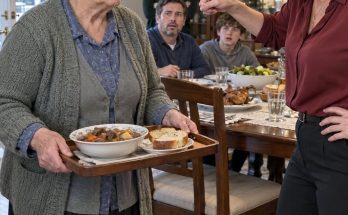
She was ten years old, wearing a white apron that came almost to her knees, carrying a stack of dirty plates against her chest.
Her eyes were red.
Not crying-red in the loud way little kids cry when they fall.
This was the quiet red of a child who had already learned that crying would only make adults laugh harder.
A few tables away, eight-year-old Samuel was trying to balance a serving tray that was too wide for his arms.
Two uncles were laughing as he moved through the grass.
‘Careful,’ one of them called. ‘Don’t spill. Real workers don’t spill.’
Samuel’s sneakers dragged through the grass.
His face was stiff with concentration and shame.
Then Thomas saw Jacob.
Six years old.
Barely tall enough to reach the table properly.
He was wiping at a sticky spot with a wet rag while two teenage cousins held up their phones, recording him.
One of them smiled like this was a joke worth saving.
Thomas felt his whole body go quiet.
That quiet scared him more than anger would have.
He had been angry at his parents before.
He had been hurt by them.
He had sat through dinners where Robert made little comments about responsibility and Helen corrected the children’s manners with a sharpness she never used on anyone else’s grandkids.
He had heard every version of the same insult.
Three children.
Three mothers.
No wife.
No real family.
Thomas had spent years swallowing those words because they came from the people who raised him.
Cruelty gets away with a lot when it arrives wearing an old family name.
You call it advice.
You call it tradition.
You call it concern.
Then one day you walk into a party and find your children in aprons.
Thomas had built his life from the ground up.
He had become a father earlier than anyone expected, and nothing about it had been neat.
Rebecca’s mother loved their daughter, but she and Thomas had been too young and too different to stay together.
Samuel’s mother had left the state when he was three.
Jacob’s mother was still in his life in the way she could be, but the daily weight of homework, doctor visits, lunch boxes, laundry, nightmares, and school pickup lines belonged mostly to Thomas.
People had opinions about that.
People always did.
But inside his house, there were no half children.
Rebecca knew Samuel liked his cereal dry and milk on the side.
Samuel knew Jacob could not sleep unless the hallway light stayed on.
Jacob knew Rebecca kept emergency granola bars in her backpack because she hated when anyone got hungry.
They were not a mistake that needed explaining.
They were breakfast arguments, mismatched socks, bedtime negotiations, sticky fingerprints on car windows, and three warm bodies piled on one couch during movie night.
They were his home.
Robert and Helen never saw them that way.
They saw evidence.
They saw shame.
They saw a son who had not lived according to their script.
The ugly part was that Thomas had still trusted them with the children that afternoon.
At 2:18 p.m., while he was checking a catering drop-off, he texted his mother.
‘Please bring the kids by 3. I’ll meet you there after the catering drop-off. Just watch them for a couple hours.’
Helen replied one minute later.
‘Of course, son. Don’t worry.’
So Thomas did not worry.
That was what made the sight in front of him feel like betrayal twice over.
The party was for Helen’s 70th birthday.
The venue agreement had Thomas’s signature on it.
The catering invoice had Thomas’s card on it.
The staff schedule, rental contract, vendor confirmation, and final payment receipt were all in the folder he had approved before noon.
He owned two modern diners and a small catering company.
He had started with one used griddle, one rented kitchen, and a willingness to work hours most people would never admit to needing.
His name was on the business license.
His name was on the payroll files.
His name was on the vendor invoices.
His parents knew all of that.
They also knew he paid their utilities.
They knew he covered groceries when Helen’s card declined.
They knew he paid Robert’s medication, car insurance, water heater repairs, and little emergency bills that always seemed to arrive after payday.
They accepted his help.
They rejected his family.
That afternoon, in front of relatives, they had finally stopped pretending those two things could live together.
Robert noticed Thomas watching.
He lifted his glass.
‘Just look at that,’ he said loudly. ‘This is how you fix bad parenting. Nobody here is special just because they’re Thomas’s children.’
A few relatives laughed.
A few looked away.
One cousin pretended to read something on his phone.
Thomas’s aunt kept cutting her cake into smaller and smaller pieces even though she was not eating it.
The whole yard had the frozen feeling of a room where everyone knew something was wrong and nobody wanted the cost of saying it first.
Plastic forks hovered over plates.
A red cup tilted in one man’s hand but did not fall.
A red cup tilted in one man’s hand but did not fall.
Nobody moved.
Nobody spoke.
The summer air suddenly felt heavy.
Thomas looked at Rebecca first.
She still held the stack of dirty plates.
Her arms trembled slightly.
Not because the plates were heavy.
Because she was trying not to cry.
Samuel stood frozen beside a table.
Jacob still clutched the rag.
Three children.
Three little faces searching for their father.
Waiting to learn whether this was normal.
Waiting to learn whether they deserved it.
Thomas began walking.
Slowly.
Not toward Robert.
Toward his children.
The crowd parted without being asked.
Rebecca lowered her head.
“I’m sorry, Dad.”
The words hit him harder than anything Robert had said.
Sorry.
A ten-year-old apologizing for being humiliated.
Thomas set down his keys.
Then carefully lifted the plates from her arms.
“You have nothing to apologize for.”
Rebecca’s lip trembled.
A tear slipped free.
Thomas handed the plates to a stunned cousin.
Then he turned to Samuel.
The serving tray disappeared from the boy’s hands.
Samuel blinked.
“Grandpa said we had to earn dinner.”
A muscle jumped in Thomas’s jaw.
He crouched.
Looked his son directly in the eyes.
“You already earned dinner.”
Samuel frowned.
“How?”
“By being my son.”
The little boy’s face crumpled.
Not from sadness.
From relief.
Children carry burdens adults never notice.
Jacob rushed forward next.
The wet rag dropped into the grass.
Thomas picked him up immediately.
The six-year-old wrapped both arms around his neck.
The way frightened children hold on when they finally find safety.
Only then did Thomas stand.
Only then did he look at Robert.
His father smiled.
The same smile.
The one that had poisoned half his childhood.
“Don’t be dramatic.”
Thomas stared.
Robert lifted his drink.
“We’re teaching them responsibility.”
Silence spread across the yard.
Thomas looked around.
At relatives.
At neighbors.
At friends.
At people who knew exactly what they had witnessed.
Then he asked one question.
“If responsibility was the lesson, why weren’t your other grandchildren serving?”
Nobody answered.
Robert’s smile faded slightly.
Thomas continued.
“Why weren’t Kevin’s boys carrying plates?”
A cousin looked away.
“Why wasn’t Emily’s daughter cleaning tables?”
More silence.
“Why only mine?”
The answer hung in the air.
Everybody knew.
Nobody wanted to say it.
Because once spoken aloud, cruelty becomes harder to disguise.
Robert scoffed.
“You know why.”
“Say it.”
Robert’s eyes narrowed.
Thomas took another step forward.
“Say it out loud.”
Helen appeared beside her husband.
“Thomas, stop making a scene.”
He laughed.
One short laugh.
Disbelieving.
“I made a scene?”
Helen crossed her arms.
“Your children need structure.”
Thomas nodded slowly.
“Interesting.”
He pointed toward the catering staff.
Real employees.
Adults being paid.
People he employed.
“Because I hired twelve workers today.”
Nobody moved.
“I paid every one of them.”
Still silence.
“But somehow my children were selected for unpaid labor.”
Robert slammed his cup onto a table.
“Because they need to learn consequences.”
The words echoed.
Thomas felt something settle inside him.
Not anger.
Clarity.
Pure clarity.
“What consequences?”
Robert opened his mouth.
Then stopped.
Thomas’s voice remained calm.
“What exactly are they being punished for?”
Nobody laughed now.
Not one person.
Even the teenagers lowered their phones.
The entire yard waited.
Robert finally answered.
“For the choices you made.”
There it was.
The truth.
Ugly.
Naked.
Unhidden.
Thomas nodded.
“You mean having children.”
Robert said nothing.
“You mean loving them.”
Nothing.
“You mean raising them.”
Nothing.
Thomas looked at Rebecca.
At Samuel.
At Jacob.
Then back at his father.
“My children are not punishment.”
The words landed harder than shouting ever could.
Helen looked uncomfortable.
For the first time all afternoon.
Thomas continued.
“You spent years acting embarrassed by them.”
His voice stayed level.
“But every electric bill I’ve paid wasn’t embarrassing.”
Robert’s face reddened.
“The mortgage assistance wasn’t embarrassing.”
More red.
“The medication wasn’t embarrassing.”
Helen’s eyes widened.
“The car repairs weren’t embarrassing.”
Several relatives shifted awkwardly.
Thomas wasn’t finished.
“The groceries.”
“The insurance.”
“The emergency plumbing.”
“The credit card debt.”
“The roof repair.”
Every item landed like a stone.
One by one.
One by one.
One by one.
Because the truth has weight.
And eventually somebody has to carry it.
Robert stood abruptly.
“I never asked for charity.”
Thomas nodded.
“You’re right.”
“You didn’t.”
“I offered because you’re my parents.”
Silence.
“Just like I offered trust.”
His eyes moved toward the children.
“And this is what you did with it.”
Nobody defended them.
Not anymore.
The crowd had changed.
Earlier they were uncomfortable.
Now they were ashamed.
Ashamed of watching.
Ashamed of laughing.
Ashamed of staying quiet.
Thomas’s aunt suddenly stood.
The same aunt who had been cutting cake into tiny pieces.
She walked across the yard.
Stopped beside Rebecca.
Then wrapped the girl in a hug.
A small gesture.
But important.
Very important.
Because courage spreads.
Sometimes all it takes is one person.
Then another cousin spoke.
“That wasn’t right.”
Another nodded.
“No, it wasn’t.”
A neighbor added,
“They’re just kids.”
The silence protecting Robert began breaking apart.
Crack by crack.
Truth has a way of finding air.
Helen looked around nervously.
“This is family business.”
“No,” Thomas said.
“It stopped being private when you humiliated children in public.”
Nobody argued.
Because he was right.
Robert looked suddenly older.
Not weak.
Smaller.
The difference mattered.
Bullies depend on audiences.
Without one, they shrink.
Thomas turned toward the catering manager.
A woman named Denise.
She had worked with him for years.
“Denise.”
“Yes?”
“How many staff members are here?”
“Twelve.”
“Good.”
He reached into his pocket.
Pulled out an envelope.
Inside were bonus checks.
Planned before the party.
He handed them over.
“Distribute these.”
The staff smiled.
Then Thomas pointed toward his children.
“And these three are off duty.”
A few people laughed softly.
The good kind of laughter.
Warm.
Protective.
Human.
Rebecca smiled for the first time all afternoon.
Samuel too.
Even Jacob giggled.
The tension cracked.
Just enough.
Thomas looked down at his watch.
Then made another decision.
A permanent one.
He removed a folded document from the event folder.
The venue contract.
The invoices.
The payment confirmations.
All signed.
All his.
He set them on the gift table.
Then spoke clearly.
“So everyone understands.”
The yard fell silent again.
“I paid for this party.”
Helen’s face drained of color.
Thomas continued.
“I paid for the venue.”
“The food.”
“The decorations.”
“The entertainment.”
Everything.
Nobody looked surprised.
Not really.
Just uncomfortable hearing it aloud.
Thomas took a breath.
Then delivered the sentence that changed everything.
“It will be the last bill I ever pay for either of you.”
Complete silence.
Even the wind seemed to stop.
Helen stared.
Robert stared.
Everyone stared.
Thomas nodded once.
“I’m done.”
The words sounded simple.
They weren’t.
Years of guilt.
Years of obligation.
Years of excuses.
Finished.
Done.
Over.
Helen’s eyes filled.
“You can’t mean that.”
“I do.”
“What about family?”
Thomas looked at his children.
All three standing close together.
Like they always did.
Then he answered.
“I’m looking at my family.”
The sentence broke something.
Not in Thomas.
In the illusion his parents had been living inside.
Because for years they believed they could reject his children while keeping his support.
They believed love came with conditions.
Thomas finally understood that his didn’t.
His children were not required to earn it.
The party ended early.
People left quietly.
Some stopped to hug the children.
Others apologized.
A few looked embarrassed.
Good.
Embarrassment is sometimes the first step toward accountability.
As the sun began sinking lower, Thomas loaded his children into the SUV.
Nobody wanted to leave immediately.
Not because they were unhappy.
Because they were processing.
Rebecca sat in the front seat.
The boys climbed into the back.
For several minutes nobody spoke.
Then Samuel asked,
“Are Grandpa and Grandma mad?”
Thomas smiled sadly.
“Probably.”
Jacob leaned forward.
“Are we in trouble?”
Thomas turned.
“No.”
The answer came instantly.
Firmly.
Absolutely.
“No.”
Jacob relaxed.
Rebecca stared out the window.
Then quietly asked,
“Did we do something wrong?”
Thomas felt his heart break a little.
Because that question should never have existed.
Not in a child’s mind.
Not because of family.
He reached across the console.
Took her hand.
“Listen carefully.”
All three children looked at him.
“You are not responsible for other people’s disappointment.”
Silence.
“You are not mistakes.”
More silence.
“You are not embarrassments.”
Rebecca blinked back tears.
Samuel looked down.
Jacob climbed forward and hugged his arm.
Thomas smiled.
“You are my favorite people.”
That finally made them laugh.
The drive home felt different.
Lighter.
Not easy.
Just honest.
Three months later, the first holiday arrived.
No invitation came.
Neither side reached out.
Thomas didn’t either.
Instead, he hosted dinner himself.
Small.
Simple.
Perfect.
The house smelled like roasted turkey and cinnamon rolls.
Samuel spilled juice.
Jacob dropped a fork.
Rebecca burned half a batch of cookies.
Nobody cared.
After dinner they built a blanket fort in the living room.
A ridiculous one.
Huge.
Crooked.
Wonderful.
Thomas sat inside it with all three children.
A movie played softly in the background.
Popcorn covered the floor.
Jacob fell asleep first.
Then Samuel.
Rebecca rested her head on her father’s shoulder.
“Dad?”
“Yeah?”
“I’m glad you came.”
The words were almost identical to something Clara had once said in another story.
Simple.
Powerful.
True.
Thomas kissed the top of her head.
“So am I.”
Years later, Rebecca would remember the party.
Samuel would remember the tray.
Jacob would remember the rag.
But none of those memories became the most important part.
What stayed with them was something else.
The moment their father chose them.
Publicly.
Completely.
Without hesitation.
Because children don’t remember every gift.
They don’t remember every meal.
They don’t remember every birthday decoration.
But they remember who stood beside them when standing beside them cost something.
And on a hot summer afternoon in Denver, while relatives watched and a family finally revealed its true face,
Thomas made his choice.
Not between parents and children.
That choice had never existed.
He simply stopped pretending the people who shamed his children deserved a front-row seat in their lives.
The party ended.
The illusion ended.
The excuses ended.
But the family inside that SUV remained.
Three children.
One father.
No perfect story.
No perfect history.
Just love stubborn enough to stay.
And in the end, that was the only inheritance worth passing down.